Faith receives
Faith involves freely trusting God who reveals, with the assistance of grace.
The First Vatican Council · 1869–1870
Faith, reason & the
ministry of the pope.
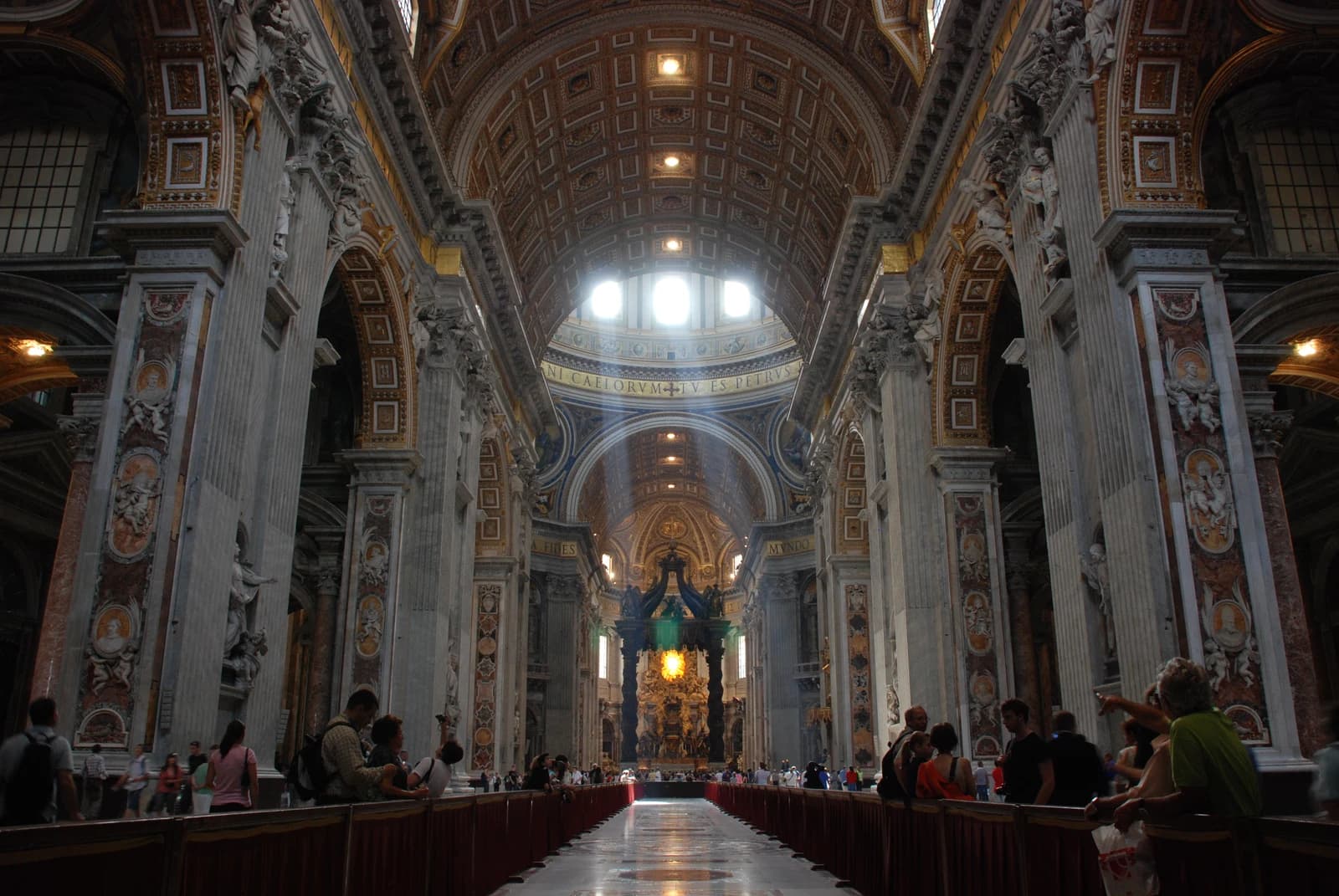
Can faith and reason work together? How does Christ preserve His Church in truth and unity? Explore a council shaped by these enduring questions.
Begin the journeySaint Peter’s Basilica today · the setting of Vatican I · Photo credit
01 / A world in transition
The nineteenth century brought challenges to Christian belief and disagreements about the Church’s authority.
Rationalism, which treated human reason as the ultimate measure of religious truth, was an important concern. Vatican I addressed how Catholics could remain faithful while responding thoughtfully to a changing world.
Read the historical background1869
Pope Pius IX convenes the First Vatican Council amid challenges to Christian belief and debates about the Church’s authority.
24 April 1870
Dei Filius addresses God, revelation, faith, and reason.
18 July 1870
Pastor Aeternus addresses papal primacy and infallibility.
1870
War and the capture of Rome interrupt the council before its broader work can be completed.
Two documents. Two enduring questions.
The summaries below explain the teachings in everyday language. They are paraphrases, not quotations from the council.
24 April 1870
On the Catholic faith
Read the English translationChapters 2–4 · Ad Fontes Library
Faith and reason can work together in the search for truth.
Dei Filius affirmed that human reason can know God through creation. Revelation also communicates truths beyond reason’s unaided reach, including the mysteries God makes known about Himself.
Faith involves freely trusting God who reveals, with the assistance of grace.
Reason helps us examine the credibility of belief and deepen our understanding.
Because God is the source of both revelation and human reason, genuine truth cannot contradict genuine truth.
You can study, ask sincere questions, and seek understanding while growing in trust.
18 July 1870
On the Church of Christ
Read the English translationChapters 3–4 · Ad Fontes Library
Pastor Aeternus affirmed that the pope, as successor of Peter, possesses real authority to teach and govern the universal Church. Its stated purpose includes preserving unity and faithfully safeguarding the apostolic faith. The document also recognizes the proper authority of bishops in their own churches.
Understanding infallibility
Vatican I defined that the pope is protected from error when all of these conditions are met:
He acts as shepherd and teacher of all Christians.
He exercises his supreme apostolic teaching authority.
He definitively teaches a doctrine concerning faith or morals.
He intends that doctrine to be held by the whole Church.
This does not mean that the pope is sinless or that every interview, personal opinion, or administrative decision is infallible. The protection concerns a particular exercise of his teaching office.
Other authentic Church teaching also deserves a faithful response, even when it is not expressed as an infallible definition. Vatican II explains this distinction in Lumen Gentium, 25.
Read the councils together
Vatican II explicitly reaffirmed Vatican I’s teaching on the pope and developed a fuller account of bishops, their shared responsibility, and the whole People of God. Reading the councils together helps us understand papal leadership within the Church’s broader life of communion and mission.
Explore Lumen Gentium, 18–25 ↗Discover Vatican II04 / Pause & remember
Three short questions to revisit the essentials. Choose an answer to see an explanation.
05 / From learning to living
Consider these questions quietly, or bring them to a group discussion.