Skip to content

A Pilgrim’s Path through the Gospels

The Life of Jesus Christ

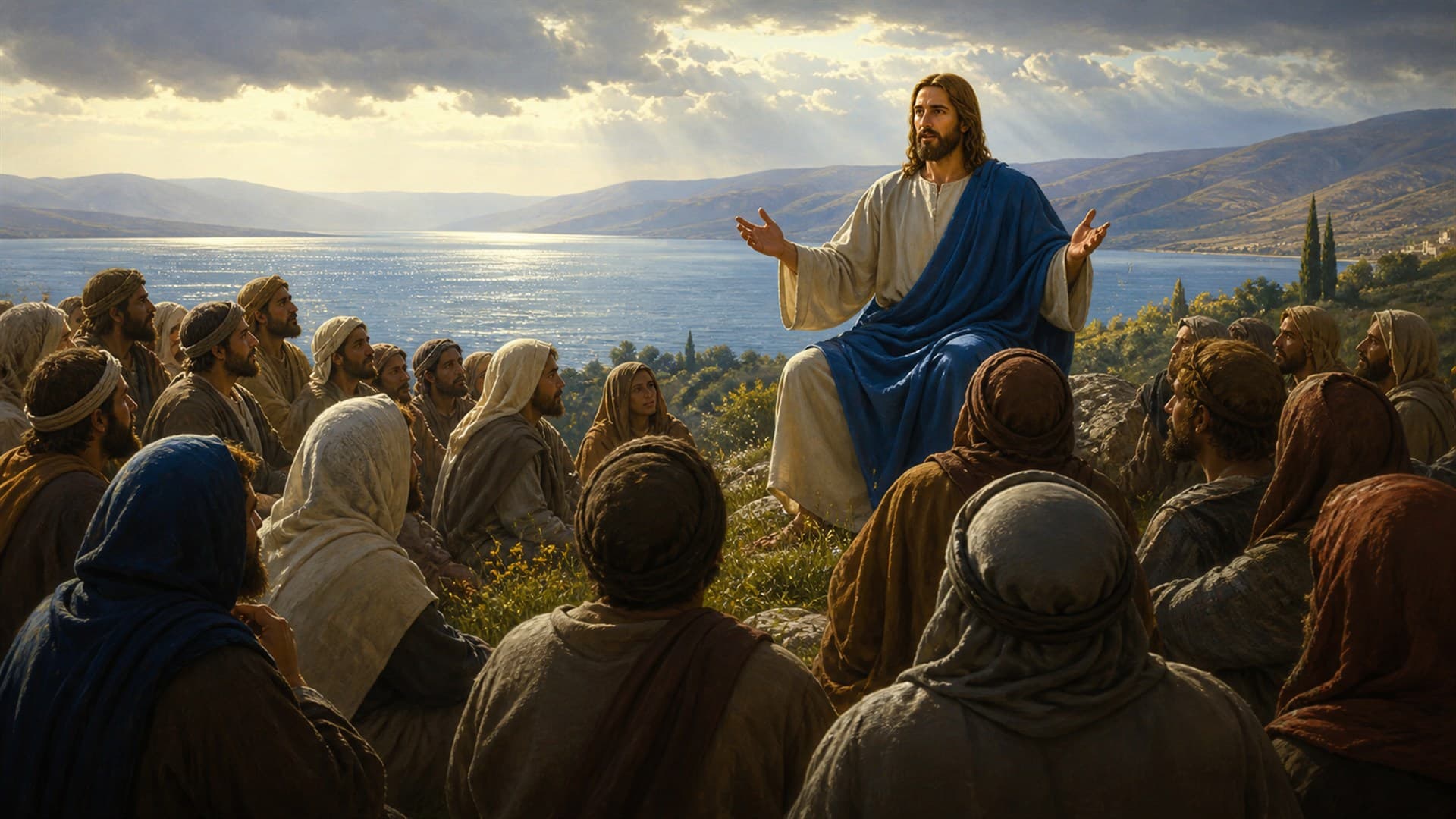
Jesus teaching · devotional sacred-art representation

Walk the Gospel road with Jesus—from the promises of salvation and the Incarnation to the Cross, Resurrection, and Ascension. Each stop preserves its exact Scripture book, chapter, and verse range, with public-domain Douay–Rheims devotional reading in every Scripture box.

Daily Oratory is an independent Catholic resource. The Douay–Rheims reading is devotional material and is not an official liturgical edition or ecclesial endorsement.

Explore the complete pathJourney through the life of Jesus15 eras · 18 chapters · 154 pilgrimage stops
Before you readHow this path handles chronology and sources

How to read this path

A faithful guide, not a claim of exact chronology

The Gospels proclaim one Lord but do not always arrange every teaching, journey, and appearance in the same order. This path distinguishes explicit sequence, traditional harmony, and unresolved order.

Each stop preserves the exact Scripture book, chapter, and verse range from the reviewed source model. The accompanying reading uses locally bundled text from the public-domain Douay–Rheims American Edition of 1899. Numbering differences are identified beside their passages. Daily Oratory does not reproduce NABRE or other modern copyrighted Bible text.

Jesus, Mary, the apostles, and the first disciples were Jewish. References to particular leaders or groups in the Passion narratives must never be read as blame directed toward the Jewish people as a whole.

Chronology guide

  • Sequence stated in ScriptureThe text supplies the order.
  • Strong chronological inferenceThe order follows close textual evidence.
  • Traditional Gospel-harmony placementA received arrangement, not an explicit date.
  • Order remains uncertainThe sources allow more than one placement.
Journey outlineJump to an era

Part I

THE INCARNATION AND THE COMING OF THE MESSIAH

The eternal Son of God enters human history.

Approximate period: Before Jesus' birth

Light descending through a quiet sacred space, evoking the promise of the Messiah
The promise · devotional sacred-art representationDevotional artwork from the Daily Oratory sacred-art library

Chapter 1

The Eternal Word and the Promise of Salvation

  1. 001

    Theological prologue

    The Eternal Word

    Jesus Christ, the eternal Son of God, exists before all creation.

    Sequence stated in ScriptureDoctrine

    Read in Sacred Scripture

    • John 1:1–5primary
      Sacred Scripture · Douay–RheimsRead John 1:1–5

      Douay-Rheims American Edition, 1899 · Public-domain text

      John 1:1–5

      1In the beginning was the Word, and the Word was with God, and the Word was God.

      2The same was in the beginning with God.

      3All things were made by him: and without him was made nothing that was made.

      4In him was life, and the life was the light of men.

      5And the light shineth in darkness, and the darkness did not comprehend it.

      Source: eBible.org ↗

      Douay–Rheims American Edition of 1899; public-domain text courtesy of eBible.org.
  2. 002

    Theological prologue

    The Word Through Whom Everything Was Created

    All things were created through the eternal Word.

    Sequence stated in ScriptureDoctrine

    Read in Sacred Scripture

    • John 1:1–3primary
      Sacred Scripture · Douay–RheimsRead John 1:1–3

      Douay-Rheims American Edition, 1899 · Public-domain text

      John 1:1–3

      1In the beginning was the Word, and the Word was with God, and the Word was God.

      2The same was in the beginning with God.

      3All things were made by him: and without him was made nothing that was made.

      Source: eBible.org ↗

      Douay–Rheims American Edition of 1899; public-domain text courtesy of eBible.org.
    • Colossians 1:15–17supporting
      Sacred Scripture · Douay–RheimsRead Colossians 1:15–17

      Douay-Rheims American Edition, 1899 · Public-domain text

      Colossians 1:15–17

      15Who is the image of the invisible God, the firstborn of every creature:

      16For in him were all things created in heaven and on earth, visible and invisible, whether thrones, or dominations, or principalities, or powers: all things were created by him and in him.

      17And he is before all, and by him all things consist.

      Source: eBible.org ↗

      Douay–Rheims American Edition of 1899; public-domain text courtesy of eBible.org.

  3. 003

    Theological prologue

    The Promise of a Redeemer

    Following the fall of Adam and Eve, God announces the conflict between the serpent and the woman's offspring.

    Traditional Gospel-harmony placementBiblical typologyDoctrine

    Read in Sacred Scripture

    • Genesis 3:14–15typological
      Sacred Scripture · Douay–RheimsRead Genesis 3:14–15

      Douay-Rheims American Edition, 1899 · Public-domain text

      Genesis 3:14–15

      14And the Lord God said to the serpent: Because thou hast done this thing, thou art cursed among all cattle, and beasts of the earth: upon thy breast shalt thou go, and earth shalt thou eat all the days of thy life.

      15I will put enmities between thee and the woman, and thy seed and her seed: she shall crush thy head, and thou shalt lie in wait for her heel.

      Source: eBible.org ↗

      Douay–Rheims American Edition of 1899; public-domain text courtesy of eBible.org.
    • Genesis 3:15typological
      Sacred Scripture · Douay–RheimsRead Genesis 3:15

      Douay-Rheims American Edition, 1899 · Public-domain text

      Genesis 3:15

      15I will put enmities between thee and the woman, and thy seed and her seed: she shall crush thy head, and thou shalt lie in wait for her heel.

      Source: eBible.org ↗

      Douay–Rheims American Edition of 1899; public-domain text courtesy of eBible.org.
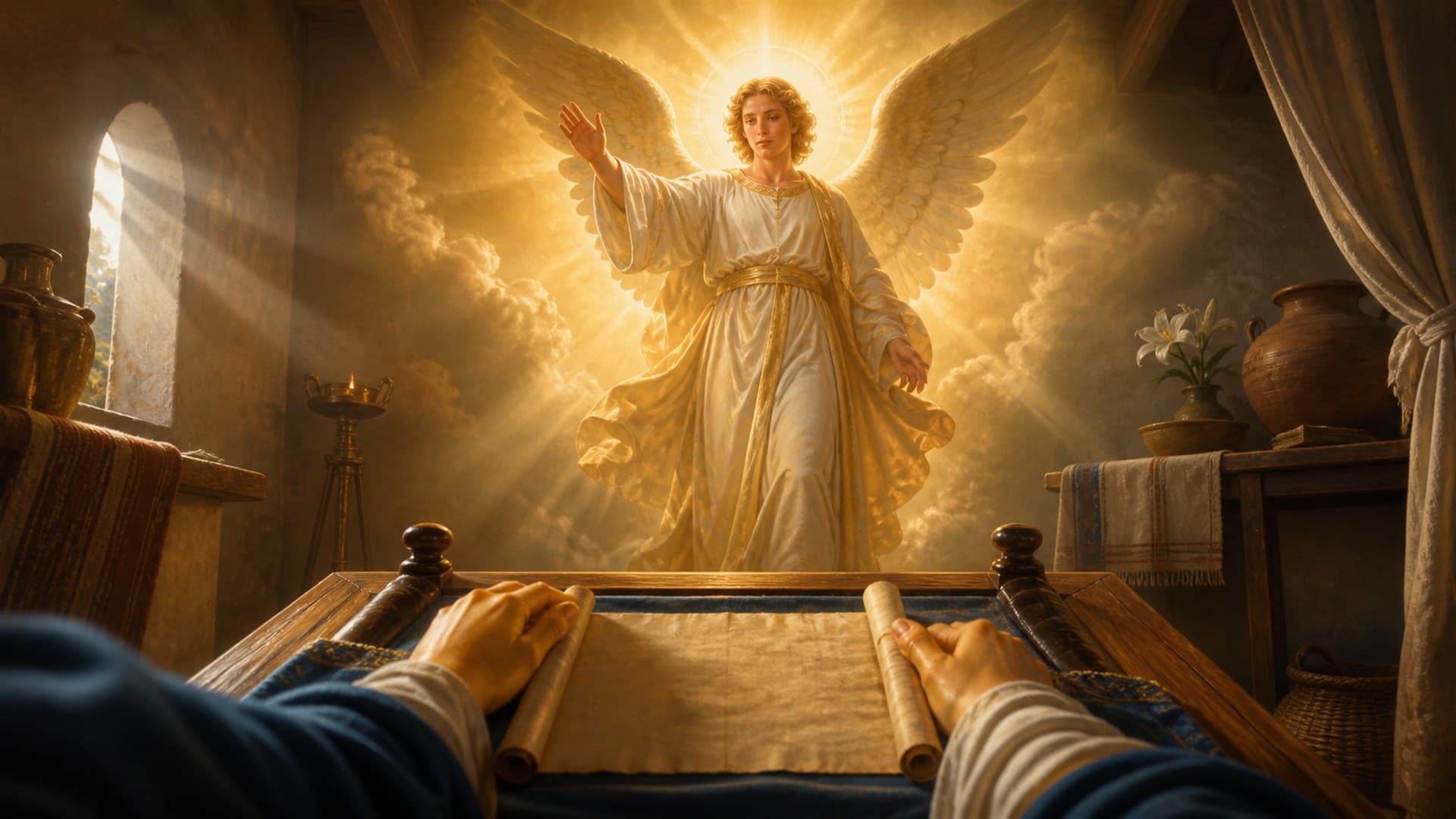
  4. 004

    Theological prologue

    God's Covenant with Abraham

    God promises that all nations will be blessed through Abraham's descendants.

    Traditional Gospel-harmony placementBiblical typologyDoctrine

    Read in Sacred Scripture

    • Genesis 12:1–3typological
      Sacred Scripture · Douay–RheimsRead Genesis 12:1–3

      Douay-Rheims American Edition, 1899 · Public-domain text

      Genesis 12:1–3

      1And the Lord said to Abram: Go forth out of thy country, and from thy kindred, and out of thy father’s house, and come into the land which I shall shew thee.

      2And I will make of thee a great nation, and I will bless thee, and magnify thy name, and thou shalt be blessed.

      3I will bless them that bless thee, and curse them that curse thee, and IN THEE shall all the kindred of the earth be blessed:

      Source: eBible.org ↗

      Douay–Rheims American Edition of 1899; public-domain text courtesy of eBible.org.
  5. 005

    Theological prologue

    The Promise of an Everlasting Davidic Kingdom

    God promises David a royal dynasty whose ultimate fulfillment Christians recognize in Jesus Christ.

    Traditional Gospel-harmony placementBiblical typologyDoctrine

    Read in Sacred Scripture

    • 2 Samuel 7:12–16typological
      Sacred Scripture · Douay–RheimsRead 2 Samuel 7:12–16

      Douay-Rheims American Edition, 1899 · Public-domain text

      2 Samuel 7:12–16

      12And when thy days shall be fulfilled, and thou shalt sleep with thy fathers, I will raise up thy seed after thee, which shall proceed out of thy bowels, and I will establish his kingdom.

      13He shall build a house to my name, and I will establish the throne of his kingdom for ever.

      14I will be to him a father, and he shall be to me a son: and if he commit any iniquity, I will correct him with the rod of men, and with the stripes of the children of men.

      15But my mercy I will not take away from him, as I took it from Saul, whom I removed from before my face.

      16And thy house shall be faithful, and thy kingdom for ever before thy face, and thy throne shall be firm for ever.

      Source: eBible.org ↗

      Douay–Rheims American Edition of 1899; public-domain text courtesy of eBible.org.
  6. 006

    Theological prologue

    Isaiah's Prophecy of Emmanuel

    The prophet Isaiah announces the sign of Emmanuel.

    Traditional Gospel-harmony placementBiblical typologyDoctrine

    Read in Sacred Scripture

    • Isaiah 7:14typological
      Sacred Scripture · Douay–RheimsRead Isaiah 7:14

      Douay-Rheims American Edition, 1899 · Public-domain text

      Isaiah 7:14

      14Therefore the Lord himself shall give you a sign. Behold a virgin shall conceive, and bear a son, and his name shall be called Emmanuel.

      Source: eBible.org ↗

      Douay–Rheims American Edition of 1899; public-domain text courtesy of eBible.org.
    • Matthew 1:22–23supporting
      Sacred Scripture · Douay–RheimsRead Matthew 1:22–23

      Douay-Rheims American Edition, 1899 · Public-domain text

      Matthew 1:22–23

      22Now all this was done that it might be fulfilled which the Lord spoke by the prophet, saying:

      23Behold a virgin shall be with child, and bring forth a son, and they shall call his name Emmanuel, which being interpreted is, God with us.

      Source: eBible.org ↗

      Douay–Rheims American Edition of 1899; public-domain text courtesy of eBible.org.
  7. 007

    Theological prologue

    The Prophecy of the Messiah's Birthplace

    The prophet Micah identifies Bethlehem in his prophecy of a future ruler.

    Traditional Gospel-harmony placementBiblical typologyDoctrine

    Read in Sacred Scripture

    • Micah 5:1–4typological
      Sacred Scripture · Douay–RheimsRead Micah 5:1–4

      Douay-Rheims American Edition, 1899 · Public-domain text

      Micah 5:2–5

      The timeline cites Micah 5:1–4 in modern numbering; this Douay–Rheims edition numbers the same passage Micah 5:2–5.

      2AND THOU, BETHLEHEM Ephrata, art a little one among the thousands of Juda: out of thee shall he come forth unto me that is to be the ruler in Israel: and his going forth is from the beginning, from the days of eternity.

      3Therefore will he give them up even till the time wherein she that travaileth shall bring forth: and the remnant of his brethren shall be converted to the children of Israel.

      4And he shall stand, and feed in the strength of the Lord, in the height of the name of the Lord his God: and they shall be converted, for now shall he be magnified even to the ends of the earth.

      5And this man shall be our peace, when the Assyrian shall come into our land, and when he shall set his foot in our houses: and we shall raise against him seven shepherds, and eight principal men.

      Source: eBible.org ↗

      Douay–Rheims American Edition of 1899; public-domain text courtesy of eBible.org.
Back to the eras ↑

Part II

THE ANNUNCIATION AND THE BIRTH OF JESUS

God fulfills His promises through the Incarnation.

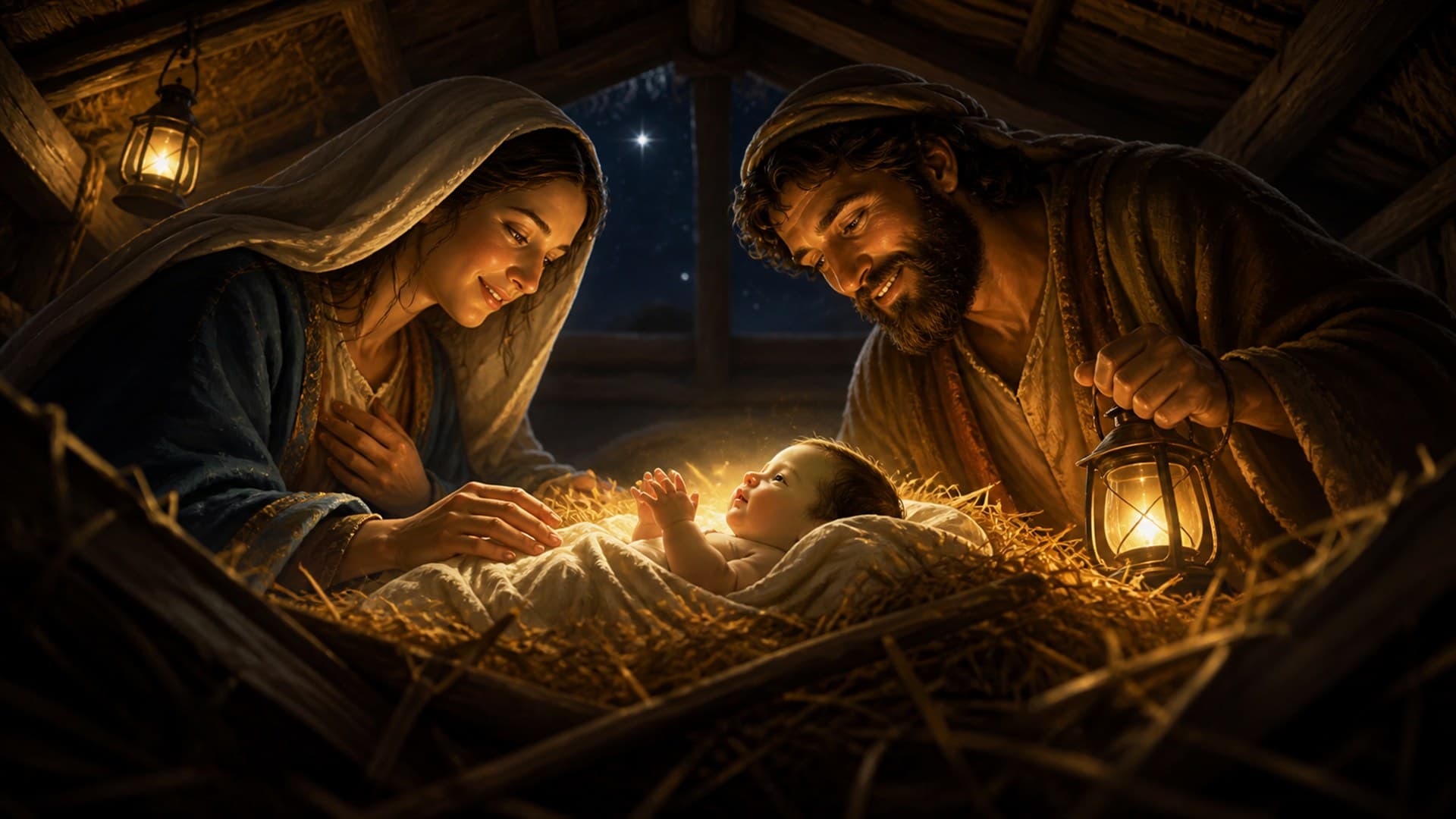
A devotional view from within the manger at Bethlehem
Bethlehem · traditional setting of the NativityDevotional artwork from the Daily Oratory sacred-art library

Chapter 2

The Annunciation and Preparation for Christ's Birth

  1. 008

    Gospel event

    The Angel Gabriel Appears to Zechariah

    Gabriel announces that Zechariah and Elizabeth will have a son, John, who will prepare the people for the Lord.

    Sequence stated in ScriptureNarrated event

    Read in Sacred Scripture

    • Luke 1:5–25primary
      Sacred Scripture · Douay–RheimsRead Luke 1:5–25

      Douay-Rheims American Edition, 1899 · Public-domain text

      Luke 1:5–25

      5There was in the days of Herod, the king of Judea, a certain priest named Zachary, of the course of Abia; and his wife was of the daughters of Aaron, and her name Elizabeth.

      6And they were both just before God, walking in all the commandments and justifications of the Lord without blame.

      7And they had no son, for that Elizabeth was barren, and they both were well advanced in years.

      8And it came to pass, when he executed the priestly function in the order of his course before God,

      9According to the custom of the priestly office, it was his lot to offer incense, going into the temple of the Lord.

      10And all the multitude of the people was praying without, at the hour of incense.

      11And there appeared to him an angel of the Lord, standing on the right side of the alter of incense.

      12And Zachary seeing him, was troubled, and fear fell upon him.

      13But the angel said to him: Fear not, Zachary, for thy prayer is heard; and thy wife Elizabeth shall bear thee a son, and thou shalt call his name John:

      14And thou shalt have joy and gladness, and many shall rejoice in his nativity.

      15For he shall be great before the Lord; and shall drink no wine nor strong drink: and he shall be filled with the Holy Ghost, even from his mother’s womb.

      16And he shall convert many of the children of Israel to the Lord their God.

      17And he shall go before him in the spirit and power of Elias; that he may turn the hearts of the fathers unto the children, and the incredulous to the wisdom of the just, to prepare unto the Lord a perfect people.

      18And Zachary said to the angel: Whereby shall I know this? for I am an old man, and my wife is advanced in years.

      19And the angel answering, said to him: I am Gabriel, who stand before God: and am sent to speak to thee, and to bring thee these good tidings.

      20And behold, thou shalt be dumb, and shalt not be able to speak until the day wherein these things shall come to pass, because thou hast not believed my words, which shall be fulfilled in their time.

      21And the people were waiting for Zachary; and they wondered that he tarried so long in the temple.

      22And when he came out, he could not speak to them: and they understood that he had seen a vision in the temple. And he made signs to them, and remained dumb.

      23And it came to pass, after the days of his office were accomplished, he departed to his own house.

      24And after those days, Elizabeth his wife conceived, and hid herself five months, saying:

      25Thus hath the Lord dealt with me in the days wherein he hath had regard to take away my reproach among men.

      Source: eBible.org ↗

      Douay–Rheims American Edition of 1899; public-domain text courtesy of eBible.org.
  2. 009

    Gospel event

    The Annunciation to the Blessed Virgin Mary

    Gabriel announces that Mary will conceive Jesus, the Son of God, through the Holy Spirit.

    Sequence stated in ScriptureNarrated eventDevotional tradition

    Read in Sacred Scripture

    • Luke 1:26–38primary
      Sacred Scripture · Douay–RheimsRead Luke 1:26–38

      Douay-Rheims American Edition, 1899 · Public-domain text

      Luke 1:26–38

      26And in the sixth month, the angel Gabriel was sent from God into a city of Galilee, called Nazareth,

      27To a virgin espoused to a man whose name was Joseph, of the house of David; and the virgin’s name was Mary.

      28And the angel being come in, said unto her: Hail, full of grace, the Lord is with thee: blessed art thou among women.

      29Who having heard, was troubled at his saying, and thought with herself what manner of salutation this should be.

      30And the angel said to her: Fear not, Mary, for thou hast found grace with God.

      31Behold thou shalt conceive in thy womb, and shalt bring forth a son; and thou shalt call his name Jesus.

      32He shall be great, and shall be called the Son of the most High; and the Lord God shall give unto him the throne of David his father; and he shall reign in the house of Jacob for ever.

      33And of his kingdom there shall be no end.

      34And Mary said to the angel: How shall this be done, because I know not man?

      35And the angel answering, said to her: The Holy Ghost shall come upon thee, and the power of the most High shall overshadow thee. And therefore also the Holy which shall be born of thee shall be called the Son of God.

      36And behold thy cousin Elizabeth, she also hath conceived a son in her old age; and this is the sixth month with her that is called barren:

      37Because no word shall be impossible with God.

      38And Mary said: Behold the handmaid of the Lord; be it done to me according to thy word. And the angel departed from her.

      Source: eBible.org ↗

      Douay–Rheims American Edition of 1899; public-domain text courtesy of eBible.org.
    Teachings and moments within this stop

    Mystery of faith

    The Incarnation

    By the Holy Spirit, the eternal Son assumes human nature in Mary’s womb; Mary freely gives her fiat.

    Traditional Gospel-harmony placementNarrated eventDoctrine

    Scripture

    • Luke 1:35–38primary
      Sacred Scripture · Douay–RheimsRead Luke 1:35–38

      Douay-Rheims American Edition, 1899 · Public-domain text

      Luke 1:35–38

      35And the angel answering, said to her: The Holy Ghost shall come upon thee, and the power of the most High shall overshadow thee. And therefore also the Holy which shall be born of thee shall be called the Son of God.

      36And behold thy cousin Elizabeth, she also hath conceived a son in her old age; and this is the sixth month with her that is called barren:

      37Because no word shall be impossible with God.

      38And Mary said: Behold the handmaid of the Lord; be it done to me according to thy word. And the angel departed from her.

      Source: eBible.org ↗

      Douay–Rheims American Edition of 1899; public-domain text courtesy of eBible.org.
    • John 1:14supporting
      Sacred Scripture · Douay–RheimsRead John 1:14

      Douay-Rheims American Edition, 1899 · Public-domain text

      John 1:14

      14And the Word was made flesh, and dwelt among us, (and we saw his glory, the glory as it were of the only begotten of the Father,) full of grace and truth.

      Source: eBible.org ↗

      Douay–Rheims American Edition of 1899; public-domain text courtesy of eBible.org.
  3. 010

    Gospel event

    Mary's Visitation to Elizabeth

    Mary journeys to visit her relative Elizabeth.

    Sequence stated in ScriptureNarrated eventDevotional tradition

    Read in Sacred Scripture

    • Luke 1:39–45primary
      Sacred Scripture · Douay–RheimsRead Luke 1:39–45

      Douay-Rheims American Edition, 1899 · Public-domain text

      Luke 1:39–45

      39And Mary rising up in those days, went into the hill country with haste into a city of Juda.

      40And she entered into the house of Zachary, and saluted Elizabeth.

      41And it came to pass, that when Elizabeth heard the salutation of Mary, the infant leaped in her womb. And Elizabeth was filled with the Holy Ghost:

      42And she cried out with a loud voice, and said: Blessed art thou among women, and blessed is the fruit of thy womb.

      43And whence is this to me, that the mother of my Lord should come to me?

      44For behold as soon as the voice of thy salutation sounded in my ears, the infant in my womb leaped for joy.

      45And blessed art thou that hast believed, because those things shall be accomplished that were spoken to thee by the Lord.

      Source: eBible.org ↗

      Douay–Rheims American Edition of 1899; public-domain text courtesy of eBible.org.

    • Luke 1:36supporting
      Sacred Scripture · Douay–RheimsRead Luke 1:36

      Douay-Rheims American Edition, 1899 · Public-domain text

      Luke 1:36

      36And behold thy cousin Elizabeth, she also hath conceived a son in her old age; and this is the sixth month with her that is called barren:

      Source: eBible.org ↗

      Douay–Rheims American Edition of 1899; public-domain text courtesy of eBible.org.
    Teachings and moments within this stop

    Gospel event

    The Magnificat

    Mary praises God for His mercy and faithfulness.

    Sequence stated in ScriptureNarrated event

    Scripture

    • Luke 1:46–56primary
      Sacred Scripture · Douay–RheimsRead Luke 1:46–56

      Douay-Rheims American Edition, 1899 · Public-domain text

      Luke 1:46–56

      46And Mary said: My soul doth magnify the Lord.

      47And my spirit hath rejoiced in God my Saviour.

      48Because he hath regarded the humility of his handmaid; for behold from henceforth all generations shall call me blessed.

      49Because he that is mighty, hath done great things to me; and holy is his name.

      50And his mercy is from generation unto generations, to them that fear him.

      51He hath shewed might in his arm: he hath scattered the proud in the conceit of their heart.

      52He hath put down the mighty from their seat, and hath exalted the humble.

      53He hath filled the hungry with good things; and the rich he hath sent empty away.

      54He hath received Israel his servant, being mindful of his mercy:

      55As he spoke to our fathers, to Abraham and to his seed for ever.

      56And Mary abode with her about three months; and she returned to her own house.

      Source: eBible.org ↗

      Douay–Rheims American Edition of 1899; public-domain text courtesy of eBible.org.

  4. 011

    Gospel event

    The Birth of John the Baptist

    Elizabeth gives birth to John, the future forerunner of Christ.

    Sequence stated in ScriptureNarrated event

    Read in Sacred Scripture

    • Luke 1:57–66primary
      Sacred Scripture · Douay–RheimsRead Luke 1:57–66

      Douay-Rheims American Edition, 1899 · Public-domain text

      Luke 1:57–66

      57Now Elizabeth’s full time of being delivered was come, and she brought forth a son.

      58And her neighbours and kinsfolks heard that the Lord had shewed his great mercy towards her, and they congratulated with her.

      59And it came to pass, that on the eighth day they came to circumcise the child, and they called him by his father’s name Zachary.

      60And his mother answering, said: Not so; but he shall be called John.

      61And they said to her: There is none of thy kindred that is called by this name.

      62And they made signs to his father, how he would have him called.

      63And demanding a writing table, he wrote, saying: John is his name. And they all wondered.

      64And immediately his mouth was opened, and his tongue loosed, and he spoke, blessing God.

      65And fear came upon all their neighbours; and all these things were noised abroad over all the hill country of Judea.

      66And all they that had heard them laid them up in their heart, saying: What an one, think ye, shall this child be? For the hand of the Lord was with him.

      Source: eBible.org ↗

      Douay–Rheims American Edition of 1899; public-domain text courtesy of eBible.org.
  5. 012

    Gospel event

    Zechariah's Prophecy

    Zechariah proclaims the Benedictus, blessing God for His promise of salvation.

    Sequence stated in ScriptureNarrated event

    Read in Sacred Scripture

    • Luke 1:67–79primary
      Sacred Scripture · Douay–RheimsRead Luke 1:67–79

      Douay-Rheims American Edition, 1899 · Public-domain text

      Luke 1:67–79

      67And Zachary his father was filled with the Holy Ghost; and he prophesied, saying:

      68Blessed be the Lord God of Israel; because he hath visited and wrought the redemption of his people:

      69And hath raised up an horn of salvation to us, in the house of David his servant:

      70As he spoke by the mouth of his holy prophets, who are from the beginning:

      71Salvation from our enemies, and from the hand of all that hate us:

      72To perform mercy to our fathers, and to remember his holy testament,

      73The oath, which he swore to Abraham our father, that he would grant to us,

      74That being delivered from the hand of our enemies, we may serve him without fear,

      75In holiness and justice before him, all our days.

      76And thou, child, shalt be called the prophet of the Highest: for thou shalt go before the face of the Lord to prepare his ways:

      77To give knowledge of salvation to his people, unto the remission of their sins:

      78Through the bowels of the mercy of our God, in which the Orient from on high hath visited us:

      79To enlighten them that sit in darkness, and in the shadow of death: to direct our feet into the way of peace.

      Source: eBible.org ↗

      Douay–Rheims American Edition of 1899; public-domain text courtesy of eBible.org.
  6. 013

    Gospel event

    An Angel Appears to Joseph

    Joseph learns in a dream that Mary's child was conceived through the Holy Spirit.

    Order remains uncertainNarrated event

    Read in Sacred Scripture

    • Matthew 1:18–25primary
      Sacred Scripture · Douay–RheimsRead Matthew 1:18–25

      Douay-Rheims American Edition, 1899 · Public-domain text

      Matthew 1:18–25

      18Now the generation of Christ was in this wise. When as his mother Mary was espoused to Joseph, before they came together, she was found with child, of the Holy Ghost.

      19Whereupon Joseph her husband, being a just man, and not willing publicly to expose her, was minded to put her away privately.

      20But while he thought on these things, behold the angel of the Lord appeared to him in his sleep, saying: Joseph, son of David, fear not to take unto thee Mary thy wife, for that which is conceived in her, is of the Holy Ghost.

      21And she shall bring forth a son: and thou shalt call his name JESUS. For he shall save his people from their sins.

      22Now all this was done that it might be fulfilled which the Lord spoke by the prophet, saying:

      23Behold a virgin shall be with child, and bring forth a son, and they shall call his name Emmanuel, which being interpreted is, God with us.

      24And Joseph rising up from sleep, did as the angel of the Lord had commanded him, and took unto him his wife.

      25And he knew her not till she brought forth her firstborn son: and he called his name JESUS.

      Source: eBible.org ↗

      Douay–Rheims American Edition of 1899; public-domain text courtesy of eBible.org.
Chapter 3

The Nativity

  1. 014

    Gospel event

    The Journey to Bethlehem

    Joseph travels with Mary to Bethlehem in connection with the census.

    Sequence stated in ScriptureNarrated event

    Read in Sacred Scripture

    • Luke 2:1–5primary
      Sacred Scripture · Douay–RheimsRead Luke 2:1–5

      Douay-Rheims American Edition, 1899 · Public-domain text

      Luke 2:1–5

      1And it came to pass, that in those days there went out a decree from Caesar Augustus, that the whole world should be enrolled.

      2This enrolling was first made by Cyrinus, the governor of Syria.

      3And all went to be enrolled, every one into his own city.

      4And Joseph also went up from Galilee, out of the city of Nazareth into Judea, to the city of David, which is called Bethlehem: because he was of the house and family of David,

      5To be enrolled with Mary his espoused wife, who was with child.

      Source: eBible.org ↗

      Douay–Rheims American Edition of 1899; public-domain text courtesy of eBible.org.
  2. 015

    Gospel event

    The Birth of Jesus Christ

    Jesus is born in Bethlehem.

    Traditional Gospel-harmony placementNarrated eventDevotional tradition

    Read in Sacred Scripture

    • Luke 2:6–7primary
      Sacred Scripture · Douay–RheimsRead Luke 2:6–7

      Douay-Rheims American Edition, 1899 · Public-domain text

      Luke 2:6–7

      6And it came to pass, that when they were there, her days were accomplished, that she should be delivered.

      7And she brought forth her firstborn son, and wrapped him up in swaddling clothes, and laid him in a manger; because there was no room for them in the inn.

      Source: eBible.org ↗

      Douay–Rheims American Edition of 1899; public-domain text courtesy of eBible.org.
    • Matthew 1:24–25parallel
      Sacred Scripture · Douay–RheimsRead Matthew 1:24–25

      Douay-Rheims American Edition, 1899 · Public-domain text

      Matthew 1:24–25

      24And Joseph rising up from sleep, did as the angel of the Lord had commanded him, and took unto him his wife.

      25And he knew her not till she brought forth her firstborn son: and he called his name JESUS.

      Source: eBible.org ↗

      Douay–Rheims American Edition of 1899; public-domain text courtesy of eBible.org.
    Teachings and moments within this stop

    Gospel event

    The Angel Announces the Savior's Birth to the Shepherds

    An angel announces the birth of Christ the Lord.

    Sequence stated in ScriptureNarrated event

    Scripture

    • Luke 2:8–12primary
      Sacred Scripture · Douay–RheimsRead Luke 2:8–12

      Douay-Rheims American Edition, 1899 · Public-domain text

      Luke 2:8–12

      8And there were in the same country shepherds watching, and keeping the night watches over their flock.

      9And behold an angel of the Lord stood by them, and the brightness of God shone round about them; and they feared with a great fear.

      10And the angel said to them: Fear not; for, behold, I bring you good tidings of great joy, that shall be to all the people:

      11For, this day, is born to you a Saviour, who is Christ the Lord, in the city of David.

      12And this shall be a sign unto you. You shall find the infant wrapped in swaddling clothes, and laid in a manger.

      Source: eBible.org ↗

      Douay–Rheims American Edition of 1899; public-domain text courtesy of eBible.org.

    Gospel event

    The Heavenly Host Praises God

    The shepherds witness the angelic proclamation of glory to God and peace on earth.

    Sequence stated in ScriptureNarrated event

    Scripture

    • Luke 2:13–14primary
      Sacred Scripture · Douay–RheimsRead Luke 2:13–14

      Douay-Rheims American Edition, 1899 · Public-domain text

      Luke 2:13–14

      13And suddenly there was with the angel a multitude of the heavenly army, praising God, and saying:

      14Glory to God in the highest; and on earth peace to men of good will.

      Source: eBible.org ↗

      Douay–Rheims American Edition of 1899; public-domain text courtesy of eBible.org.

    Gospel event

    The Shepherds Visit the Infant Jesus

    The shepherds travel to Bethlehem and find Mary, Joseph, and the infant Jesus.

    Sequence stated in ScriptureNarrated event

    Scripture

    • Luke 2:15–20primary
      Sacred Scripture · Douay–RheimsRead Luke 2:15–20

      Douay-Rheims American Edition, 1899 · Public-domain text

      Luke 2:15–20

      15And it came to pass, after the angels departed from them into heaven, the shepherds said one to another: Let us go over to Bethlehem, and let us see this word that is come to pass, which the Lord hath shewed to us.

      16And they came with haste; and they found Mary and Joseph, and the infant lying in the manger.

      17And seeing, they understood of the word that had been spoken to them concerning this child.

      18And all that heard, wondered; and at those things that were told them by the shepherds.

      19But Mary kept all these words, pondering them in her heart.

      20And the shepherds returned, glorifying and praising God, for all the things they had heard and seen, as it was told unto them.

      Source: eBible.org ↗

      Douay–Rheims American Edition of 1899; public-domain text courtesy of eBible.org.
  3. 016

    Gospel event

    The Circumcision and Naming of Jesus

    Eight days after His birth, Jesus is circumcised and receives the name announced by Gabriel.

    Sequence stated in ScriptureNarrated event

    Read in Sacred Scripture

    • Luke 2:21primary
      Sacred Scripture · Douay–RheimsRead Luke 2:21

      Douay-Rheims American Edition, 1899 · Public-domain text

      Luke 2:21

      21And after eight days were accomplished, that the child should be circumcised, his name was called JESUS, which was called by the angel, before he was conceived in the womb.

      Source: eBible.org ↗

      Douay–Rheims American Edition of 1899; public-domain text courtesy of eBible.org.
  4. 017

    Gospel event

    The Presentation of Jesus in the Temple

    Mary and Joseph bring Jesus to Jerusalem in accordance with the Law.

    Traditional Gospel-harmony placementNarrated eventDevotional tradition

    Read in Sacred Scripture

    • Luke 2:22–24primary
      Sacred Scripture · Douay–RheimsRead Luke 2:22–24

      Douay-Rheims American Edition, 1899 · Public-domain text

      Luke 2:22–24

      22And after the days of her purification, according to the law of Moses, were accomplished, they carried him to Jerusalem, to present him to the Lord:

      23As it is written in the law of the Lord: Every male opening the womb shall be called holy to the Lord:

      24And to offer a sacrifice, according as it is written in the law of the Lord, a pair of turtledoves, or two young pigeons:

      Source: eBible.org ↗

      Douay–Rheims American Edition of 1899; public-domain text courtesy of eBible.org.

    Accounts preserved side by side

    The sources do not establish one certain placement

    The visible order of the Presentation, Magi, flight into Egypt, return, and Nazareth material is a traditional harmony; the Gospels do not state every interval or a single combined sequence.

    These sources remain distinct so a Gospel-harmony arrangement is not mistaken for a sequence explicitly stated by Scripture.

    Luke

    Alternative placement

    Simeon Recognizes the Messiah

    Simeon takes Jesus into his arms and proclaims Him a light for the nations.

    Traditional Gospel-harmony placementNarrated event

    Scripture

    • Luke 2:25–32primary
      Sacred Scripture · Douay–RheimsRead Luke 2:25–32

      Douay-Rheims American Edition, 1899 · Public-domain text

      Luke 2:25–32

      25And behold there was a man in Jerusalem named Simeon, and this man was just and devout, waiting for the consolation of Israel; and the Holy Ghost was in him.

      26And he had received an answer from the Holy Ghost, that he should not see death, before he had seen the Christ of the Lord.

      27And he came by the Spirit into the temple. And when his parents brought in the child Jesus, to do for him according to the custom of the law,

      28He also took him into his arms, and blessed God, and said:

      29Now thou dost dismiss thy servant, O Lord, according to thy word in peace;

      30Because my eyes have seen thy salvation,

      31Which thou hast prepared before the face of all peoples:

      32A light to the revelation of the Gentiles, and the glory of thy people Israel.

      Source: eBible.org ↗

      Douay–Rheims American Edition of 1899; public-domain text courtesy of eBible.org.

    Luke

    Alternative placement

    Simeon's Prophecy to Mary

    Simeon foretells that Jesus will be a sign of contradiction and that a sword will pierce Mary's soul.

    Traditional Gospel-harmony placementNarrated eventDevotional tradition

    Scripture

    • Luke 2:33–35primary
      Sacred Scripture · Douay–RheimsRead Luke 2:33–35

      Douay-Rheims American Edition, 1899 · Public-domain text

      Luke 2:33–35

      33And his father and mother were wondering at those things which were spoken concerning him.

      34And Simeon blessed them, and said to Mary his mother: Behold this child is set for the fall, and for the resurrection of many in Israel, and for a sign which shall be contradicted;

      35And thy own soul a sword shall pierce, that, out of many hearts, thoughts may be revealed.

      Source: eBible.org ↗

      Douay–Rheims American Edition of 1899; public-domain text courtesy of eBible.org.

    Luke

    Alternative placement

    Anna the Prophetess Recognizes Jesus

    Anna gives thanks to God and speaks about Jesus to those awaiting Jerusalem's redemption.

    Traditional Gospel-harmony placementNarrated event

    Scripture

    • Luke 2:36–38primary
      Sacred Scripture · Douay–RheimsRead Luke 2:36–38

      Douay-Rheims American Edition, 1899 · Public-domain text

      Luke 2:36–38

      36And there was one Anna, a prophetess, the daughter of Phanuel, of the tribe of Aser; she was far advanced in years, and had lived with her husband seven years from her virginity.

      37And she was a widow until fourscore and four years; who departed not from the temple, by fastings and prayers serving night and day.

      38Now she, at the same hour, coming in, confessed to the Lord; and spoke of him to all that looked for the redemption of Israel.

      Source: eBible.org ↗

      Douay–Rheims American Edition of 1899; public-domain text courtesy of eBible.org.
  5. 018

    Gospel event

    The Magi Seek the Newborn King

    Wise men from the East arrive in Jerusalem seeking the newborn King of the Jews.

    Traditional Gospel-harmony placementNarrated event

    Read in Sacred Scripture

    • Matthew 2:1–8primary
      Sacred Scripture · Douay–RheimsRead Matthew 2:1–8

      Douay-Rheims American Edition, 1899 · Public-domain text

      Matthew 2:1–8

      1When Jesus therefore was born in Bethlehem of Juda, in the days of king Herod, behold, there came wise men from the east to Jerusalem.

      2Saying, Where is he that is born king of the Jews? For we have seen his star in the east, and are come to adore him.

      3And king Herod hearing this, was troubled, and all Jerusalem with him.

      4And assembling together all the chief priests and the scribes of the people, he inquired of them where Christ should be born.

      5But they said to him: In Bethlehem of Juda. For so it is written by the prophet:

      6And thou Bethlehem the land of Juda art not the least among the princes of Juda: for out of thee shall come forth the captain that shall rule my people Israel.

      7Then Herod, privately calling the wise men, learned diligently of them the time of the star which appeared to them;

      8And sending them into Bethlehem, said: Go and diligently inquire after the child, and when you have found him, bring me word again, that I also may come to adore him.

      Source: eBible.org ↗

      Douay–Rheims American Edition of 1899; public-domain text courtesy of eBible.org.
  6. 019

    Gospel event

    The Adoration of the Magi

    The Magi find Jesus with Mary and offer gifts of gold, frankincense, and myrrh.

    Traditional Gospel-harmony placementNarrated event

    Read in Sacred Scripture

    • Matthew 2:9–12primary
      Sacred Scripture · Douay–RheimsRead Matthew 2:9–12

      Douay-Rheims American Edition, 1899 · Public-domain text

      Matthew 2:9–12

      9Who having heard the king, went their way; and behold the star which they had seen in the east, went before them, until it came and stood over where the child was.

      10And seeing the star they rejoiced with exceeding great joy.

      11And entering into the house, they found the child with Mary his mother, and falling down they adored him; and opening their treasures, they offered him gifts; gold, frankincense, and myrrh.

      12And having received an answer in sleep that they should not return to Herod, they went back another way into their country.

      Source: eBible.org ↗

      Douay–Rheims American Edition of 1899; public-domain text courtesy of eBible.org.
  7. 020

    Gospel event

    Joseph Is Warned to Flee to Egypt

    An angel warns Joseph that Herod intends to kill Jesus.

    Traditional Gospel-harmony placementNarrated event

    Read in Sacred Scripture

    • Matthew 2:13primary
      Sacred Scripture · Douay–RheimsRead Matthew 2:13

      Douay-Rheims American Edition, 1899 · Public-domain text

      Matthew 2:13

      13And after they were departed, behold an angel of the Lord appeared in sleep to Joseph, saying: Arise, and take the child and his mother, and fly into Egypt: and be there until I shall tell thee. For it will come to pass that Herod will seek the child to destroy him.

      Source: eBible.org ↗

      Douay–Rheims American Edition of 1899; public-domain text courtesy of eBible.org.
  8. 021

    Gospel event

    The Flight into Egypt

    Joseph takes Mary and Jesus into Egypt.

    Traditional Gospel-harmony placementNarrated eventDevotional tradition

    Read in Sacred Scripture

    • Matthew 2:14–15primary
      Sacred Scripture · Douay–RheimsRead Matthew 2:14–15

      Douay-Rheims American Edition, 1899 · Public-domain text

      Matthew 2:14–15

      14Who arose, and took the child and his mother by night, and retired into Egypt: and he was there until the death of Herod:

      15That it might be fulfilled which the Lord spoke by the prophet, saying: Out of Egypt have I called my son.

      Source: eBible.org ↗

      Douay–Rheims American Edition of 1899; public-domain text courtesy of eBible.org.
  9. 022

    Gospel event

    The Massacre of the Innocents

    Herod orders the killing of young boys in Bethlehem and its vicinity.

    Traditional Gospel-harmony placementNarrated event

    Read in Sacred Scripture

    • Matthew 2:16–18primary
      Sacred Scripture · Douay–RheimsRead Matthew 2:16–18

      Douay-Rheims American Edition, 1899 · Public-domain text

      Matthew 2:16–18

      16Then Herod perceiving that he was deluded by the wise men, was exceeding angry; and sending killed all the men children that were in Bethlehem, and in all the borders thereof, from two years old and under, according to the time which he had diligently inquired of the wise men.

      17Then was fulfilled that which was spoken by Jeremias the prophet, saying:

      18A voice in Rama was heard, lamentation and great mourning; Rachel bewailing her children, and would not be comforted, because they are not.

      Source: eBible.org ↗

      Douay–Rheims American Edition of 1899; public-domain text courtesy of eBible.org.
  10. 023

    Gospel event

    The Holy Family Returns from Egypt

    Following Herod's death, Joseph receives instructions to return to Israel.

    Traditional Gospel-harmony placementNarrated event

    Read in Sacred Scripture

    • Matthew 2:19–21primary
      Sacred Scripture · Douay–RheimsRead Matthew 2:19–21

      Douay-Rheims American Edition, 1899 · Public-domain text

      Matthew 2:19–21

      19But when Herod was dead, behold an angel of the Lord appeared in sleep to Joseph in Egypt,

      20Saying: Arise, and take the child and his mother, and go into the land of Israel. For they are dead that sought the life of the child.

      21Who arose, and took the child and his mother, and came into the land of Israel.

      Source: eBible.org ↗

      Douay–Rheims American Edition of 1899; public-domain text courtesy of eBible.org.
  11. 024

    Gospel event

    The Holy Family Settles in Nazareth

    Matthew recounts the Holy Family settling in Nazareth after the return from Egypt; Luke summarizes their return after the Presentation.

    Order remains uncertainNarrated event

    Read in Sacred Scripture

    • Matthew 2:22–23primary
      Sacred Scripture · Douay–RheimsRead Matthew 2:22–23

      Douay-Rheims American Edition, 1899 · Public-domain text

      Matthew 2:22–23

      22But hearing that Archelaus reigned in Judea in the room of Herod his father, he was afraid to go thither: and being warned in sleep retired into the quarters of Galilee.

      23And coming he dwelt in a city called Nazareth: that it might be fulfilled which was said by prophets: That he shall be called a Nazarene.

      Source: eBible.org ↗

      Douay–Rheims American Edition of 1899; public-domain text courtesy of eBible.org.
    • Luke 2:39supporting
      Sacred Scripture · Douay–RheimsRead Luke 2:39

      Douay-Rheims American Edition, 1899 · Public-domain text

      Luke 2:39

      39And after they had performed all things according to the law of the Lord, they returned into Galilee, to their city Nazareth.

      Source: eBible.org ↗

      Douay–Rheims American Edition of 1899; public-domain text courtesy of eBible.org.
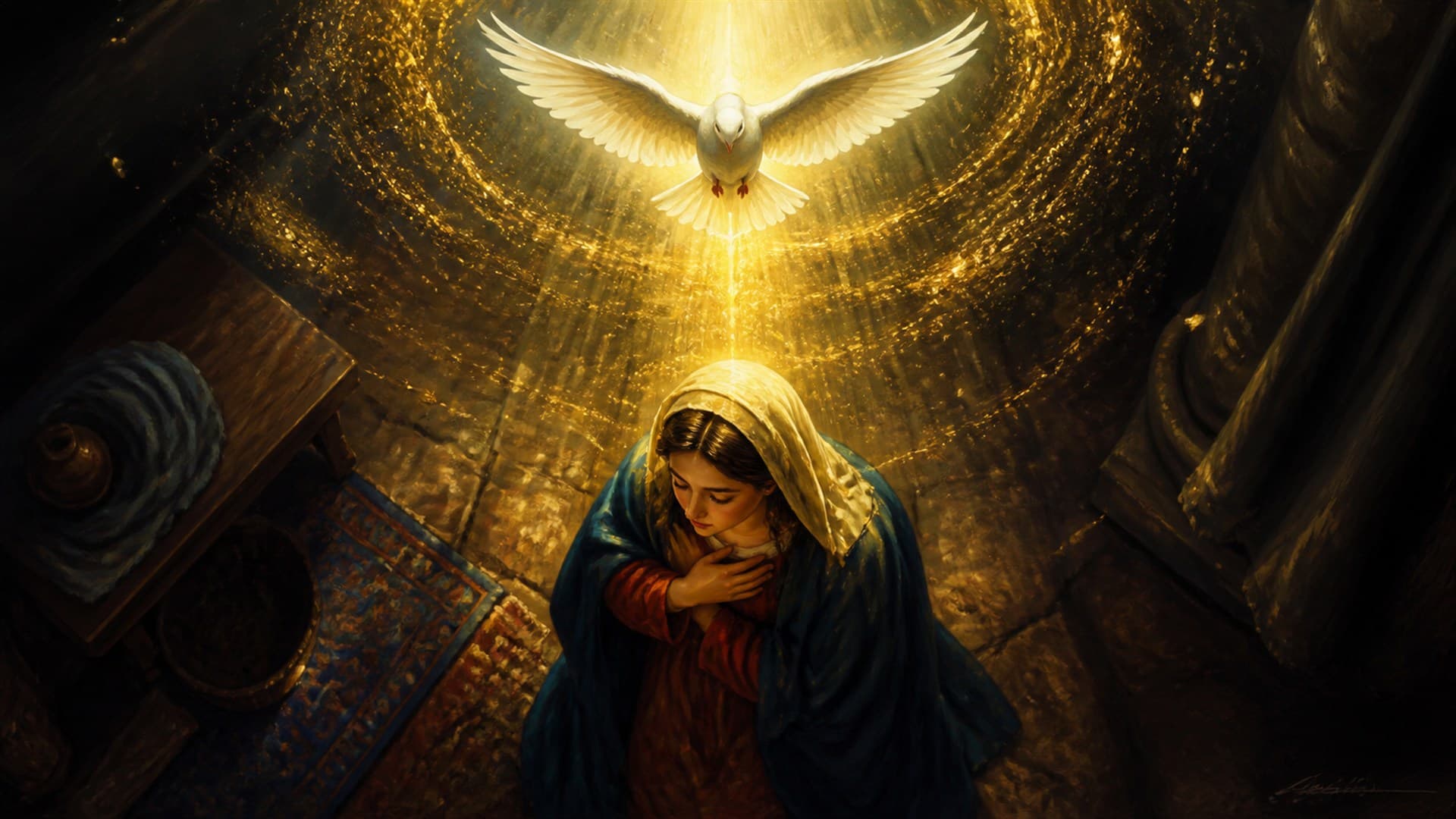
The Annunciation in devotional sacred art
The Annunciation
Back to the eras ↑

Part III

THE HIDDEN LIFE OF JESUS

The Son of God sanctifies ordinary human life.

Approximate period: Childhood through approximately age 30

Mary and Joseph near the Temple in devotional artwork
Jerusalem · the Temple in the hidden-life narrativeDevotional artwork from the Daily Oratory sacred-art library

Chapter 4

Childhood, Adolescence, and Hidden Years

  1. 025

    Gospel event

    Jesus Grows in Nazareth

    Jesus grows physically and spiritually in the care of Mary and Joseph.

    Traditional Gospel-harmony placementNarrated event

    Read in Sacred Scripture

    • Luke 2:39–40primary
      Sacred Scripture · Douay–RheimsRead Luke 2:39–40

      Douay-Rheims American Edition, 1899 · Public-domain text

      Luke 2:39–40

      39And after they had performed all things according to the law of the Lord, they returned into Galilee, to their city Nazareth.

      40And the child grew, and waxed strong, full of wisdom; and the grace of God was in him.

      Source: eBible.org ↗

      Douay–Rheims American Edition of 1899; public-domain text courtesy of eBible.org.
  2. 026

    Gospel event

    The Holy Family Makes Its Annual Pilgrimage to Jerusalem

    Mary and Joseph travel to Jerusalem for Passover.

    Sequence stated in ScriptureNarrated event

    Read in Sacred Scripture

    • Luke 2:41–42primary
      Sacred Scripture · Douay–RheimsRead Luke 2:41–42

      Douay-Rheims American Edition, 1899 · Public-domain text

      Luke 2:41–42

      41And his parents went every year to Jerusalem, at the solemn day of the pasch,

      42And when he was twelve years old, they going up into Jerusalem, according to the custom of the feast,

      Source: eBible.org ↗

      Douay–Rheims American Edition of 1899; public-domain text courtesy of eBible.org.
    Teachings and moments within this stop

    Gospel event

    The Twelve-Year-Old Jesus Remains in Jerusalem

    Following the feast, Jesus remains behind without His parents' knowledge.

    Sequence stated in ScriptureNarrated event

    Scripture

    • Luke 2:43–45primary
      Sacred Scripture · Douay–RheimsRead Luke 2:43–45

      Douay-Rheims American Edition, 1899 · Public-domain text

      Luke 2:43–45

      43And having fulfilled the days, when they returned, the child Jesus remained in Jerusalem; and his parents knew it not.

      44And thinking that he was in the company, they came a day’s journey, and sought him among their kinsfolks and acquaintance.

      45And not finding him, they returned into Jerusalem, seeking him.

      Source: eBible.org ↗

      Douay–Rheims American Edition of 1899; public-domain text courtesy of eBible.org.

    Gospel event

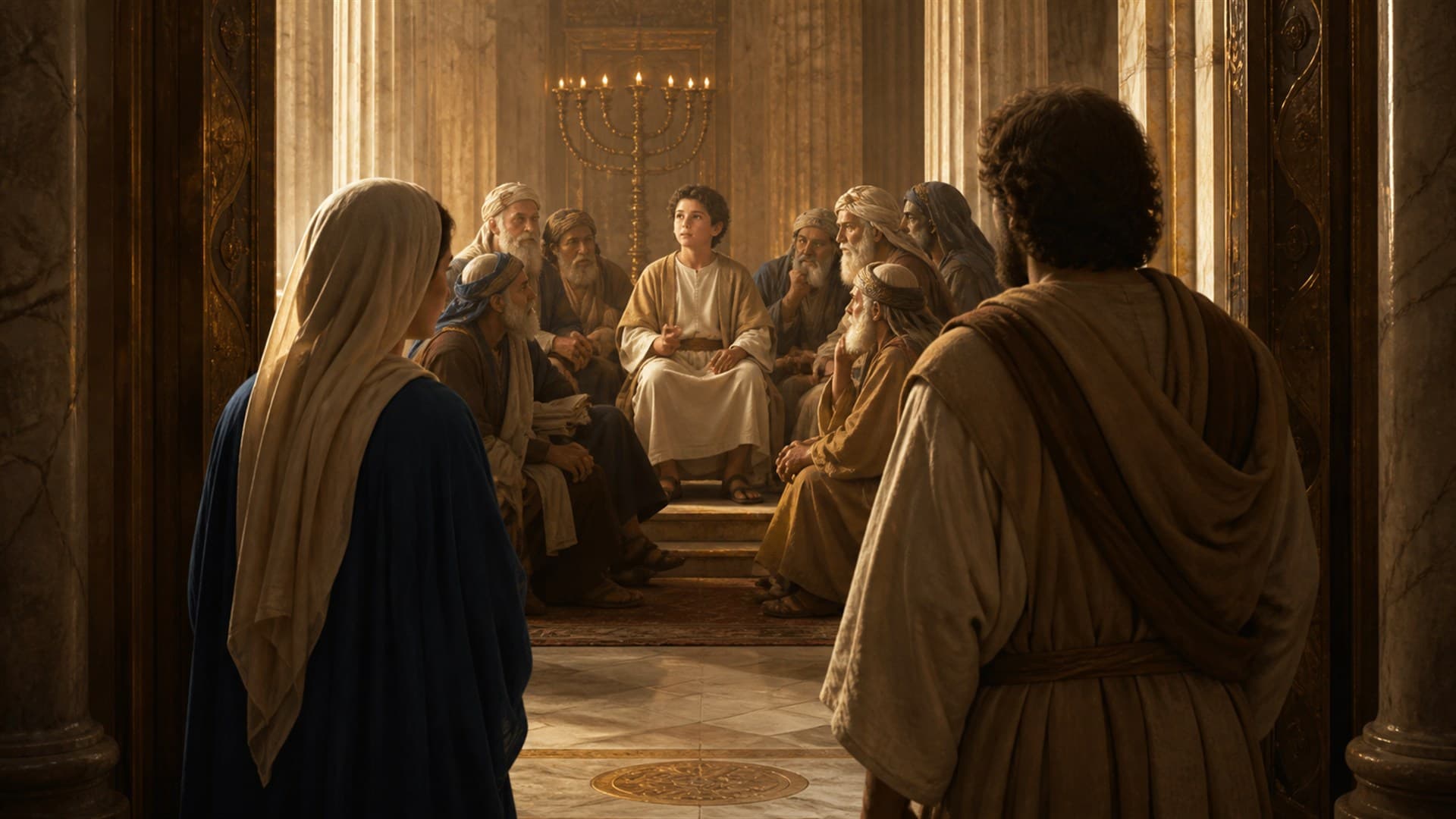
    Mary and Joseph Find Jesus in the Temple

    After searching for Him, Mary and Joseph find Jesus among the teachers in the Temple.

    Sequence stated in ScriptureNarrated eventDevotional tradition

    Scripture

    • Luke 2:46–47primary
      Sacred Scripture · Douay–RheimsRead Luke 2:46–47

      Douay-Rheims American Edition, 1899 · Public-domain text

      Luke 2:46–47

      46And it came to pass, that, after three days, they found him in the temple, sitting in the midst of the doctors, hearing them, and asking them questions.

      47And all that heard him were astonished at his wisdom and his answers.

      Source: eBible.org ↗

      Douay–Rheims American Edition of 1899; public-domain text courtesy of eBible.org.

    Gospel event

    Jesus Reveals His Special Relationship with the Father

    Jesus explains His presence in the Temple in relation to His Father's concerns.

    Sequence stated in ScriptureNarrated event

    Scripture

    • Luke 2:48–50primary
      Sacred Scripture · Douay–RheimsRead Luke 2:48–50

      Douay-Rheims American Edition, 1899 · Public-domain text

      Luke 2:48–50

      48And seeing him, they wondered. And his mother said to him: Son, why hast thou done so to us? behold thy father and I have sought thee sorrowing.

      49And he said to them: How is it that you sought me? did you not know, that I must be about my father’s business?

      50And they understood not the word that he spoke unto them.

      Source: eBible.org ↗

      Douay–Rheims American Edition of 1899; public-domain text courtesy of eBible.org.

    Gospel event

    Jesus Returns to Nazareth and Lives in Obedience

    Jesus returns home and remains obedient to Mary and Joseph.

    Sequence stated in ScriptureNarrated event

    Scripture

    • Luke 2:51–52primary
      Sacred Scripture · Douay–RheimsRead Luke 2:51–52

      Douay-Rheims American Edition, 1899 · Public-domain text

      Luke 2:51–52

      51And he went down with them, and came to Nazareth, and was subject to them. And his mother kept all these words in her heart.

      52And Jesus advanced in wisdom, and age, and grace with God and men.

      Source: eBible.org ↗

      Douay–Rheims American Edition of 1899; public-domain text courtesy of eBible.org.
  3. 027

    Gospel-harmony overview

    The Hidden Years in Nazareth

    Jesus lives His ordinary human life, growing in wisdom and maturity.

    Traditional Gospel-harmony placementNarrated event

    Read in Sacred Scripture

    • Luke 2:51–52primary
      Sacred Scripture · Douay–RheimsRead Luke 2:51–52

      Douay-Rheims American Edition, 1899 · Public-domain text

      Luke 2:51–52

      51And he went down with them, and came to Nazareth, and was subject to them. And his mother kept all these words in her heart.

      52And Jesus advanced in wisdom, and age, and grace with God and men.

      Source: eBible.org ↗

      Douay–Rheims American Edition of 1899; public-domain text courtesy of eBible.org.
    • Matthew 13:54–56supporting
      Sacred Scripture · Douay–RheimsRead Matthew 13:54–56

      Douay-Rheims American Edition, 1899 · Public-domain text

      Matthew 13:54–56

      54And coming into his own country, he taught them in their synagogues, so that they wondered and said: How came this man by this wisdom and miracles?

      55Is not this the carpenter’s son? Is not his mother called Mary, and his brethren James, and Joseph, and Simon, and Jude:

      56And his sisters, are they not all with us? Whence therefore hath he all these things?

      Source: eBible.org ↗

      Douay–Rheims American Edition of 1899; public-domain text courtesy of eBible.org.
    • Mark 6:1–3supporting
      Sacred Scripture · Douay–RheimsRead Mark 6:1–3

      Douay-Rheims American Edition, 1899 · Public-domain text

      Mark 6:1–3

      1And going out from thence, he went into his own country; and his disciples followed him.

      2And when the sabbath was come, he began to teach in the synagogue: and many hearing him were in admiration at his doctrine, saying: How came this man by all these things? and what wisdom is this that is given to him, and such mighty works as are wrought by his hands?

      3Is not this the carpenter, the son of Mary, the brother of James, and Joseph, and Jude, and Simon? are not also his sisters here with us? And they were scandalized in regard of him.

      Source: eBible.org ↗

      Douay–Rheims American Edition of 1899; public-domain text courtesy of eBible.org.
Back to the eras ↑

Part IV

PREPARATION FOR PUBLIC MINISTRY

The Messiah is revealed and prepares for His mission.

Approximate period: Beginning around age 30

The Jordan riverbank in devotional artwork of Jesus’ Baptism
The Jordan · associated region of Jesus’ BaptismDevotional artwork from the Daily Oratory sacred-art library

Chapter 5

John the Baptist and the Baptism of Jesus

  1. 028

    Gospel event

    John the Baptist Begins His Public Ministry

    John preaches repentance and prepares Israel for the Messiah.

    Sequence stated in ScriptureNarrated event

    Read in Sacred Scripture

    • Luke 3:1–6primary
      Sacred Scripture · Douay–RheimsRead Luke 3:1–6

      Douay-Rheims American Edition, 1899 · Public-domain text

      Luke 3:1–6

      1Now in the fifteenth year of the reign of Tiberius Caesar, Pontius Pilate being governor of Judea, and Herod being tetrarch of Galilee, and Philip his brother tetrarch of Iturea, and the country of Trachonitis, and Lysanias tetrarch of Abilina;

      2Under the high priests Annas and Caiphas; the word of the Lord was made unto John, the son of Zachary, in the desert.

      3And he came into all the country about the Jordan, preaching the baptism of penance for the remission of sins;

      4As it was written in the book of the sayings of Isaias the prophet: A voice of one crying in the wilderness: Prepare ye the way of the Lord, make straight his paths.

      5Every valley shall be filled; and every mountain and hill shall be brought low; and the crooked shall be made straight; and the rough ways plain;

      6And all flesh shall see the salvation of God.

      Source: eBible.org ↗

      Douay–Rheims American Edition of 1899; public-domain text courtesy of eBible.org.
    • Matthew 3:1–6parallel
      Sacred Scripture · Douay–RheimsRead Matthew 3:1–6

      Douay-Rheims American Edition, 1899 · Public-domain text

      Matthew 3:1–6

      1And in those days cometh John the Baptist preaching in the desert of Judea.

      2And saying: Do penance: for the kingdom of heaven is at hand.

      3For this is he that was spoken of by Isaias the prophet, saying: A voice of one crying in the desert, Prepare ye the way of the Lord, make straight his paths.

      4And the same John had his garment of camels’ hair, and a leathern girdle about his loins: and his meat was locusts and wild honey.

      5Then went out to him Jerusalem and all Judea, and all the country about Jordan:

      6And were baptized by him in the Jordan, confessing their sins.

      Source: eBible.org ↗

      Douay–Rheims American Edition of 1899; public-domain text courtesy of eBible.org.
    • Mark 1:1–6parallel
      Sacred Scripture · Douay–RheimsRead Mark 1:1–6

      Douay-Rheims American Edition, 1899 · Public-domain text

      Mark 1:1–6

      1The beginning of the gospel of Jesus Christ, the Son of God.

      2As it is written in Isaias the prophet: Behold I send my angel before thy face, who shall prepare the way before thee.

      3A voice of one crying in the desert: Prepare ye the way of the Lord, make straight his paths.

      4John was in the desert baptizing, and preaching the baptism of penance, unto remission of sins.

      5And there went out to him all the country of Judea, and all they of Jerusalem, and were baptized by him in the river of Jordan, confessing their sins.

      6And John was clothed with camel’s hair, and a leathern girdle about his loins; and he ate locusts and wild honey.

      Source: eBible.org ↗

      Douay–Rheims American Edition of 1899; public-domain text courtesy of eBible.org.
  2. 029

    Gospel event

    John Calls the People to Repentance

    John instructs the crowds to produce good fruits as evidence of repentance.

    Sequence stated in ScriptureNarrated event

    Read in Sacred Scripture

    • Luke 3:7–14primary
      Sacred Scripture · Douay–RheimsRead Luke 3:7–14

      Douay-Rheims American Edition, 1899 · Public-domain text

      Luke 3:7–14

      7He said therefore to the multitudes that went forth to be baptized by him: Ye offspring of vipers, who hath shewed you to flee from the wrath to come?

      8Bring forth therefore fruits worthy of penance; and do not begin to say, We have Abraham for our father. For I say unto you, that God is able of these stones to raise up children to Abraham.

      9For now the axe is laid to the root of the trees. Every tree therefore that bringeth not forth good fruit, shall be cut down and cast into the fire.

      10And the people asked him, saying: What then shall we do?

      11And he answering, said to them: He that hath two coats, let him give to him that hath none; and he that hath meat, let him do in like manner.

      12And the publicans also came to be baptized, and said to him: Master, what shall we do?

      13But he said to them: Do nothing more than that which is appointed you.

      14And the soldiers also asked him, saying: And what shall we do? And he said to them: Do violence to no man; neither calumniate any man; and be content with your pay.

      Source: eBible.org ↗

      Douay–Rheims American Edition of 1899; public-domain text courtesy of eBible.org.
  3. 030

    Gospel event

    John Announces the Coming Messiah

    John explains that someone greater than himself is coming.

    Sequence stated in ScriptureNarrated event

    Read in Sacred Scripture

    • Luke 3:15–18primary
      Sacred Scripture · Douay–RheimsRead Luke 3:15–18

      Douay-Rheims American Edition, 1899 · Public-domain text

      Luke 3:15–18

      15And as the people were of opinion, and all were thinking in their hearts of John, that perhaps he might be the Christ;

      16John answered, saying unto all: I indeed baptize you with water; but there shall come one mightier that I, the latchet of whose shoes I am not worthy to loose: he shall baptize you with the Holy Ghost, and with fire:

      17Whose fan is in his hand, and he will purge his floor, and will gather the wheat into his barn; but the chaff he will burn with unquenchable fire.

      18And many other things exhorting, did he preach to the people.

      Source: eBible.org ↗

      Douay–Rheims American Edition of 1899; public-domain text courtesy of eBible.org.
    • Matthew 3:11–12supporting
      Sacred Scripture · Douay–RheimsRead Matthew 3:11–12

      Douay-Rheims American Edition, 1899 · Public-domain text

      Matthew 3:11–12

      11I indeed baptize you in the water unto penance, but he that shall come after me, is mightier than I, whose shoes I am not worthy to bear; he shall baptize you in the Holy Ghost and fire.

      12Whose fan is in his hand, and he will thoroughly cleanse his floor and gather his wheat into the barn; but the chaff he will burn with unquenchable fire.

      Source: eBible.org ↗

      Douay–Rheims American Edition of 1899; public-domain text courtesy of eBible.org.
    • Mark 1:7–8supporting
      Sacred Scripture · Douay–RheimsRead Mark 1:7–8

      Douay-Rheims American Edition, 1899 · Public-domain text

      Mark 1:7–8

      7And he preached, saying: There cometh after me one mightier than I, the latchet of whose shoes I am not worthy to stoop down and loose.

      8I have baptized you with water; but he shall baptize you with the Holy Ghost.

      Source: eBible.org ↗

      Douay–Rheims American Edition of 1899; public-domain text courtesy of eBible.org.
  4. 031

    Gospel event

    Jesus Comes to the Jordan River

    Jesus approaches John to receive baptism.

    Sequence stated in ScriptureNarrated event

    Read in Sacred Scripture

    • Matthew 3:13–15primary
      Sacred Scripture · Douay–RheimsRead Matthew 3:13–15

      Douay-Rheims American Edition, 1899 · Public-domain text

      Matthew 3:13–15

      13Then cometh Jesus from Galilee to the Jordan, unto John, to be baptized by him.

      14But John stayed him, saying: I ought to be baptized by thee, and comest thou to me?

      15And Jesus answering, said to him: Suffer it to be so now. For so it becometh us to fulfill all justice. Then he suffered him.

      Source: eBible.org ↗

      Douay–Rheims American Edition of 1899; public-domain text courtesy of eBible.org.
  5. 032

    Gospel event

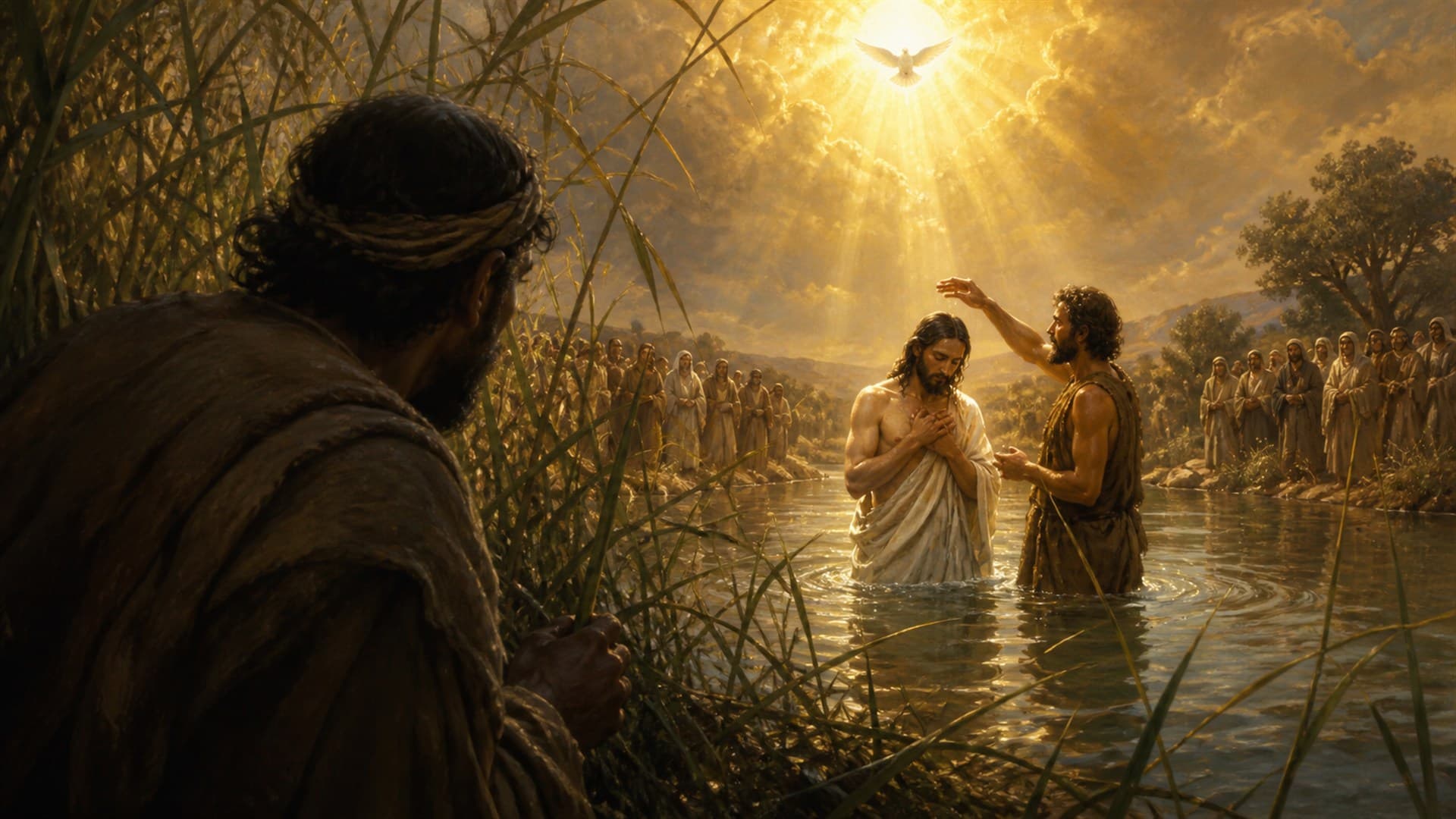
    The Baptism of Jesus

    John baptizes Jesus in the Jordan.

    Sequence stated in ScriptureNarrated eventDevotional tradition

    Read in Sacred Scripture

    • Matthew 3:13–17primary
      Sacred Scripture · Douay–RheimsRead Matthew 3:13–17

      Douay-Rheims American Edition, 1899 · Public-domain text

      Matthew 3:13–17

      13Then cometh Jesus from Galilee to the Jordan, unto John, to be baptized by him.

      14But John stayed him, saying: I ought to be baptized by thee, and comest thou to me?

      15And Jesus answering, said to him: Suffer it to be so now. For so it becometh us to fulfill all justice. Then he suffered him.

      16And Jesus being baptized, forthwith came out of the water: and lo, the heavens were opened to him: and he saw the Spirit of God descending as a dove, and coming upon him.

      17And behold a voice from heaven, saying: This is my beloved Son, in whom I am well pleased.

      Source: eBible.org ↗

      Douay–Rheims American Edition of 1899; public-domain text courtesy of eBible.org.
    • Mark 1:9–11parallel
      Sacred Scripture · Douay–RheimsRead Mark 1:9–11

      Douay-Rheims American Edition, 1899 · Public-domain text

      Mark 1:9–11

      9And it came to pass, in those days, Jesus came from Nazareth of Galilee, and was baptized by John in the Jordan.

      10And forthwith coming up out of he water, he saw the heavens opened, and the Spirit as a dove descending, and remaining on him.

      11And there came a voice from heaven: Thou art my beloved Son; in thee I am well pleased.

      Source: eBible.org ↗

      Douay–Rheims American Edition of 1899; public-domain text courtesy of eBible.org.
    • Luke 3:21–22parallel
      Sacred Scripture · Douay–RheimsRead Luke 3:21–22

      Douay-Rheims American Edition, 1899 · Public-domain text

      Luke 3:21–22

      21Now it came to pass, when all the people were baptized, that Jesus also being baptized and praying, heaven was opened;

      22And the Holy Ghost descended in a bodily shape, as a dove upon him; and a voice came from heaven: Thou art my beloved Son; in thee I am well pleased.

      Source: eBible.org ↗

      Douay–Rheims American Edition of 1899; public-domain text courtesy of eBible.org.
    Teachings and moments within this stop

    Mystery of faith

    The Holy Trinity Is Manifested at Jesus' Baptism

    At Jesus’ baptism, the Spirit descends and the Father’s voice identifies the beloved Son—a revelation the Church receives as Trinitarian.

    Traditional Gospel-harmony placementNarrated eventDoctrine

    Scripture

    • Matthew 3:16–17primary
      Sacred Scripture · Douay–RheimsRead Matthew 3:16–17

      Douay-Rheims American Edition, 1899 · Public-domain text

      Matthew 3:16–17

      16And Jesus being baptized, forthwith came out of the water: and lo, the heavens were opened to him: and he saw the Spirit of God descending as a dove, and coming upon him.

      17And behold a voice from heaven, saying: This is my beloved Son, in whom I am well pleased.

      Source: eBible.org ↗

      Douay–Rheims American Edition of 1899; public-domain text courtesy of eBible.org.
  6. 033

    Gospel event

    Jesus Is Led into the Wilderness

    Following His baptism, Jesus enters the wilderness.

    Sequence stated in ScriptureNarrated event

    Read in Sacred Scripture

    • Mark 1:12–13primary
      Sacred Scripture · Douay–RheimsRead Mark 1:12–13

      Douay-Rheims American Edition, 1899 · Public-domain text

      Mark 1:12–13

      12And immediately the Spirit drove him out into the desert.

      13And he was in the desert forty days and forty nights, and was tempted by Satan; and he was with beasts, and the angels ministered to him.

      Source: eBible.org ↗

      Douay–Rheims American Edition of 1899; public-domain text courtesy of eBible.org.
    • Matthew 4:1parallel
      Sacred Scripture · Douay–RheimsRead Matthew 4:1

      Douay-Rheims American Edition, 1899 · Public-domain text

      Matthew 4:1

      1Then Jesus was led by the spirit into the desert, to be tempted by the devil.

      Source: eBible.org ↗

      Douay–Rheims American Edition of 1899; public-domain text courtesy of eBible.org.
    • Luke 4:1parallel
      Sacred Scripture · Douay–RheimsRead Luke 4:1

      Douay-Rheims American Edition, 1899 · Public-domain text

      Luke 4:1

      1And Jesus being full of the Holy Ghost, returned from the Jordan, and was led by the Spirit into the desert,

      Source: eBible.org ↗

      Douay–Rheims American Edition of 1899; public-domain text courtesy of eBible.org.
    Teachings and moments within this stop

    Gospel event

    Jesus Fasts for Forty Days

    Jesus fasts in the desert before beginning His public ministry.

    Sequence stated in ScriptureNarrated event

    Scripture

    • Matthew 4:1–2primary
      Sacred Scripture · Douay–RheimsRead Matthew 4:1–2

      Douay-Rheims American Edition, 1899 · Public-domain text

      Matthew 4:1–2

      1Then Jesus was led by the spirit into the desert, to be tempted by the devil.

      2And when he had fasted forty days and forty nights, afterwards he was hungry.

      Source: eBible.org ↗

      Douay–Rheims American Edition of 1899; public-domain text courtesy of eBible.org.
    • Luke 4:1–2parallel
      Sacred Scripture · Douay–RheimsRead Luke 4:1–2

      Douay-Rheims American Edition, 1899 · Public-domain text

      Luke 4:1–2

      1And Jesus being full of the Holy Ghost, returned from the Jordan, and was led by the Spirit into the desert,

      2For the space of forty days; and was tempted by the devil. And he ate nothing in those days; and when they were ended, he was hungry.

      Source: eBible.org ↗

      Douay–Rheims American Edition of 1899; public-domain text courtesy of eBible.org.

    Gospel event

    Angels Minister to Jesus

    Following the temptations, angels minister to Him.

    Sequence stated in ScriptureNarrated event

    Scripture

    • Matthew 4:11primary
      Sacred Scripture · Douay–RheimsRead Matthew 4:11

      Douay-Rheims American Edition, 1899 · Public-domain text

      Matthew 4:11

      11Then the devil left him; and behold angels came and ministered to him.

      Source: eBible.org ↗

      Douay–Rheims American Edition of 1899; public-domain text courtesy of eBible.org.
    • Mark 1:13parallel
      Sacred Scripture · Douay–RheimsRead Mark 1:13

      Douay-Rheims American Edition, 1899 · Public-domain text

      Mark 1:13

      13And he was in the desert forty days and forty nights, and was tempted by Satan; and he was with beasts, and the angels ministered to him.

      Source: eBible.org ↗

      Douay–Rheims American Edition of 1899; public-domain text courtesy of eBible.org.

    Accounts preserved side by side

    The sources do not establish one certain placement

    The record follows the cited passage’s narrative or literary order.

    These sources remain distinct so a Gospel-harmony arrangement is not mistaken for a sequence explicitly stated by Scripture.

    Matthew · Luke

    Alternative placement

    The First Temptation: Turning Stones into Bread

    Jesus refuses the devil's temptation and affirms dependence upon God's Word.

    Order remains uncertainNarrated event

    Scripture

    • Matthew 4:3–4primary
      Sacred Scripture · Douay–RheimsRead Matthew 4:3–4

      Douay-Rheims American Edition, 1899 · Public-domain text

      Matthew 4:3–4

      3And the tempter coming said to him: If thou be the Son of God, command that these stones be made bread.

      4Who answered and said: It is written, Not in bread alone doth man live, but in every word that proceedeth from the mouth of God.

      Source: eBible.org ↗

      Douay–Rheims American Edition of 1899; public-domain text courtesy of eBible.org.
    • Luke 4:3–4parallel
      Sacred Scripture · Douay–RheimsRead Luke 4:3–4

      Douay-Rheims American Edition, 1899 · Public-domain text

      Luke 4:3–4

      3And the devil said to him: If thou be the Son of God, say to this stone that it be made bread.

      4And Jesus answered him: It is written, that Man liveth not by bread alone, but by every word of God.

      Source: eBible.org ↗

      Douay–Rheims American Edition of 1899; public-domain text courtesy of eBible.org.

    Matthew · Luke

    Alternative placement

    The Second Temptation: Testing God

    Jesus refuses to put God to the test.

    Order remains uncertainNarrated event

    Scripture

    • Matthew 4:5–7primary
      Sacred Scripture · Douay–RheimsRead Matthew 4:5–7

      Douay-Rheims American Edition, 1899 · Public-domain text

      Matthew 4:5–7

      5Then the devil took him up into the holy city, and set him upon the pinnacle of the temple,

      6And said to him: If thou be the Son of God, cast thyself down, for it is written: That he hath given his angels charge over thee, and in their hands shall they bear thee up, lest perhaps thou dash thy foot against a stone.

      7Jesus said to him: It is written again: Thou shalt not tempt the Lord thy God.

      Source: eBible.org ↗

      Douay–Rheims American Edition of 1899; public-domain text courtesy of eBible.org.
    • Luke 4:9–12parallel
      Sacred Scripture · Douay–RheimsRead Luke 4:9–12

      Douay-Rheims American Edition, 1899 · Public-domain text

      Luke 4:9–12

      9And he brought him to Jerusalem, and set him on a pinnacle of the temple, and he said to him: If thou be the Son of God, cast thyself from hence.

      10For it is written, that He hath given his angels charge over thee, that they keep thee.

      11And that in their hands they shall bear thee up, lest perhaps thou dash thy foot against a stone.

      12And Jesus answering, said to him: It is said: Thou shalt not tempt the Lord thy God.

      Source: eBible.org ↗

      Douay–Rheims American Edition of 1899; public-domain text courtesy of eBible.org.

    Matthew · Luke

    Alternative placement

    The Third Temptation: Worshiping Satan

    Jesus rejects worldly power obtained through false worship.

    Order remains uncertainNarrated event

    Scripture

    • Matthew 4:8–10primary
      Sacred Scripture · Douay–RheimsRead Matthew 4:8–10

      Douay-Rheims American Edition, 1899 · Public-domain text

      Matthew 4:8–10

      8Again the devil took him up into a very high mountain, and shewed him all the kingdoms of the world, and the glory of them,

      9And said to him: All these will I give thee, if falling down thou wilt adore me.

      10Then Jesus saith to him: Begone, Satan: for it is written, The Lord thy God shalt thou adore, and him only shalt thou serve.

      Source: eBible.org ↗

      Douay–Rheims American Edition of 1899; public-domain text courtesy of eBible.org.
    • Luke 4:5–8parallel
      Sacred Scripture · Douay–RheimsRead Luke 4:5–8

      Douay-Rheims American Edition, 1899 · Public-domain text

      Luke 4:5–8

      5And the devil led him into a high mountain, and shewed him all the kingdoms of the world in a moment of time;

      6And he said to him: To thee will I give all this power, and the glory of them; for to me they are delivered, and to whom I will, I give them.

      7If thou therefore wilt adore before me, all shall be thine.

      8And Jesus answering said to him: It is written: Thou shalt adore the Lord thy God, and him only shalt thou serve.

      Source: eBible.org ↗

      Douay–Rheims American Edition of 1899; public-domain text courtesy of eBible.org.
The Jordan at the Baptism of Jesus in devotional artwork
The Baptism
Back to the eras ↑

Part V

THE BEGINNING OF JESUS' PUBLIC MINISTRY

Jesus reveals Himself as the promised Messiah.

The wedding feast at Cana in devotional sacred art
Cana · the first sign in John’s GospelDevotional artwork from the Daily Oratory sacred-art library

Chapter 6

The First Disciples and Early Ministry

  1. 034

    Gospel event

    John the Baptist Identifies Jesus as the Lamb of God

    John publicly identifies Jesus as the Lamb of God.

    Traditional Gospel-harmony placementNarrated event

    Read in Sacred Scripture

    • John 1:29–34primary
      Sacred Scripture · Douay–RheimsRead John 1:29–34

      Douay-Rheims American Edition, 1899 · Public-domain text

      John 1:29–34

      29The next day, John saw Jesus coming to him, and he saith: Behold the Lamb of God, behold him who taketh away the sin of the world.

      30This is he, of whom I said: After me there cometh a man, who is preferred before me: because he was before me.

      31And I knew him not, but that he may be made manifest in Israel, therefore am I come baptizing with water.

      32And John gave testimony, saying: I saw the Spirit coming down, as a dove from heaven, and he remained upon him.

      33And I knew him not; but he who sent me to baptize with water, said to me: He upon whom thou shalt see the Spirit descending, and remaining upon him, he it is that baptizeth with the Holy Ghost.

      34And I saw, and I gave testimony, that this is the Son of God.

      Source: eBible.org ↗

      Douay–Rheims American Edition of 1899; public-domain text courtesy of eBible.org.
  2. 035

    Gospel event

    The First Disciples Begin Following Jesus

    Two of John's disciples begin following Jesus.

    Traditional Gospel-harmony placementNarrated event

    Read in Sacred Scripture

    • John 1:35–39primary
      Sacred Scripture · Douay–RheimsRead John 1:35–39

      Douay-Rheims American Edition, 1899 · Public-domain text

      John 1:35–39

      35The next day again John stood, and two of his disciples.

      36And beholding Jesus walking, he saith: Behold the Lamb of God.

      37And the two disciples heard him speak, and they followed Jesus.

      38And Jesus turning, and seeing them following him, saith to them: What seek you? Who said to him, Rabbi, (which is to say, being interpreted, Master,) where dwellest thou?

      39He saith to them: Come and see. They came, and saw where he abode, and they stayed with him that day: now it was about the tenth hour.

      Source: eBible.org ↗

      Douay–Rheims American Edition of 1899; public-domain text courtesy of eBible.org.
  3. 036

    Gospel event

    Andrew Brings Simon Peter to Jesus

    Andrew introduces his brother Simon to Jesus.

    Traditional Gospel-harmony placementNarrated event

    Read in Sacred Scripture

    • John 1:40–42primary
      Sacred Scripture · Douay–RheimsRead John 1:40–42

      Douay-Rheims American Edition, 1899 · Public-domain text

      John 1:40–42

      40And Andrew, the brother of Simon Peter, was one of the two who had heard of John, and followed him.

      41He findeth first his brother Simon, and saith to him: We have found the Messias, which is, being interpreted, the Christ.

      42And he brought him to Jesus. And Jesus looking upon him, said: Thou art Simon the son of Jona: thou shalt be called Cephas, which is interpreted Peter.

      Source: eBible.org ↗

      Douay–Rheims American Edition of 1899; public-domain text courtesy of eBible.org.
  4. 037

    Gospel event

    Jesus Calls Philip

    Jesus invites Philip to follow Him.

    Traditional Gospel-harmony placementNarrated event

    Read in Sacred Scripture

    • John 1:43–44primary
      Sacred Scripture · Douay–RheimsRead John 1:43–44

      Douay-Rheims American Edition, 1899 · Public-domain text

      John 1:43–44

      43On the following day, he would go forth into Galilee, and he findeth Philip. And Jesus saith to him: Follow me.

      44Now Philip was of Bethsaida, the city of Andrew and Peter.

      Source: eBible.org ↗

      Douay–Rheims American Edition of 1899; public-domain text courtesy of eBible.org.
  5. 038

    Gospel event

    Philip Introduces Nathanael to Jesus

    Nathanael encounters Jesus and professes faith.

    Traditional Gospel-harmony placementNarrated event

    Read in Sacred Scripture

    • John 1:45–51primary
      Sacred Scripture · Douay–RheimsRead John 1:45–51

      Douay-Rheims American Edition, 1899 · Public-domain text

      John 1:45–51

      45Philip findeth Nathanael, and saith to him: We have found him of whom Moses in the law, and the prophets did write, Jesus the son of Joseph of Nazareth.

      46And Nathanael said to him: Can any thing of good come from Nazareth? Philip saith to him: Come and see.

      47Jesus saw Nathanael coming to him: and he saith of him: Behold an Israelite indeed, in whom there is no guile.

      48Nathanael saith to him: Whence knowest thou me? Jesus answered, and said to him: Before that Philip called thee, when thou wast under the fig tree, I saw thee.

      49Nathanael answered him, and said: Rabbi, thou art the Son of God, thou art the King of Israel.

      50Jesus answered, and said to him: Because I said unto thee, I saw thee under the fig tree, thou believest: greater things than these shalt thou see.

      51And he saith to him: Amen, amen I say to you, you shall see the heaven opened, and the angels of God ascending and descending upon the Son of man.

      Source: eBible.org ↗

      Douay–Rheims American Edition of 1899; public-domain text courtesy of eBible.org.
  6. 039

    Gospel event

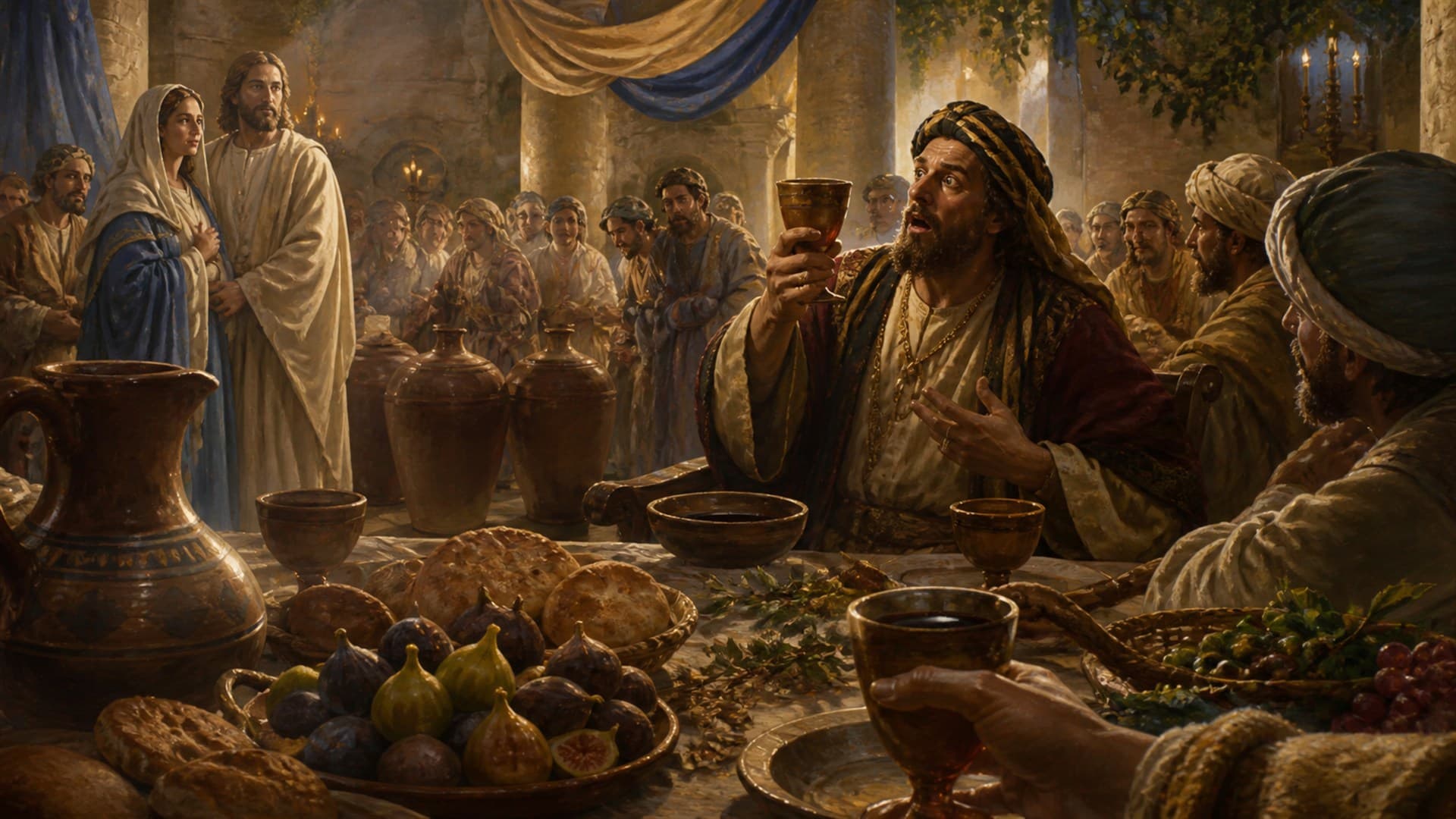
    The Wedding Feast at Cana

    Jesus, Mary, and the disciples attend a wedding.

    Sequence stated in ScriptureNarrated event

    Read in Sacred Scripture

    • John 2:1–5primary
      Sacred Scripture · Douay–RheimsRead John 2:1–5

      Douay-Rheims American Edition, 1899 · Public-domain text

      John 2:1–5

      1And the third day, there was a marriage in Cana of Galilee: and the mother of Jesus was there.

      2And Jesus also was invited, and his disciples, to the marriage.

      3And the wine failing, the mother of Jesus saith to him: They have no wine.

      4And Jesus saith to her: Woman, what is that to me and to thee? my hour is not yet come.

      5His mother saith to the waiters: Whatsoever he shall say to you, do ye.

      Source: eBible.org ↗

      Douay–Rheims American Edition of 1899; public-domain text courtesy of eBible.org.
    Teachings and moments within this stop

    Gospel event

    Jesus Performs His First Sign

    Jesus changes water into wine, revealing His glory.

    Sequence stated in ScriptureNarrated eventDevotional tradition

    Scripture

    • John 2:6–11primary
      Sacred Scripture · Douay–RheimsRead John 2:6–11

      Douay-Rheims American Edition, 1899 · Public-domain text

      John 2:6–11

      6Now there were set there six waterpots of stone, according to the manner of the purifying of the Jews, containing two or three measures apiece.

      7Jesus saith to them: Fill the waterpots with water. And they filled them up to the brim.

      8And Jesus saith to them: Draw out now, and carry to the chief steward of the feast. And they carried it.

      9And when the chief steward had tasted the water made wine, and knew not whence it was, but the waiters knew who had drawn the water; the chief steward calleth the bridegroom,

      10And saith to him: Every man at first setteth forth good wine, and when men have well drunk, then that which is worse. But thou hast kept the good wine until now.

      11This beginning of miracles did Jesus in Cana of Galilee; and manifested his glory, and his disciples believed in him.

      Source: eBible.org ↗

      Douay–Rheims American Edition of 1899; public-domain text courtesy of eBible.org.
  7. 040

    Gospel event

    Jesus Travels to Capernaum

    Jesus goes to Capernaum with His mother, brothers, and disciples.

    Sequence stated in ScriptureNarrated event

    Read in Sacred Scripture

    • John 2:12primary
      Sacred Scripture · Douay–RheimsRead John 2:12

      Douay-Rheims American Edition, 1899 · Public-domain text

      John 2:12

      12After this he went down to Capharnaum, he and his mother, and his brethren, and his disciples: and they remained there not many days.

      Source: eBible.org ↗

      Douay–Rheims American Edition of 1899; public-domain text courtesy of eBible.org.
  8. 041

    Gospel event

    The Temple Cleansing in John’s Narrative

    John places Jesus’ expulsion of merchants and money changers during an early Passover visit.

    Order remains uncertainNarrated event

    Read in Sacred Scripture

    • John 2:13–22primary
      Sacred Scripture · Douay–RheimsRead John 2:13–22

      Douay-Rheims American Edition, 1899 · Public-domain text

      John 2:13–22

      13And the pasch of the Jews was at hand, and Jesus went up to Jerusalem.

      14And he found in the temple them that sold oxen and sheep and doves, and the changers of money sitting.

      15And when he had made, as it were, a scourge of little cords, he drove them all out of the temple, the sheep also and the oxen, and the money of the changers he poured out, and the tables he overthrew.

      16And to them that sold doves he said: Take these things hence, and make not the house of my Father a house of traffic.

      17And his disciples remembered, that it was written: The zeal of thy house hath eaten me up.

      18The Jews, therefore, answered, and said to him: What sign dost thou shew unto us, seeing thou dost these things?

      19Jesus answered, and said to them: Destroy this temple, and in three days I will raise it up.

      20The Jews then said: Six and forty years was this temple in building; and wilt thou raise it up in three days?

      21But he spoke of the temple of his body.

      22When therefore he was risen again from the dead, his disciples remembered, that he had said this, and they believed the scripture, and the word that Jesus had said.

      Source: eBible.org ↗

      Douay–Rheims American Edition of 1899; public-domain text courtesy of eBible.org.
  9. 042

    Gospel-harmony overview

    Jesus Performs Signs in Jerusalem

    Many respond to Jesus’ signs with belief, though the evangelist immediately qualifies the depth of that response.

    Sequence stated in ScriptureNarrated event

    Read in Sacred Scripture

    • John 2:23–25primary
      Sacred Scripture · Douay–RheimsRead John 2:23–25

      Douay-Rheims American Edition, 1899 · Public-domain text

      John 2:23–25

      23Now when he was at Jerusalem, at the pasch, upon the festival day, many believed in his name, seeing his signs which he did.

      24But Jesus did not trust himself unto them, for that he knew all men,

      25And because he needed not that any should give testimony of man: for he knew what was in man.

      Source: eBible.org ↗

      Douay–Rheims American Edition of 1899; public-domain text courtesy of eBible.org.
  10. 043

    Gospel event

    Nicodemus Visits Jesus

    Nicodemus, a Pharisee, approaches Jesus at night.

    Sequence stated in ScriptureNarrated event

    Read in Sacred Scripture

    • John 3:1–15primary
      Sacred Scripture · Douay–RheimsRead John 3:1–15

      Douay-Rheims American Edition, 1899 · Public-domain text

      John 3:1–15

      1And there was a man of the Pharisees, named Nicodemus, a ruler of the Jews.

      2This man came to Jesus by night, and said to him: Rabbi, we know that thou art come a teacher from God; for no man can do these signs which thou dost, unless God be with him.

      3Jesus answered, and said to him: Amen, amen I say to thee, unless a man be born again, he cannot see the kingdom of God.

      4Nicodemus saith to him: How can a man be born when he is old? can he enter a second time into his mother’s womb, and be born again?

      5Jesus answered: Amen, amen I say to thee, unless a man be born again of water and the Holy Ghost, he cannot enter into the kingdom of God.

      6That which is born of the flesh, is flesh; and that which is born of the Spirit, is spirit.

      7Wonder not, that I said to thee, you must be born again.

      8The Spirit breatheth where he will; and thou hearest his voice, but thou knowest not whence he cometh, and whither he goeth: so is every one that is born of the Spirit.

      9Nicodemus answered, and said to him: How can these things be done?

      10Jesus answered, and said to him: Art thou a master in Israel, and knowest not these things?

      11Amen, amen I say to thee, that we speak what we know, and we testify what we have seen, and you receive not our testimony.

      12If I have spoken to you earthly things, and you believe not; how will you believe, if I shall speak to you heavenly things?

      13And no man hath ascended into heaven, but he that descended from heaven, the Son of man who is in heaven.

      14And as Moses lifted up the serpent in the desert, so must the Son of man be lifted up:

      15That whosoever believeth in him, may not perish; but may have life everlasting.

      Source: eBible.org ↗

      Douay–Rheims American Edition of 1899; public-domain text courtesy of eBible.org.
    Teachings and moments within this stop

    Gospel-harmony overview

    God’s Love and Salvation Revealed

    Jesus’ discourse and the evangelist’s reflection reveal the Father’s saving love in sending the Son.

    Order remains uncertainNarrated event

    Scripture

    • John 3:16–21primary
      Sacred Scripture · Douay–RheimsRead John 3:16–21

      Douay-Rheims American Edition, 1899 · Public-domain text

      John 3:16–21

      16For God so loved the world, as to give his only begotten Son; that whosoever believeth in him, may not perish, but may have life everlasting.

      17For God sent not his Son into the world, to judge the world, but that the world may be saved by him.

      18He that believeth in him is not judged. But he that doth not believe, is already judged: because he believeth not in the name of the only begotten Son of God.

      19And this is the judgment: because the light is come into the world, and men loved darkness rather than the light: for their works were evil.

      20For every one that doth evil hateth the light, and cometh not to the light, that his works may not be reproved.

      21But he that doth truth, cometh to the light, that his works may be made manifest, because they are done in God.

      Source: eBible.org ↗

      Douay–Rheims American Edition of 1899; public-domain text courtesy of eBible.org.
  11. 044

    Gospel event

    Jesus Ministers in Judea

    Jesus and His disciples spend time in the Judean countryside.

    Sequence stated in ScriptureNarrated event

    Read in Sacred Scripture

    • John 3:22–24primary
      Sacred Scripture · Douay–RheimsRead John 3:22–24

      Douay-Rheims American Edition, 1899 · Public-domain text

      John 3:22–24

      22After these things Jesus and his disciples came into the land of Judea: and there he abode with them, and baptized.

      23And John also was baptizing in Ennon near Salim; because there was much water there; and they came and were baptized.

      24For John was not yet cast into prison.

      Source: eBible.org ↗

      Douay–Rheims American Edition of 1899; public-domain text courtesy of eBible.org.
  12. 045

    Gospel-harmony overview

    John the Baptist’s Final Explicit Testimony

    John identifies Jesus as the bridegroom and declares that Christ must increase; the following verses may be evangelist reflection.

    Order remains uncertainNarrated event

    Read in Sacred Scripture

    • John 3:25–30primary
      Sacred Scripture · Douay–RheimsRead John 3:25–30

      Douay-Rheims American Edition, 1899 · Public-domain text

      John 3:25–30

      25And there arose a question between some of John’s disciples and the Jews concerning purification:

      26And they came to John, and said to him: Rabbi, he that was with thee beyond the Jordan, to whom thou gavest testimony, behold he baptizeth, and all men come to him.

      27John answered, and said: A man cannot receive any thing, unless it be given him from heaven.

      28You yourselves do bear me witness, that I said, I am not Christ, but that I am sent before him.

      29He that hath the bride, is the bridegroom: but the friend of the bridegroom, who standeth and heareth him, rejoiceth with joy because of the bridegroom’s voice. This my joy therefore is fulfilled.

      30He must increase, but I must decrease.

      Source: eBible.org ↗

      Douay–Rheims American Edition of 1899; public-domain text courtesy of eBible.org.
    • John 3:31–36supporting
      Sacred Scripture · Douay–RheimsRead John 3:31–36

      Douay-Rheims American Edition, 1899 · Public-domain text

      John 3:31–36

      31He that cometh from above, is above all. He that is of the earth, of the earth he is, and of the earth he speaketh. He that cometh from heaven, is above all.

      32And what he hath seen and heard, that he testifieth: and no man receiveth his testimony.

      33He that hath received his testimony, hath set to his seal that God is true.

      34For he whom God hath sent, speaketh the words of God: for God doth not give the Spirit by measure.

      35The Father loveth the Son: and he hath given all things into his hand.

      36He that believeth in the Son, hath life everlasting; but he that believeth not the Son, shall not see life; but the wrath of God abideth on him.

      Source: eBible.org ↗

      Douay–Rheims American Edition of 1899; public-domain text courtesy of eBible.org.
  13. 046

    Gospel event

    Jesus Encounters the Samaritan Woman

    Jesus speaks with a Samaritan woman at Jacob's well.

    Sequence stated in ScriptureNarrated event

    Read in Sacred Scripture

    • John 4:1–26primary
      Sacred Scripture · Douay–RheimsRead John 4:1–26

      Douay-Rheims American Edition, 1899 · Public-domain text

      John 4:1–26

      1When Jesus therefore understood that the Pharisees had heard that Jesus maketh more disciples, and baptizeth more than John,

      2(Though Jesus himself did not baptize, but his disciples,)

      3He left Judea, and went again into Galilee.

      4And he was of necessity to pass through Samaria.

      5He cometh therefore to a city of Samaria, which is called Sichar, near the land which Jacob gave to his son Joseph.

      6Now Jacob’s well was there. Jesus therefore being wearied with his journey, sat thus on the well. It was about the sixth hour.

      7There cometh a woman of Samaria, to draw water. Jesus saith to her: Give me to drink.

      8For his disciples were gone into the city to buy meats.

      9Then that Samaritan woman saith to him: How dost thou, being a Jew, ask of me to drink, who am a Samaritan woman? For the Jews do not communicate with the Samaritans.

      10Jesus answered, and said to her: If thou didst know the gift of God, and who he is that saith to thee, Give me to drink; thou perhaps wouldst have asked of him, and he would have given thee living water.

      11The woman saith to him: Sir, thou hast nothing wherein to draw, and the well is deep; from whence then hast thou living water?

      12Art thou greater than our father Jacob, who gave us the well, and drank thereof himself, and his children, and his cattle?

      13Jesus answered, and said to her: Whosoever drinketh of this water, shall thirst again; but he that shall drink of the water that I will give him, shall not thirst for ever:

      14But the water that I will give him, shall become in him a fountain of water, springing up into life everlasting.

      15The woman saith to him: Sir, give me this water, that I may not thirst, nor come hither to draw.

      16Jesus saith to her: Go, call thy husband, and come hither.

      17The woman answered, and said: I have no husband. Jesus said to her: Thou hast said well, I have no husband:

      18For thou hast had five husbands: and he whom thou now hast, is not thy husband. This thou hast said truly.

      19The woman saith to him: Sir, I perceive that thou art a prophet.

      20Our fathers adored on this mountain, and you say, that at Jerusalem is the place where men must adore.

      21Jesus saith to her: Woman, believe me, that the hour cometh, when you shall neither on this mountain, not in Jerusalem, adore the Father.

      22You adore that which you know not: we adore that which we know; for salvation is of the Jews.

      23But the hour cometh, and now is, when the true adorers shall adore the Father in spirit and in truth. For the Father also seeketh such to adore him.

      24God is a spirit; and they that adore him, must adore him in spirit and in truth.

      25The woman saith to him: I know that the Messias cometh (who is called Christ). Therefore, when he is come, he will tell us all things.

      26Jesus saith to her: I am he, who am speaking with thee.

      Source: eBible.org ↗

      Douay–Rheims American Edition of 1899; public-domain text courtesy of eBible.org.
    Teachings and moments within this stop

    Gospel event

    Many Samaritans Believe in Jesus

    The Samaritan woman's testimony leads others to Jesus.

    Sequence stated in ScriptureNarrated event

    Scripture

    • John 4:39–42primary
      Sacred Scripture · Douay–RheimsRead John 4:39–42

      Douay-Rheims American Edition, 1899 · Public-domain text

      John 4:39–42

      39Now of that city many of the Samaritans believed in him, for the word of the woman giving testimony: He told me all things whatsoever I have done.

      40So when the Samaritans were come to him, they desired that he would tarry there. And he abode there two days.

      41And many more believed in him because of his own word.

      42And they said to the woman: We now believe, not for thy saying: for we ourselves have heard him, and know that this is indeed the Saviour of the world.

      Source: eBible.org ↗

      Douay–Rheims American Edition of 1899; public-domain text courtesy of eBible.org.
  14. 047

    Gospel event

    Jesus Reveals His Mission in Samaria

    Jesus teaches His disciples about accomplishing the Father's will.

    Sequence stated in ScriptureNarrated event

    Read in Sacred Scripture

    • John 4:27–38primary
      Sacred Scripture · Douay–RheimsRead John 4:27–38

      Douay-Rheims American Edition, 1899 · Public-domain text

      John 4:27–38

      27And immediately his disciples came; and they wondered that he talked with the woman. Yet no man said: What seekest thou? or, why talkest thou with her?

      28The woman therefore left her waterpot, and went her way into the city, and saith to the men there:

      29Come, and see a man who has told me all things whatsoever I have done. Is not he the Christ?

      30They went therefore out of the city, and came unto him.

      31In the mean time the disciples prayed him, saying: Rabbi, eat.

      32But he said to them: I have meat to eat, which you know not.

      33The disciples therefore said one to another: Hath any man brought him to eat?

      34Jesus saith to them: My meat is to do the will of him that sent me, that I may perfect his work.

      35Do you not say, There are yet four months, and then the harvest cometh? Behold, I say to you, lift up your eyes, and see the countries; for they are white already to harvest.

      36And he that reapeth receiveth wages, and gathereth fruit unto life everlasting: that both he that soweth, and he that reapeth, may rejoice together.

      37For in this is the saying true: That it is one man that soweth, and it is another that reapeth.

      38I have sent you to reap that in which you did not labour: others have laboured, and you have entered into their labours.

      Source: eBible.org ↗

      Douay–Rheims American Edition of 1899; public-domain text courtesy of eBible.org.
  15. 048

    Gospel event

    Jesus Returns to Galilee

    Jesus travels from Samaria into Galilee.

    Sequence stated in ScriptureNarrated event

    Read in Sacred Scripture

    • John 4:43–45primary
      Sacred Scripture · Douay–RheimsRead John 4:43–45

      Douay-Rheims American Edition, 1899 · Public-domain text

      John 4:43–45

      43Now after two days, he departed thence, and went into Galilee.

      44For Jesus himself gave testimony that a prophet hath no honour in his own country.

      45And when he was come into Galilee, the Galileans received him, having seen all the things he had done at Jerusalem on the festival day; for they also went to the festival day.

      Source: eBible.org ↗

      Douay–Rheims American Edition of 1899; public-domain text courtesy of eBible.org.
  16. 049

    Gospel event

    Jesus Heals a Royal Official's Son

    Jesus heals the official's child from a distance.

    Sequence stated in ScriptureNarrated event

    Read in Sacred Scripture

    • John 4:46–54primary
      Sacred Scripture · Douay–RheimsRead John 4:46–54

      Douay-Rheims American Edition, 1899 · Public-domain text

      John 4:46–54

      46He came again therefore into Cana of Galilee, where he made the water wine. And there was a certain ruler, whose son was sick at Capharnaum.

      47He having heard that Jesus was come from Judea into Galilee, went to him, and prayed him to come down, and heal his son; for he was at the point of death.

      48Jesus therefore said to him: Unless you see signs and wonders, you believe not.

      49The ruler saith to him: Lord, come down before that my son die.

      50Jesus saith to him: Go thy way; thy son liveth. The man believed the word which Jesus said to him, and went his way.

      51And as he was going down, his servants met him; and they brought word, saying, that his son lived.

      52He asked therefore of them the hour wherein he grew better. And they said to him: Yesterday, at the seventh hour, the fever left him.

      53The father therefore knew, that it was at the same hour that Jesus said to him, Thy son liveth; and himself believed, and his whole house.

      54This is again the second miracle that Jesus did, when he was come out of Judea into Galilee.

      Source: eBible.org ↗

      Douay–Rheims American Edition of 1899; public-domain text courtesy of eBible.org.
Back to the eras ↑

Part VI

THE GALILEAN MINISTRY

Jesus proclaims the Kingdom of God through His words and miracles.

A panoramic devotional view of Galilee
Galilee · associated region of the public ministryDevotional artwork from the Daily Oratory sacred-art library

Chapter 7

Jesus Establishes His Ministry in Galilee

  1. 050

    Gospel event

    Jesus Proclaims the Kingdom of God

    After John the Baptist has been arrested, Jesus begins proclaiming the gospel of God and calling people to repentance and faith.

    Sequence stated in ScriptureNarrated event

    Read in Sacred Scripture

    • Mark 1:14–15primary
      Sacred Scripture · Douay–RheimsRead Mark 1:14–15

      Douay-Rheims American Edition, 1899 · Public-domain text

      Mark 1:14–15

      14And after that John was delivered up, Jesus came into Galilee, preaching the gospel of the kingdom of God,

      15And saying: The time is accomplished, and the kingdom of God is at hand: repent, and believe the gospel.

      Source: eBible.org ↗

      Douay–Rheims American Edition of 1899; public-domain text courtesy of eBible.org.
  2. 051

    Teaching

    Jesus Teaches in the Synagogue at Nazareth

    Jesus reads Isaiah and announces the fulfillment of Scripture.

    Order remains uncertainNarrated event

    Read in Sacred Scripture

    • Luke 4:16–22primary
      Sacred Scripture · Douay–RheimsRead Luke 4:16–22

      Douay-Rheims American Edition, 1899 · Public-domain text

      Luke 4:16–22

      16And he came to Nazareth, where he was brought up: and he went into the synagogue, according to his custom, on the sabbath day; and he rose up to read.

      17And the book of Isaias the prophet was delivered unto him. And as he unfolded the book, he found the place where it was written:

      18The Spirit of the Lord is upon me. Wherefore he hath anointed me to preach the gospel to the poor, he hath sent me to heal the contrite of heart,

      19To preach deliverance to the captives, and sight to the blind, to set at liberty them that are bruised, to preach the acceptable year of the Lord, and the day of reward.

      20And when he had folded the book, he restored it to the minister, and sat down. And the eyes of all in the synagogue were fixed on him.

      21And he began to say to them: This day is fulfilled this scripture in your ears.

      22And all gave testimony to him: and they wondered at the words of grace that proceeded from his mouth, and they said: Is not this the son of Joseph?

      Source: eBible.org ↗

      Douay–Rheims American Edition of 1899; public-domain text courtesy of eBible.org.

    Accounts preserved side by side

    The sources do not establish one certain placement

    Luke’s early Nazareth rejection may relate to the later-positioned Matthew/Mark account.

    These sources remain distinct so a Gospel-harmony arrangement is not mistaken for a sequence explicitly stated by Scripture.

    Luke

    Possibly parallel

    Jesus Is Rejected at Nazareth

    The people react negatively to His teaching.

    Order remains uncertainNarrated event

    Scripture

    • Luke 4:23–30primary
      Sacred Scripture · Douay–RheimsRead Luke 4:23–30

      Douay-Rheims American Edition, 1899 · Public-domain text

      Luke 4:23–30

      23And he said to them: Doubtless you will say to me this similitude: Physician, heal thyself: as great things as we have heard done in Capharnaum, do also here in thy own country.

      24And he said: Amen I say to you, that no prophet is accepted in his own country.

      25In truth I say to you, there were many widows in the days of Elias in Israel, when heaven was shut up three years and six months, when there was a great famine throughout all the earth.

      26And to none of them was Elias sent, but to Sarepta of Sidon, to a widow woman.

      27And there were many lepers in Israel in the time of Eliseus the prophet: and none of them was cleansed but Naaman the Syrian.

      28And all they in the synagogue, hearing these things, were filled with anger.

      29And they rose up and thrust him out of the city; and they brought him to the brow of the hill, whereon their city was built, that they might cast him down headlong.

      30But he passing through the midst of them, went his way.

      Source: eBible.org ↗

      Douay–Rheims American Edition of 1899; public-domain text courtesy of eBible.org.
  3. 052

    Gospel event

    Jesus Makes His Home in Capernaum and Begins Proclaiming

    Jesus makes his home in Capernaum and begins proclaiming the nearness of the kingdom of heaven.

    Sequence stated in ScriptureNarrated event

    Read in Sacred Scripture

    • Matthew 4:12–17primary
      Sacred Scripture · Douay–RheimsRead Matthew 4:12–17

      Douay-Rheims American Edition, 1899 · Public-domain text

      Matthew 4:12–17

      12And when Jesus had heard that John was delivered up, he retired into Galilee:

      13And leaving the city Nazareth, he came and dwelt in Capharnaum on the sea coast, in the borders of Zabulon and Nephthalim;

      14That it might be fulfilled which was said by Isaias the prophet:

      15Land of Zabulon and land of Nephthalim, the way of the sea beyond the Jordan, Galilee of the Gentiles:

      16The people that sat in darkness, hath seen great light: and to them that sat in the region of the shadow of death, light is sprung up.

      17From that time Jesus began to preach, and to say: Do penance, for the kingdom of heaven is at hand.

      Source: eBible.org ↗

      Douay–Rheims American Edition of 1899; public-domain text courtesy of eBible.org.
  4. 053

    Gospel event

    The Miraculous Catch of Fish

    Simon Peter witnesses a miraculous catch.

    Order remains uncertainNarrated event

    Read in Sacred Scripture

    • Luke 5:1–11primary
      Sacred Scripture · Douay–RheimsRead Luke 5:1–11

      Douay-Rheims American Edition, 1899 · Public-domain text

      Luke 5:1–11

      1And it came to pass, that when the multitudes pressed upon him to hear the word of God, he stood by the lake of Genesareth,

      2And saw two ships standing by the lake: but the fishermen were gone out of them, and were washing their nets.

      3And going into one of the ships that was Simon’s, he desired him to draw back a little from the land. And sitting he taught the multitudes out of the ship.

      4Now when he had ceased to speak, he said to Simon: Launch out into the deep, and let down your nets for a draught.

      5And Simon answering said to him: Master, we have labored all the night, and have taken nothing: but at thy word I will let down the net.

      6And when they had done this, they enclosed a very great multitude of fishes, and their net broke.

      7And they beckoned to their partners that were in the other ship, that they should come and help them. And they came, and filled both the ships, so that they were almost sinking.

      8Which when Simon Peter saw, he fell down at Jesus’ knees, saying: Depart from me, for I am a sinful man, O Lord.

      9For he was wholly astonished, and all that were with him, at the draught of the fishes which they had taken.

      10And so were also James and John the sons of Zebedee, who were Simon’s partners. And Jesus saith to Simon: Fear not: from henceforth thou shalt catch men.

      11And having brought their ships to land, leaving all things, they followed him.

      Source: eBible.org ↗

      Douay–Rheims American Edition of 1899; public-domain text courtesy of eBible.org.
  5. 054

    Gospel event

    Jesus Calls Simon Peter, Andrew, James, and John

    Jesus calls the fishermen to become His disciples.

    Order remains uncertainNarrated event

    Read in Sacred Scripture

    • Matthew 4:18–22primary
      Sacred Scripture · Douay–RheimsRead Matthew 4:18–22

      Douay-Rheims American Edition, 1899 · Public-domain text

      Matthew 4:18–22

      18And Jesus walking by the sea of Galilee, saw two brethren, Simon who is called Peter, and Andrew his brother, casting a net into the sea (for they were fishers).

      19And he saith to them: Come ye after me, and I will make you to be fishers of men.

      20And they immediately leaving their nets, followed him.

      21And going on from thence, he saw other two brethren, James the son of Zebedee, and John his brother, in a ship with Zebedee their father, mending their nets: and he called them.

      22And they forthwith left their nets and father, and followed him.

      Source: eBible.org ↗

      Douay–Rheims American Edition of 1899; public-domain text courtesy of eBible.org.
    • Mark 1:16–20parallel
      Sacred Scripture · Douay–RheimsRead Mark 1:16–20

      Douay-Rheims American Edition, 1899 · Public-domain text

      Mark 1:16–20

      16And passing by the sea of Galilee, he saw Simon and Andrew his brother, casting nets into the sea (for they were fishermen).

      17And Jesus said to them: Come after me, and I will make you to become fishers of men.

      18And immediately leaving their nets, they followed him.

      19And going on from thence a little farther, he saw James the son of Zebedee, and John his brother, who also were mending their nets in the ship:

      20And forthwith he called them. And leaving their father Zebedee in the ship with his hired men, they followed him.

      Source: eBible.org ↗

      Douay–Rheims American Edition of 1899; public-domain text courtesy of eBible.org.
  6. 055

    Gospel event

    Jesus Expels an Unclean Spirit in Capernaum

    Jesus demonstrates authority over evil spirits.

    Sequence stated in ScriptureNarrated event

    Read in Sacred Scripture

    • Mark 1:21–28primary
      Sacred Scripture · Douay–RheimsRead Mark 1:21–28

      Douay-Rheims American Edition, 1899 · Public-domain text

      Mark 1:21–28

      21And they entered into Capharnaum, and forthwith upon the sabbath days going into the synagogue, he taught them.

      22And they were astonished at his doctrine. For he was teaching them as one having power, and not as the scribes.

      23And there was in their synagogue a man with an unclean spirit; and he cried out,

      24Saying: What have we to do with thee, Jesus of Nazareth? art thou come to destroy us? I know who thou art, the Holy One of God.

      25And Jesus threatened him, saying: Speak no more, and go out of the man.

      26And the unclean spirit tearing him, and crying out with a loud voice, went out of him.

      27And they were all amazed, insomuch that they questioned among themselves, saying: What thing is this? what is this new doctrine? for with power he commandeth even the unclean spirits, and they obey him.

      28And the fame of him was spread forthwith into all the country of Galilee.

      Source: eBible.org ↗

      Douay–Rheims American Edition of 1899; public-domain text courtesy of eBible.org.
    • Luke 4:31–37parallel
      Sacred Scripture · Douay–RheimsRead Luke 4:31–37

      Douay-Rheims American Edition, 1899 · Public-domain text

      Luke 4:31–37

      31And he went down into Capharnaum, a city of Galilee, and there he taught them on the sabbath days.

      32And they were astonished at his doctrine: for his speech was with power.

      33And in the synagogue there was a man who had an unclean devil, and he cried out with a loud voice,

      34Saying: Let us alone, what have we to do with thee, Jesus of Nazareth? art thou come to destroy us? I know thee who thou art, the holy one of God.

      35And Jesus rebuked him, saying: Hold thy peace, and go out of him. And when the devil had thrown him into the midst, he went out of him, and hurt him not at all.

      36And there came fear upon all, and they talked among themselves, saying: What word is this, for with authority and power he commandeth the unclean spirits, and they go out?

      37And the fame of him was published into every place of the country.

      Source: eBible.org ↗

      Douay–Rheims American Edition of 1899; public-domain text courtesy of eBible.org.
  7. 056

    Gospel event

    Jesus Heals Peter's Mother-in-Law

    Jesus heals Simon Peter's mother-in-law.

    Sequence stated in ScriptureNarrated event

    Read in Sacred Scripture

    • Mark 1:29–31primary
      Sacred Scripture · Douay–RheimsRead Mark 1:29–31

      Douay-Rheims American Edition, 1899 · Public-domain text

      Mark 1:29–31

      29And immediately going out of the synagogue they came into the house of Simon and Andrew, with James and John.

      30And Simon’s wife’s mother lay in a fit of a fever: and forthwith they tell him of her.

      31And coming to her, he lifted her up, taking her by the hand; and immediately the fever left her, and she ministered unto them.

      Source: eBible.org ↗

      Douay–Rheims American Edition of 1899; public-domain text courtesy of eBible.org.
    • Matthew 8:14–15parallel
      Sacred Scripture · Douay–RheimsRead Matthew 8:14–15

      Douay-Rheims American Edition, 1899 · Public-domain text

      Matthew 8:14–15

      14And when Jesus was come into Peter’s house, he saw his wife’s mother lying, and sick of a fever:

      15And he touched her hand, and the fever left her, and she arose and ministered to them.

      Source: eBible.org ↗

      Douay–Rheims American Edition of 1899; public-domain text courtesy of eBible.org.
    • Luke 4:38–39parallel
      Sacred Scripture · Douay–RheimsRead Luke 4:38–39

      Douay-Rheims American Edition, 1899 · Public-domain text

      Luke 4:38–39

      38And Jesus rising up out of the synagogue, went into Simon’s house. And Simon’s wife’s mother was taken with a great fever, and they besought him for her.

      39And standing over her, he commanded the fever, and it left her. And immediately rising, she ministered to them.

      Source: eBible.org ↗

      Douay–Rheims American Edition of 1899; public-domain text courtesy of eBible.org.
  8. 057

    Gospel event

    Jesus Heals Many Who Are Sick

    Crowds bring the sick and possessed to Jesus.

    Sequence stated in ScriptureNarrated event

    Read in Sacred Scripture

    • Mark 1:32–34primary
      Sacred Scripture · Douay–RheimsRead Mark 1:32–34

      Douay-Rheims American Edition, 1899 · Public-domain text

      Mark 1:32–34

      32And when it was evening, after sunset, they brought to him all that were ill and that were possessed with devils.

      33And all the city was gathered together at the door.

      34And he healed many that were troubled with divers diseases; and he cast out many devils, and he suffered them not to speak, because they knew him.

      Source: eBible.org ↗

      Douay–Rheims American Edition of 1899; public-domain text courtesy of eBible.org.
    • Matthew 8:16–17parallel
      Sacred Scripture · Douay–RheimsRead Matthew 8:16–17

      Douay-Rheims American Edition, 1899 · Public-domain text

      Matthew 8:16–17

      16And when evening was come, they brought to him many that were possessed with devils: and he cast out the spirits with his word: and all that were sick he healed:

      17That it might be fulfilled, which was spoken by the prophet Isaias, saying: He took our infirmities, and bore our diseases.

      Source: eBible.org ↗

      Douay–Rheims American Edition of 1899; public-domain text courtesy of eBible.org.
    • Luke 4:40–41parallel
      Sacred Scripture · Douay–RheimsRead Luke 4:40–41

      Douay-Rheims American Edition, 1899 · Public-domain text

      Luke 4:40–41

      40And when the sun was down, all they that had any sick with divers diseases, brought them to him. But he laying his hands on every one of them, healed them.

      41And devils went out from many, crying out and saying: Thou art the Son of God. And rebuking them he suffered them not to speak, for they knew that he was Christ.

      Source: eBible.org ↗

      Douay–Rheims American Edition of 1899; public-domain text courtesy of eBible.org.
  9. 058

    Gospel event

    Jesus Withdraws to Pray

    Jesus rises early and withdraws to a deserted place.

    Sequence stated in ScriptureNarrated event

    Read in Sacred Scripture

    • Mark 1:35–39primary
      Sacred Scripture · Douay–RheimsRead Mark 1:35–39

      Douay-Rheims American Edition, 1899 · Public-domain text

      Mark 1:35–39

      35And rising very early, going out, he went into a desert place: and there he prayed.

      36And Simon, and they that were with him, followed after him.

      37And when they had found him, they said to him: All seek for thee.

      38And he saith to them: Let us go into the neighbouring towns and cities, that I may preach there also; for to this purpose am I come.

      39And he was preaching in their synagogues, and in all Galilee, and casting out devils.

      Source: eBible.org ↗

      Douay–Rheims American Edition of 1899; public-domain text courtesy of eBible.org.
    • Luke 4:42–44parallel
      Sacred Scripture · Douay–RheimsRead Luke 4:42–44

      Douay-Rheims American Edition, 1899 · Public-domain text

      Luke 4:42–44

      42And when it was day, going out he went into a desert place, and the multitudes sought him, and came unto him: and they stayed him that he should not depart from them.

      43To whom he said: To other cities also I must preach the kingdom of God: for therefore am I sent.

      44And he was preaching in the synagogues of Galilee.

      Source: eBible.org ↗

      Douay–Rheims American Edition of 1899; public-domain text courtesy of eBible.org.
  10. 059

    Gospel event

    Jesus Cleanses a Leper

    Jesus heals a man suffering from leprosy.

    Sequence stated in ScriptureNarrated event

    Read in Sacred Scripture

    • Mark 1:40–45primary
      Sacred Scripture · Douay–RheimsRead Mark 1:40–45

      Douay-Rheims American Edition, 1899 · Public-domain text

      Mark 1:40–45

      40And there came a leper to him, beseeching him, and kneeling down said to him: If thou wilt, thou canst make me clean.

      41And Jesus having compassion on him, stretched forth his hand; and touching him, saith to him: I will. Be thou made clean.

      42And when he had spoken, immediately the leprosy departed from him, and he was made clean.

      43And he strictly charged him, and forthwith sent him away.

      44And he saith to him: See thou tell no one; but go, shew thyself to the high priest, and offer for thy cleansing the things that Moses commanded, for a testimony to them.

      45But he being gone out, began to publish and to blaze abroad the word: so that he could not openly go into the city, but was without in desert places: and they flocked to him from all sides.

      Source: eBible.org ↗

      Douay–Rheims American Edition of 1899; public-domain text courtesy of eBible.org.
    • Matthew 8:1–4parallel
      Sacred Scripture · Douay–RheimsRead Matthew 8:1–4

      Douay-Rheims American Edition, 1899 · Public-domain text

      Matthew 8:1–4

      1And when he was come down from the mountain, great multitudes followed him:

      2And behold a leper came and adored him, saying: Lord, if thou wilt, thou canst make me clean.

      3And Jesus stretching forth his hand, touched him, saying: I will, be thou made clean. And forthwith his leprosy was cleansed.

      4And Jesus saith to him: See thou tell no man: but go, shew thyself to the priest, and offer the gift which Moses commanded for a testimony unto them.

      Source: eBible.org ↗

      Douay–Rheims American Edition of 1899; public-domain text courtesy of eBible.org.
    • Luke 5:12–16parallel
      Sacred Scripture · Douay–RheimsRead Luke 5:12–16

      Douay-Rheims American Edition, 1899 · Public-domain text

      Luke 5:12–16

      12And it came to pass, when he was in a certain city, behold a man full of leprosy, who seeing Jesus, and falling on his face, besought him, saying: Lord, if thou wilt, thou canst make me clean.

      13And stretching forth his hand, he touched him, saying: I will. Be thou cleansed. And immediately the leprosy departed from him.

      14And he charged him that he should tell no man, but, Go, shew thyself to the priest, and offer for thy cleansing according as Moses commanded, for a testimony to them.

      15But the fame of him went abroad the more, and great multitudes came together to hear, and to be healed by him of their infirmities.

      16And he retired into the desert, and prayed.

      Source: eBible.org ↗

      Douay–Rheims American Edition of 1899; public-domain text courtesy of eBible.org.
  11. 060

    Gospel event

    Jesus Heals a Paralytic Lowered Through a Roof

    Jesus forgives and heals a paralyzed man.

    Sequence stated in ScriptureNarrated event

    Read in Sacred Scripture

    • Mark 2:1–12primary
      Sacred Scripture · Douay–RheimsRead Mark 2:1–12

      Douay-Rheims American Edition, 1899 · Public-domain text

      Mark 2:1–12

      1And again he entered into Capharnaum after some days.

      2And it was heard that he was in the house, and many came together, so that there was no room; no, not even at the door; and he spoke to them the word.

      3And they came to him, bringing one sick of the palsy, who was carried by four.

      4And when they could not offer him unto him for the multitude, they uncovered the roof where he was; and opening it, they let down the bed wherein the man sick of the palsy lay.

      5And when Jesus had seen their faith, he saith to the sick of the palsy: Son, thy sins are forgiven thee.

      6And there were some of the scribes sitting there, and thinking in their hearts:

      7Why doth this man speak thus? he blasphemeth. Who can forgive sins, but God only?

      8Which Jesus presently knowing in his spirit, that they so thought within themselves, saith to them: Why think you these things in your hearts?

      9Which is easier, to say to the sick of the palsy: Thy sins are forgiven thee; or to say: Arise, take up thy bed, and walk?

      10But that you may know that the Son of man hath power on earth to forgive sins, (he saith to the sick of the palsy,)

      11I say to thee: Arise, take up thy bed, and go into thy house.

      12And immediately he arose; and taking up his bed, went his way in the sight of all; so that all wondered and glorified God, saying: We never saw the like.

      Source: eBible.org ↗

      Douay–Rheims American Edition of 1899; public-domain text courtesy of eBible.org.
    • Matthew 9:1–8parallel
      Sacred Scripture · Douay–RheimsRead Matthew 9:1–8

      Douay-Rheims American Edition, 1899 · Public-domain text

      Matthew 9:1–8

      1And entering into a boat, he passed over the water and came into his own city.

      2And behold they brought to him one sick of the palsy lying in a bed. And Jesus, seeing their faith, said to the man sick of the palsy: Be of good heart, son, thy sins are forgiven thee.

      3And behold some of the scribes said within themselves: He blasphemeth.

      4And Jesus seeing their thoughts, said: Why do you think evil in your hearts?

      5Whether is easier, to say, Thy sins are forgiven thee: or to say, Arise, and walk?

      6But that you may know that the Son of man hath power on earth to forgive sins, (then said he to the man sick of palsy,) Arise, take up thy bed, and go into thy house.

      7And he arose, and went into his house.

      8And the multitude seeing it, feared, and glorified God that gave such power to men.

      Source: eBible.org ↗

      Douay–Rheims American Edition of 1899; public-domain text courtesy of eBible.org.
    • Luke 5:17–26parallel
      Sacred Scripture · Douay–RheimsRead Luke 5:17–26

      Douay-Rheims American Edition, 1899 · Public-domain text

      Luke 5:17–26

      17And it came to pass on a certain day, as he sat teaching, that there were also Pharisees and doctors of the law sitting by, that were come out of every town of Galilee, and Judea and Jerusalem: and the power of the Lord was to heal them.

      18And behold, men brought in a bed a man, who had the palsy: and they sought means to bring him in, and to lay him before him.

      19And when they could not find by what way they might bring him in, because of the multitude, they went up upon the roof, and let him down through the tiles with his bed into the midst before Jesus.

      20Whose faith when he saw, he said: Man, thy sins are forgiven thee.

      21And the scribes and Pharisees began to think, saying: Who is this who speaketh blasphemies? Who can forgive sins, but God alone?

      22And when Jesus knew their thoughts, answering, he said to them: What is it you think in your hearts?

      23Which is easier to say, Thy sins are forgiven thee; or to say, Arise and walk?

      24But that you may know that the Son of man hath power on earth to forgive sins, (he saith to the sick of the palsy,) I say to thee, Arise, take up thy bed, and go into thy house.

      25And immediately rising up before them, he took up the bed on which he lay; and he went away to his own house, glorifying God.

      26And all were astonished; and they glorified God. And they were filled with fear, saying: We have seen wonderful things today.

      Source: eBible.org ↗

      Douay–Rheims American Edition of 1899; public-domain text courtesy of eBible.org.
  12. 061

    Gospel event

    Jesus Calls Matthew

    Jesus calls Matthew, the tax collector, to follow Him.

    Sequence stated in ScriptureNarrated event

    Read in Sacred Scripture

    • Matthew 9:9–13primary
      Sacred Scripture · Douay–RheimsRead Matthew 9:9–13

      Douay-Rheims American Edition, 1899 · Public-domain text

      Matthew 9:9–13

      9And when Jesus passed on from hence, he saw a man sitting in the custom house, named Matthew; and he saith to him: Follow me. And he rose up and followed him.

      10And it came to pass as he was sitting at meat in the house, behold many publicans and sinners came, and sat down with Jesus and his disciples.

      11And the Pharisees seeing it, said to his disciples: Why doth your master eat with publicans and sinners?

      12But Jesus hearing it, said: They that are in health need not a physician, but they that are ill.

      13Go then and learn what this meaneth, I will have mercy and not sacrifice. For I am not come to call the just, but sinners.

      Source: eBible.org ↗

      Douay–Rheims American Edition of 1899; public-domain text courtesy of eBible.org.
    • Mark 2:13–17parallel
      Sacred Scripture · Douay–RheimsRead Mark 2:13–17

      Douay-Rheims American Edition, 1899 · Public-domain text

      Mark 2:13–17

      13And he went forth again to the sea side; and all the multitude came to him, and he taught them.

      14And when he was passing by, he saw Levi the son of Alpheus sitting at the receipt of custom; and he saith to him: Follow me. And rising up, he followed him.

      15And it came to pass, that as he sat at meat in his house, many publicans and sinners sat down together with Jesus and his disciples. For they were many, who also followed him.

      16And the scribes and the Pharisees, seeing that he ate with publicans and sinners, said to his disiples: Why doth your master eat and drink with publicans and sinners?

      17Jesus hearing this, saith to them: They that are well have no need of a physician, but they that are sick. For I came not to call the just, but sinners.

      Source: eBible.org ↗

      Douay–Rheims American Edition of 1899; public-domain text courtesy of eBible.org.
    • Luke 5:27–32parallel
      Sacred Scripture · Douay–RheimsRead Luke 5:27–32

      Douay-Rheims American Edition, 1899 · Public-domain text

      Luke 5:27–32

      27And after these things he went forth, and saw a publican named Levi, sitting at the receipt of custom, and he said to him: Follow me.

      28And leaving all things, he rose up and followed him.

      29And Levi made him a great feast in his own house; and there was a great company of publicans, and of others, that were at table with them.

      30But the Pharisees and scribes murmured, saying to his disciples: Why do you eat and drink with publicans and sinners?

      31And Jesus answering, said to them: They that are whole, need not the physician: but they that are sick.

      32I came not to call the just, but sinners to penance.

      Source: eBible.org ↗

      Douay–Rheims American Edition of 1899; public-domain text courtesy of eBible.org.
  13. 062

    Teaching

    Jesus Teaches About Fasting

    Jesus answers questions about why His disciples do not fast in the same manner as others.

    Sequence stated in ScriptureNarrated event

    Read in Sacred Scripture

    • Mark 2:18–22primary
      Sacred Scripture · Douay–RheimsRead Mark 2:18–22

      Douay-Rheims American Edition, 1899 · Public-domain text

      Mark 2:18–22

      18And the disiples of John and the Pharisees used to fast; and they come and say to him: Why do the disciples of John and of the Pharisees fast; but thy disciples do not fast?

      19And Jesus saith to them: Can the children of the marriage fast, as long as the bridegroom is with them? As long as they have the bridegroom with them, they cannot fast.

      20But the days will come when the bridegroom shall be taken away from them; and then they shall fast in those days.

      21No man seweth a piece of raw cloth to an old garment: otherwise the new piecing taketh away from the old, and there is made a greater rent.

      22And no man putteth new wine into old bottles: otherwise the wine will burst the bottles, and both the wine will be spilled, and the bottles will be lost. But new wine must be put into new bottles.

      Source: eBible.org ↗

      Douay–Rheims American Edition of 1899; public-domain text courtesy of eBible.org.
    • Matthew 9:14–17parallel
      Sacred Scripture · Douay–RheimsRead Matthew 9:14–17

      Douay-Rheims American Edition, 1899 · Public-domain text

      Matthew 9:14–17

      14Then came to him the disciples of John, saying: Why do we and the Pharisees fast often, but thy disciples do not fast?

      15And Jesus said to them: Can the children of the bridegroom mourn, as long as the bridegroom is with them? But the days will come, when the bridegroom shall be taken away from them, and then they shall fast.

      16And nobody putteth a piece of raw cloth unto an old garment. For it taketh away the fullness thereof from the garment, and there is made a greater rent.

      17Neither do they put new wine into old bottles. Otherwise the bottles break, and the wine runneth out, and the bottles perish. But new wine they put into new bottles: and both are preserved.

      Source: eBible.org ↗

      Douay–Rheims American Edition of 1899; public-domain text courtesy of eBible.org.
    • Luke 5:33–39parallel
      Sacred Scripture · Douay–RheimsRead Luke 5:33–39

      Douay-Rheims American Edition, 1899 · Public-domain text

      Luke 5:33–39

      33And they said to him: Why do the disciples of John fast often, and make prayers, and the disciples of the Pharisees in like manner; but thine eat and drink?

      34To whom he said: Can you make the children of the bridegroom fast, whilst the bridegroom is with them?

      35But the days will come, when the bridegroom shall be taken away from them, then shall they fast in those days.

      36And he spoke also a similitude to them: That no man putteth a piece from a new garment upon an old garment; otherwise he both rendeth the new, and the piece taken from the new agreeth not with the old.

      37And no man putteth new wine into old bottle: otherwise the new wine will break the bottles, and it will be spilled, and the bottles will be lost.

      38But new wine must be put into new bottles; and both are preserved.

      39And no man drinking old, hath presently a mind to new: for he saith, The old is better.

      Source: eBible.org ↗

      Douay–Rheims American Edition of 1899; public-domain text courtesy of eBible.org.
  14. 063

    Teaching

    Jesus Teaches About the Sabbath

    Jesus explains the true purpose of the Sabbath.

    Sequence stated in ScriptureNarrated event

    Read in Sacred Scripture

    • Mark 2:23–28primary
      Sacred Scripture · Douay–RheimsRead Mark 2:23–28

      Douay-Rheims American Edition, 1899 · Public-domain text

      Mark 2:23–28

      23And it came to pass again, as the Lord walked through the corn fields on the sabbath, that his disciples began to go forward, and to pluck the ears of corn.

      24And the Pharisees said to him: Behold, why do they on the sabbath day that which is not lawful?

      25And he said to them: Have you never read what David did when he had need, and was hungry himself, and they that were with him?

      26How he went into the house of God, under Abiathar the high priest, and did eat the loaves of proposition, which was not lawful to eat but for the priests, and gave to them who were with him?

      27And he said to them: The sabbath was made for man, and not man for the sabbath.

      28Therefore the Son of man is Lord of the sabbath also.

      Source: eBible.org ↗

      Douay–Rheims American Edition of 1899; public-domain text courtesy of eBible.org.
    • Matthew 12:1–8parallel
      Sacred Scripture · Douay–RheimsRead Matthew 12:1–8

      Douay-Rheims American Edition, 1899 · Public-domain text

      Matthew 12:1–8

      1At that time Jesus went through the corn on the sabbath: and his disciples being hungry, began to pluck the ears, and to eat.

      2And the Pharisees seeing them, said to him: Behold thy disciples do that which is not lawful to do on the sabbath days.

      3But he said to them: Have you not read what David did when he was hungry, and they that were with him:

      4How he entered into the house of God, and did eat the loaves of proposition, which it was not lawful for him to eat, nor for them that were with him, but for the priests only?

      5Or have ye not read in the law, that on the sabbath days the priests in the temple break the sabbath, and are without blame?

      6But I tell you that there is here a greater than the temple.

      7And if you knew what this meaneth: I will have mercy, and not sacrifice: you would never have condemned the innocent.

      8For the Son of man is Lord even of the sabbath.

      Source: eBible.org ↗

      Douay–Rheims American Edition of 1899; public-domain text courtesy of eBible.org.
    • Luke 6:1–5parallel
      Sacred Scripture · Douay–RheimsRead Luke 6:1–5

      Douay-Rheims American Edition, 1899 · Public-domain text

      Luke 6:1–5

      1And it came to pass on the second first sabbath, that as he went through the corn fields, his disciples plucked the ears, and did eat, rubbing them in their hands.

      2And some of the Pharisees said to them: Why do you that which is not lawful on the sabbath days?

      3And Jesus answering them, said: Have you not read so much as this, what David did, when himself was hungry, and they that were with him:

      4How he went into the house of God, and took and ate the bread of proposition, and gave to them that were with him, which is not lawful to eat but only for the priests?

      5And he said to them: The Son of man is Lord also of the sabbath.

      Source: eBible.org ↗

      Douay–Rheims American Edition of 1899; public-domain text courtesy of eBible.org.
  15. 064

    Gospel event

    Jesus Heals a Man with a Withered Hand

    Jesus heals on the Sabbath.

    Sequence stated in ScriptureNarrated event

    Read in Sacred Scripture

    • Mark 3:1–6primary
      Sacred Scripture · Douay–RheimsRead Mark 3:1–6

      Douay-Rheims American Edition, 1899 · Public-domain text

      Mark 3:1–6

      1And he entered again into the synagogue, and there was a man there who had a withered hand.

      2And they watched him whether he would heal on the sabbath days; that they might accuse him.

      3And he said to the man who had the withered hand: Stand up in the midst.

      4And he saith to them: Is it lawful to do good on the sabbath days, or to do evil? to save life, or to destroy? But they held their peace.

      5And looking round about on them with anger, being grieved for the blindness of their hearts, he saith to the man: Stretch forth thy hand. And he stretched it forth: and his hand was restored unto him.

      6And the Pharisees going out, immediately made a consultation with the Herodians against him, how they might destroy him.

      Source: eBible.org ↗

      Douay–Rheims American Edition of 1899; public-domain text courtesy of eBible.org.
    • Matthew 12:9–14parallel
      Sacred Scripture · Douay–RheimsRead Matthew 12:9–14

      Douay-Rheims American Edition, 1899 · Public-domain text

      Matthew 12:9–14

      9And when he has passed from thence, he came into their synagogues.

      10And behold there was a man who had a withered hand, and they asked him, saying: Is it lawful to heal on the sabbath days? that they might accuse him.

      11But he said to them: What man shall there be among you, that hath one sheep: and if the same fall into a pit on the sabbath day, will he not take hold on it and lift it up?

      12How much better is a man than a sheep? Therefore it is lawful to do a good deed on the sabbath days.

      13Then he saith to the man: Stretch forth thy hand; and he stretched it forth, and it was restored to health even as the other.

      14And the Pharisees going out made a consultation against him, how they might destroy him.

      Source: eBible.org ↗

      Douay–Rheims American Edition of 1899; public-domain text courtesy of eBible.org.
    • Luke 6:6–11parallel
      Sacred Scripture · Douay–RheimsRead Luke 6:6–11

      Douay-Rheims American Edition, 1899 · Public-domain text

      Luke 6:6–11

      6And it came to pass also on another sabbath, that he entered into the synagogue, and taught. And there was a man, whose right hand was withered.

      7And the scribes and Pharisees watched if he would heal on the sabbath; that they might find an accusation against him.

      8But he knew their thoughts; and said to the man who had the withered hand: Arise, and stand forth in the midst. And rising he stood forth.

      9Then Jesus said to them: I ask you, if it be lawful on the sabbath days to do good, or to do evil; to save life, or to destroy?

      10And looking round about on them all, he said to the man: Stretch forth thy hand. And he stretched it forth: and his hand was restored.

      11And they were filled with madness; and they talked one with another, what they might do to Jesus.

      Source: eBible.org ↗

      Douay–Rheims American Edition of 1899; public-domain text courtesy of eBible.org.
  16. 065

    Gospel event

    Large Crowds Follow Jesus

    People come from different regions to hear Him and seek healing.

    Sequence stated in ScriptureNarrated event

    Read in Sacred Scripture

    • Mark 3:7–12primary
      Sacred Scripture · Douay–RheimsRead Mark 3:7–12

      Douay-Rheims American Edition, 1899 · Public-domain text

      Mark 3:7–12

      7But Jesus retired with his disciples to the sea; and a great multitude followed him from Galilee and Judea,

      8And from Jerusalem, and from Idumea, and from beyond the Jordan. And they about Tyre and Sidon, a great multitude, hearing the things which he did, came to him.

      9And he spoke to his disciples that a small ship should wait on him because of the multitude, lest they should throng him.

      10For he healed many, so that they pressed upon him for to touch him, as many as had evils.

      11And the unclean spirits, when they saw him, fell down before him: and they cried, saying:

      12Thou art the Son of God. And he strictly charged them that they should not make him known.

      Source: eBible.org ↗

      Douay–Rheims American Edition of 1899; public-domain text courtesy of eBible.org.
  17. 066

    Gospel event

    Jesus Chooses the Twelve Apostles

    Jesus appoints twelve apostles after spending the night in prayer.

    Sequence stated in ScriptureNarrated event

    Read in Sacred Scripture

    • Luke 6:12–16primary
      Sacred Scripture · Douay–RheimsRead Luke 6:12–16

      Douay-Rheims American Edition, 1899 · Public-domain text

      Luke 6:12–16

      12And it came to pass in those days, that he went out into a mountain to pray, and he passed the whole night in the prayer of God.

      13And when day was come, he called unto him his disciples; and he chose twelve of them (whom also he named apostles).

      14Simon, whom he surnamed Peter, and Andrew his brother, James and John, Philip and Bartholomew,

      15Matthew and Thomas, James the son of Alpheus, and Simon who is called Zelotes,

      16And Jude, the brother of James, and Judas Iscariot, who was the traitor.

      Source: eBible.org ↗

      Douay–Rheims American Edition of 1899; public-domain text courtesy of eBible.org.
    • Mark 3:13–19parallel
      Sacred Scripture · Douay–RheimsRead Mark 3:13–19

      Douay-Rheims American Edition, 1899 · Public-domain text

      Mark 3:13–19

      13And going up into a mountain, he called unto him whom he would himself: and they came to him.

      14And he made that twelve should be with him, and that he might send them to preach.

      15And he gave them power to heal sicknesses, and to cast out devils.

      16And to Simon he gave the name Peter:

      17And James the son of Zebedee, and John the brother of James; and he named them Boanerges, which is, The sons of thunder:

      18And Andrew and Philip, and Bartholomew and Matthew, and Thomas and James of Alpheus, and Thaddeus, and Simon the Cananean:

      19And Judas Iscariot, who also betrayed him.

      Source: eBible.org ↗

      Douay–Rheims American Edition of 1899; public-domain text courtesy of eBible.org.
    • Matthew 10:1–4parallel
      Sacred Scripture · Douay–RheimsRead Matthew 10:1–4

      Douay-Rheims American Edition, 1899 · Public-domain text

      Matthew 10:1–4

      1And having called his twelve disciples together, he gave them power over unclean spirits, to cast them out, and to heal all manner of diseases, and all manner of infirmities.

      2And the names of the twelve apostles are these: The first, Simon who is called Peter, and Andrew his brother,

      3James the son of Zebedee, and John his brother, Philip and Bartholomew, Thomas and Matthew the publican, and James the son of Alpheus, and Thaddeus,

      4Simon the Cananean, and Judas Iscariot, who also betrayed him.

      Source: eBible.org ↗

      Douay–Rheims American Edition of 1899; public-domain text courtesy of eBible.org.
Back to the eras ↑

Part VII

THE TEACHINGS AND MIRACLES OF JESUS

Jesus reveals the nature of God's Kingdom.

A hillside crowd listening in devotional artwork
The hillsides · places associated with Jesus’ teachingDevotional artwork from the Daily Oratory sacred-art library

Chapter 8

The Teachings of Jesus

  1. 067

    Teaching

    Jesus Preaches the Beatitudes

    Jesus reveals the attitudes and virtues that characterize the blessed life.

    Sequence stated in ScriptureNarrated event

    Read in Sacred Scripture

    • Matthew 5:1–12primary
      Sacred Scripture · Douay–RheimsRead Matthew 5:1–12

      Douay-Rheims American Edition, 1899 · Public-domain text

      Matthew 5:1–12

      1And seeing the multitudes, he went up into a mountain, and when he was set down, his disciples came unto him.

      2And opening his mouth, he taught them, saying:

      3Blessed are the poor in spirit: for theirs is the kingdom of heaven.

      4Blessed are the meek: for they shall possess the land.

      5Blessed are they that mourn: for they shall be comforted.

      6Blessed are they that hunger and thirst after justice: for they shall have their fill.

      7Blessed are the merciful: for they shall obtain mercy.

      8Blessed are the clean of heart: for they shall see God.

      9Blessed are the peacemakers: for they shall be called children of God.

      10Blessed are they that suffer persecution for justice’ sake: for theirs is the kingdom of heaven.

      11Blessed are ye when they shall revile you, and persecute you, and speak all that is evil against you, untruly, for my sake:

      12Be glad and rejoice, for your reward is very great in heaven. For so they persecuted the prophets that were before you.

      Source: eBible.org ↗

      Douay–Rheims American Edition of 1899; public-domain text courtesy of eBible.org.
    Teachings and moments within this stop

    Teaching

    Jesus Teaches About Salt and Light

    Jesus describes His disciples' responsibility to illuminate the world.

    Sequence stated in ScriptureNarrated event

    Scripture

    • Matthew 5:13–16primary
      Sacred Scripture · Douay–RheimsRead Matthew 5:13–16

      Douay-Rheims American Edition, 1899 · Public-domain text

      Matthew 5:13–16

      13You are the salt of the earth. But if the salt lose its savour, wherewith shall it be salted? It is good for nothing any more but to be cast out, and to be trodden on by men.

      14You are the light of the world. A city seated on a mountain cannot be hid.

      15Neither do men light a candle and put it under a bushel, but upon a candlestick, that it may shine to all that are in the house.

      16So let your light shine before men, that they may see your good works, and glorify your Father who is in heaven.

      Source: eBible.org ↗

      Douay–Rheims American Edition of 1899; public-domain text courtesy of eBible.org.

    Teaching

    Jesus Teaches About the Fulfillment of the Law

    Jesus explains His relationship to the Law and the Prophets.

    Sequence stated in ScriptureNarrated event

    Scripture

    • Matthew 5:17–20primary
      Sacred Scripture · Douay–RheimsRead Matthew 5:17–20

      Douay-Rheims American Edition, 1899 · Public-domain text

      Matthew 5:17–20

      17Do not think that I am come to destroy the law, or the prophets. I am not come to destroy, but to fulfill.

      18For amen I say unto you, till heaven and earth pass, one jot, or one tittle shall not pass of the law, till all be fulfilled.

      19He therefore that shall break one of these least commandments, and shall so teach men, shall be called the least in the kingdom of heaven. But he that shall do and teach, he shall be called great in the kingdom of heaven.

      20For I tell you, that unless your justice abound more than that of the scribes and Pharisees, you shall not enter into the kingdom of heaven.

      Source: eBible.org ↗

      Douay–Rheims American Edition of 1899; public-domain text courtesy of eBible.org.

    Teaching

    Jesus Teaches About Anger and Reconciliation

    Jesus teaches the importance of interior righteousness.

    Sequence stated in ScriptureNarrated event

    Scripture

    • Matthew 5:21–26primary
      Sacred Scripture · Douay–RheimsRead Matthew 5:21–26

      Douay-Rheims American Edition, 1899 · Public-domain text

      Matthew 5:21–26

      21You have heard that it was said to them of old: Thou shalt not kill. And whosoever shall kill shall be in danger of the judgment.

      22But I say to you, that whosoever is angry with his brother, shall be in danger of the judgment. And whosoever shall say to his brother, Raca, shall be in danger of the council. And whosoever shall say, Thou Fool, shall be in danger of hell fire.

      23If therefore thou offer thy gift at the altar, and there thou remember that thy brother hath any thing against thee;

      24Leave there thy offering before the altar, and go first to be reconciled to thy brother: and then coming thou shalt offer thy gift.

      25Be at agreement with thy adversary betimes, whilst thou art in the way with him: lest perhaps the adversary deliver thee to the judge, and the judge deliver thee to the officer, and thou be cast into prison.

      26Amen I say to thee, thou shalt not go out from thence till thou repay the last farthing.

      Source: eBible.org ↗

      Douay–Rheims American Edition of 1899; public-domain text courtesy of eBible.org.

    Teaching

    Jesus Teaches About Purity of Heart

    Jesus addresses adultery, lust, and marriage.

    Sequence stated in ScriptureNarrated event

    Scripture

    • Matthew 5:27–32primary
      Sacred Scripture · Douay–RheimsRead Matthew 5:27–32

      Douay-Rheims American Edition, 1899 · Public-domain text

      Matthew 5:27–32

      27You have heard that it was said to them of old: Thou shalt not commit adultery.

      28But I say to you, that whosoever shall look on a woman to lust after her, hath already committed adultery with her in his heart.

      29And if thy right eye scandalize thee, pluck it out and cast it from thee. For it is expedient for thee that one of thy members should perish, rather than that thy whole body be cast into hell.

      30And if thy right hand scandalize thee, cut it off, and cast it from thee: for it is expedient for thee that one of thy members should perish, rather than that thy whole body be cast into hell.

      31And it hath been said, whosoever shall put away his wife, let him give her a bill of divorce.

      32But I say to you, that whosoever shall put away his wife, excepting for the cause of fornication, maketh her to commit adultery: and he that shall marry her that is put away, committeth adultery.

      Source: eBible.org ↗

      Douay–Rheims American Edition of 1899; public-domain text courtesy of eBible.org.

    Teaching

    Jesus Teaches About Truthfulness and Loving Enemies

    Jesus calls His disciples to truthful speech and love extending even to enemies.

    Sequence stated in ScriptureNarrated event

    Scripture

    • Matthew 5:33–48primary
      Sacred Scripture · Douay–RheimsRead Matthew 5:33–48

      Douay-Rheims American Edition, 1899 · Public-domain text

      Matthew 5:33–48

      33Again you have heard that it was said to them of old, Thou shalt not forswear thyself: but thou shalt perform thy oaths to the Lord.

      34But I say to you not to swear at all, neither by heaven, for it is the throne of God:

      35Nor by the earth, for it is his footstool: nor by Jerusalem, for it is the city of the great king:

      36Neither shalt thou swear by thy head, because thou canst not make one hair white or black.

      37But let your speech be yea, yea: no, no: and that which is over and above these, is of evil.

      38You have heard that it hath been said, An eye for an eye, and a tooth for a tooth.

      39But I say to you not to resist evil: but if one strike thee on thy right cheek, turn to him also the other:

      40And if a man will contend with thee in judgment, and take away thy coat, let go thy cloak also unto him.

      41And whosoever will force thee one mile, go with him other two,

      42Give to him that asketh of thee and from him that would borrow of thee turn not away.

      43You have heard that it hath been said, Thou shalt love thy neighbor, and hate thy enemy.

      44But I say to you, Love your enemies: do good to them that hate you: and pray for them that persecute and calumniate you:

      45That you may be the children of your Father who is in heaven, who maketh his sun to rise upon the good, and bad, and raineth upon the just and the unjust.

      46For if you love them that love you, what reward shall you have? do not even the publicans this?

      47And if you salute your brethren only, what do you more? do not also the heathens this?

      48Be you therefore perfect, as also your heavenly Father is perfect.

      Source: eBible.org ↗

      Douay–Rheims American Edition of 1899; public-domain text courtesy of eBible.org.

    Teaching

    Jesus Teaches About Prayer, Fasting, and Almsgiving

    Jesus explains how these practices should be undertaken.

    Sequence stated in ScriptureNarrated event

    Scripture

    • Matthew 6:1–18primary
      Sacred Scripture · Douay–RheimsRead Matthew 6:1–18

      Douay-Rheims American Edition, 1899 · Public-domain text

      Matthew 6:1–18

      1Take heed that you do not your justice before men, to be seen by them: otherwise you shall not have a reward of your Father who is in heaven.

      2Therefore when thou dost an almsdeed, sound not a trumpet before thee, as the hypocrites do in the synagogues and in the streets, that they may be honoured by men. Amen I say to you, they have received their reward.

      3But when thou dost alms, let not thy left hand know what thy right hand doth.

      4That thy alms may be in secret, and thy Father who seeth in secret will repay thee.

      5And when ye pray, you shall not be as the hypocrites, that love to stand and pray in the synagogues and corners of the streets, that they may be seen by men: Amen I say to you, they have received their reward.

      6But thou when thou shalt pray, enter into thy chamber, and having shut the door, pray to thy Father in secret: and thy Father who seeth in secret will repay thee.

      7And when you are praying, speak not much, as the heathens. For they think that in their much speaking they may be heard.

      8Be not you therefore like to them, for your Father knoweth what is needful for you, before you ask him.

      9Thus therefore shall you pray: Our Father who art in heaven, hallowed be thy name.

      10Thy kingdom come. Thy will be done on earth as it is in heaven.

      11Give us this day our supersubstantial bread.

      12And forgive us our debts, as we also forgive our debtors.

      13And lead us not into temptation. But deliver us from evil. Amen.

      14For if you will forgive men their offences, your heavenly Father will forgive you also your offences.

      15But if you will not forgive men, neither will your Father forgive you your offences.

      16And when you fast, be not as the hypocrites, sad. For they disfigure their faces, that they may appear unto men to fast. Amen I say to you, they have received their reward.

      17But thou, when thou fastest anoint thy head, and wash thy face;

      18That thou appear not to men to fast, but to thy Father who is in secret: and thy Father who seeth in secret, will repay thee.

      Source: eBible.org ↗

      Douay–Rheims American Edition of 1899; public-domain text courtesy of eBible.org.

    Teaching

    Jesus Teaches the Our Father

    Jesus gives His disciples the Lord's Prayer.

    Sequence stated in ScriptureNarrated event

    Scripture

    • Matthew 6:9–13primary
      Sacred Scripture · Douay–RheimsRead Matthew 6:9–13

      Douay-Rheims American Edition, 1899 · Public-domain text

      Matthew 6:9–13

      9Thus therefore shall you pray: Our Father who art in heaven, hallowed be thy name.

      10Thy kingdom come. Thy will be done on earth as it is in heaven.

      11Give us this day our supersubstantial bread.

      12And forgive us our debts, as we also forgive our debtors.

      13And lead us not into temptation. But deliver us from evil. Amen.

      Source: eBible.org ↗

      Douay–Rheims American Edition of 1899; public-domain text courtesy of eBible.org.
    • Luke 11:1–4parallel
      Sacred Scripture · Douay–RheimsRead Luke 11:1–4

      Douay-Rheims American Edition, 1899 · Public-domain text

      Luke 11:1–4

      1And it came to pass, that as he was in a certain place praying, when he ceased, one of his disciples said to him: Lord, teach us to pray, as John also taught his disciples.

      2And he said to them: When you pray, say: Father, hallowed be thy name. Thy kingdom come.

      3Give us this day our daily bread.

      4And forgive us our sins, for we also forgive every one that is indebted to us. And lead us not into temptation.

      Source: eBible.org ↗

      Douay–Rheims American Edition of 1899; public-domain text courtesy of eBible.org.

    Teaching

    Jesus Teaches About Heavenly Treasure

    Jesus warns against attachment to worldly possessions.

    Sequence stated in ScriptureNarrated event

    Scripture

    • Matthew 6:19–24primary
      Sacred Scripture · Douay–RheimsRead Matthew 6:19–24

      Douay-Rheims American Edition, 1899 · Public-domain text

      Matthew 6:19–24

      19Lay not up to yourselves treasures on earth: where the rust, and moth consume, and where thieves break through and steal.

      20But lay up to yourselves treasures in heaven: where neither the rust nor moth doth consume, and where thieves do not break through, nor steal.

      21For where thy treasure is, there is thy heart also.

      22The light of thy body is thy eye. If thy eye be single, thy whole body shall be lightsome.

      23But if thy eye be evil thy whole body shall be darksome. If then the light that is in thee, be darkness: the darkness itself how great shall it be!

      24No man can serve two masters. For either he will hate the one, and love the other: or he will sustain the one, and despise the other. You cannot serve God and mammon.

      Source: eBible.org ↗

      Douay–Rheims American Edition of 1899; public-domain text courtesy of eBible.org.

    Teaching

    Jesus Teaches About Trust in Divine Providence

    Jesus instructs His followers not to be consumed by anxiety.

    Sequence stated in ScriptureNarrated event

    Scripture

    • Matthew 6:25–34primary
      Sacred Scripture · Douay–RheimsRead Matthew 6:25–34

      Douay-Rheims American Edition, 1899 · Public-domain text

      Matthew 6:25–34

      25Therefore I say to you, be not solicitous for your life, what you shall eat, nor for your body, what you shall put on. Is not the life more than the meat: and the body more than the raiment?

      26Behold the birds of the air, for they neither sow, nor do they reap, nor gather into barns: and your heavenly Father feedeth them. Are not you of much more value than they?

      27And which of you by taking thought, can add to his stature by one cubit?

      28And for raiment why are you solicitous? Consider the lilies of the field, how they grow: they labour not, neither do they spin.

      29But I say to you, that not even Solomon in all his glory was arrayed as one of these.

      30And if the grass of the field, which is today, and tomorrow is cast into the oven, God doth so clothe: how much more you, O ye of little faith?

      31Be not solicitous therefore, saying, What shall we eat: or what shall we drink, or wherewith shall we be clothed?

      32For after all these things do the heathens seek. For your Father knoweth that you have need of all these things.

      33Seek ye therefore first the kingdom of God, and his justice, and all these things shall be added unto you.

      34Be not therefore solicitous for tomorrow; for the morrow will be solicitous for itself. Sufficient for the day is the evil thereof.

      Source: eBible.org ↗

      Douay–Rheims American Edition of 1899; public-domain text courtesy of eBible.org.

    Teaching

    Jesus Teaches About Judgment and Charity

    Jesus warns against hypocritical judgment.

    Sequence stated in ScriptureNarrated event

    Scripture

    • Matthew 7:1–6primary
      Sacred Scripture · Douay–RheimsRead Matthew 7:1–6

      Douay-Rheims American Edition, 1899 · Public-domain text

      Matthew 7:1–6

      1Judge not, that you may not be judged,

      2For with what judgment you judge, you shall be judged: and with what measure you mete, it shall be measured to you again.

      3Any why seest thou the mote that is in thy brother’s eye; and seest not the beam that is in thy own eye?

      4Or how sayest thou to thy brother: Let me cast the mote out of thy eye; and behold a beam is in thy own eye?

      5Thou hypocrite, cast out first the beam in thy own eye, and then shalt thou see to cast out the mote out of thy brother’s eye.

      6Give not that which is holy to dogs; neither cast ye your pearls before swine, lest perhaps they trample them under their feet, and turning upon you, they tear you.

      Source: eBible.org ↗

      Douay–Rheims American Edition of 1899; public-domain text courtesy of eBible.org.

    Teaching

    Jesus Teaches About Perseverance in Prayer

    Jesus encourages His followers to ask, seek, and knock.

    Sequence stated in ScriptureNarrated event

    Scripture

    • Matthew 7:7–11primary
      Sacred Scripture · Douay–RheimsRead Matthew 7:7–11

      Douay-Rheims American Edition, 1899 · Public-domain text

      Matthew 7:7–11

      7Ask, and it shall be given you: seek, and you shall find: knock, and it shall be opened to you.

      8For every one that asketh, receiveth: and he that seeketh, findeth: and to him that knocketh, it shall be opened.

      9Or what man is there among you, of whom if his son shall ask bread, will he reach him a stone?

      10Or if he shall ask him a fish, will he reach him a serpent?

      11If you then being evil, know how to give good gifts to your children: how much more will your Father who is in heaven, give good things to them that ask him?

      Source: eBible.org ↗

      Douay–Rheims American Edition of 1899; public-domain text courtesy of eBible.org.

    Teaching

    Jesus Teaches the Golden Rule

    Jesus teaches His followers to treat others as they wish to be treated.

    Sequence stated in ScriptureNarrated event

    Scripture

    • Matthew 7:12primary
      Sacred Scripture · Douay–RheimsRead Matthew 7:12

      Douay-Rheims American Edition, 1899 · Public-domain text

      Matthew 7:12

      12All things therefore whatsoever you would that men should do to you, do you also to them. For this is the law and the prophets.

      Source: eBible.org ↗

      Douay–Rheims American Edition of 1899; public-domain text courtesy of eBible.org.

    Teaching

    Jesus Teaches About the Narrow Gate

    Jesus describes the demanding path that leads to life.

    Sequence stated in ScriptureNarrated event

    Scripture

    • Matthew 7:13–14primary
      Sacred Scripture · Douay–RheimsRead Matthew 7:13–14

      Douay-Rheims American Edition, 1899 · Public-domain text

      Matthew 7:13–14

      13Enter ye in at the narrow gate: for wide is the gate, and broad is the way that leadeth to destruction, and many there are who go in thereat.

      14How narrow is the gate, and strait is the way that leadeth to life: and few there are that find it!

      Source: eBible.org ↗

      Douay–Rheims American Edition of 1899; public-domain text courtesy of eBible.org.

    Teaching

    Jesus Teaches About True Discipleship

    Jesus teaches that doing the Father's will matters more than merely professing faith.

    Sequence stated in ScriptureNarrated event

    Scripture

    • Matthew 7:21–23primary
      Sacred Scripture · Douay–RheimsRead Matthew 7:21–23

      Douay-Rheims American Edition, 1899 · Public-domain text

      Matthew 7:21–23

      21Not every one that saith to me, Lord, Lord, shall enter into the kingdom of heaven: but he that doth the will of my Father who is in heaven, he shall enter into the kingdom of heaven.

      22Many will say to me in that day: Lord, Lord, have not we prophesied in thy name, and cast out devils in thy name, and done many miracles in thy name?

      23And then will I profess unto them, I never knew you: depart from me, you that work iniquity.

      Source: eBible.org ↗

      Douay–Rheims American Edition of 1899; public-domain text courtesy of eBible.org.

    Teaching

    The Parable of the Wise and Foolish Builders

    Jesus emphasizes the necessity of putting His words into practice.

    Sequence stated in ScriptureNarrated event

    Scripture

    • Matthew 7:24–27primary
      Sacred Scripture · Douay–RheimsRead Matthew 7:24–27

      Douay-Rheims American Edition, 1899 · Public-domain text

      Matthew 7:24–27

      24Every one therefore that heareth these my words, and doth them, shall be likened to a wise man that built his house upon a rock,

      25And the rain fell, and the floods came, and the winds blew, and they beat upon that house, and it fell not, for it was founded on a rock.

      26And every one that heareth these my words, and doth them not, shall be like a foolish man that built his house upon the sand,

      27And the rain fell, and the floods came, and the winds blew, and they beat upon that house, and it fell, and great was the fall thereof.

      Source: eBible.org ↗

      Douay–Rheims American Edition of 1899; public-domain text courtesy of eBible.org.

Chapter 9

Further Miracles and Parables

  1. 068

    Gospel event

    Jesus Heals the Centurion's Servant

    Jesus praises the faith associated with the centurion's request.

    Sequence stated in ScriptureNarrated event

    Read in Sacred Scripture

    • Matthew 8:5–13primary
      Sacred Scripture · Douay–RheimsRead Matthew 8:5–13

      Douay-Rheims American Edition, 1899 · Public-domain text

      Matthew 8:5–13

      5And when he had entered into Capharnaum, there came to him a centurion, beseeching him,

      6And saying, Lord, my servant lieth at home sick of the palsy, and is grieviously tormented.

      7And Jesus saith to him: I will come and heal him.

      8And the centurion making answer, said: Lord, I am not worthy that thou shouldst enter under my roof: but only say the word, and my servant shall be healed.

      9For I also am a man subject to authority, having under me soldiers; and I say to this, Go, and he goeth, and to another, Come, and he cometh, and to my servant, Do this, and he doeth it.

      10And Jesus hearing this, marvelled; and said to them that followed him: Amen I say to you, I have not found so great faith in Israel.

      11And I say to you that many shall come from the east and the west, and shall sit down with Abraham, and Isaac, and Jacob in the kingdom of heaven:

      12But the children of the kingdom shall be cast out into the exterior darkness: there shall be weeping and gnashing of teeth.

      13And Jesus said to the centurion: Go, and as thou hast believed, so be it done to thee. And the servant was healed at the same hour.

      Source: eBible.org ↗

      Douay–Rheims American Edition of 1899; public-domain text courtesy of eBible.org.
    • Luke 7:1–10parallel
      Sacred Scripture · Douay–RheimsRead Luke 7:1–10

      Douay-Rheims American Edition, 1899 · Public-domain text

      Luke 7:1–10

      1And when he had finished all his words in the hearing of the people, he entered into Capharnaum.

      2And the servant of a certain centurion, who was dear to him, being sick, was ready to die.

      3And when he had heard of Jesus, he sent unto him the ancients of the Jews, desiring him to come and heal his servant.

      4And when they came to Jesus, they besought him earnestly, saying to him: He is worthy that thou shouldest do this for him.

      5For he loveth our nation; and he hath built us a synagogue.

      6And Jesus went with them. And when he was now not far from the house, the centurion sent his friends to him, saying: Lord, trouble not thyself; for I am not worthy that thou shouldest enter under my roof.

      7For which cause neither did I think myself worthy to come to thee; but say the word, and my servant shall be healed.

      8For I also am a man subject to authority, having under me soldiers: and I say to one, Go, and he goeth; and to another, Come, and he cometh; and to my servant, Do this, and he doth it.

      9Which Jesus hearing, marvelled: and turning about to the multitude that followed him, he said: Amen I say to you, I have not found so great faith, not even in Israel.

      10And they who were sent, being returned to the house, found the servant whole who had been sick.

      Source: eBible.org ↗

      Douay–Rheims American Edition of 1899; public-domain text courtesy of eBible.org.
  2. 069

    Gospel event

    Jesus Raises the Widow's Son at Nain

    Jesus restores a widow's only son to life.

    Sequence stated in ScriptureNarrated event

    Read in Sacred Scripture

    • Luke 7:11–17primary
      Sacred Scripture · Douay–RheimsRead Luke 7:11–17

      Douay-Rheims American Edition, 1899 · Public-domain text

      Luke 7:11–17

      11And it came to pass afterwards, that he went into a city that is called Naim; and there went with him his disciples, and a great multitude.

      12And when he came nigh to the gate of the city, behold a dead man was carried out, the only son of his mother; and she was a widow: and a great multitude of the city was with her.

      13Whom when the Lord had seen, being moved with mercy towards her, he said to her: Weep not.

      14And he came near and touched the bier. And they that carried it, stood still. And he said: Young man, I say to thee, arise.

      15And he that was dead, sat up, and began to speak. And he gave him to his mother.

      16And there came a fear on them all: and they glorified God, saying: A great prophet is risen up among us: and, God hath visited his people.

      17And this rumour of him went forth throughout all Judea, and throughout all the country round about.

      Source: eBible.org ↗

      Douay–Rheims American Edition of 1899; public-domain text courtesy of eBible.org.
  3. 070

    Gospel event

    John the Baptist Sends Messengers to Jesus

    Jesus responds by pointing to His works.

    Sequence stated in ScriptureNarrated event

    Read in Sacred Scripture

    • Matthew 11:2–6primary
      Sacred Scripture · Douay–RheimsRead Matthew 11:2–6

      Douay-Rheims American Edition, 1899 · Public-domain text

      Matthew 11:2–6

      2Now when John had heard in prison the works of Christ: sending two of his disciples he said to him:

      3Art thou he that art to come, or look we for another?

      4And Jesus making answer said to them: Go and relate to John what you have heard and seen.

      5The blind see, the lame walk, the lepers are cleansed, the deaf hear, the dead rise again, the poor have the gospel preached to them.

      6And blessed is he that shall not be scandalized in me.

      Source: eBible.org ↗

      Douay–Rheims American Edition of 1899; public-domain text courtesy of eBible.org.
    • Luke 7:18–23parallel
      Sacred Scripture · Douay–RheimsRead Luke 7:18–23

      Douay-Rheims American Edition, 1899 · Public-domain text

      Luke 7:18–23

      18And John’s disciples told him of all these things.

      19And John called to him two of his disciples, and sent them to Jesus, saying: Art thou he that art to come; or look we for another?

      20And when the men were come unto him, they said: John the Baptist hath sent us to thee, saying: Art thou he that art to come; or look we for another?

      21(And in that same hour, he cured many of their diseases, and hurts, and evil spirits: and to many that were blind he gave sight.)

      22And answering, he said to them: Go and relate to John what you have heard and seen: the blind see, the lame walk, the lepers are made clean, the deaf hear, the dead rise again, to the poor the gospel is preached:

      23And blessed is he whosoever shall not be scandalized in me.

      Source: eBible.org ↗

      Douay–Rheims American Edition of 1899; public-domain text courtesy of eBible.org.
  4. 071

    Gospel event

    Jesus Praises John the Baptist

    Jesus identifies John's prophetic importance.

    Sequence stated in ScriptureNarrated event

    Read in Sacred Scripture

    • Matthew 11:7–19primary
      Sacred Scripture · Douay–RheimsRead Matthew 11:7–19

      Douay-Rheims American Edition, 1899 · Public-domain text

      Matthew 11:7–19

      7And when they went their way, Jesus began to say to the multitudes concerning John: What went you out into the desert to see? a reed shaken with the wind?

      8But what went you out to see? a man clothed in soft garments? Behold they that are clothed in soft garments, are in the houses of kings.

      9But what went you out to see? a prophet? yea I tell you, and more than a prophet.

      10For this is he of whom it is written: Behold I send my angel before thy face, who shall prepare thy way before thee.

      11Amen I say to you, there hath not risen among them that are born of women a greater than John the Baptist: yet he that is the lesser in the kingdom of heaven is greater than he.

      12And from the days of John the Baptist until now, the kingdom of heaven suffereth violence, and the violent bear it away.

      13For all the prophets and the law prophesied until John:

      14And if you will receive it, he is Elias that is to come.

      15He that hath ears to hear, let him hear.

      16But whereunto shall I esteem this generation to be like? It is like to children sitting in the market place.

      17Who crying to their companions say: We have piped to you, and you have not danced: we have lamented, and you have not mourned.

      18For John came neither eating nor drinking; and they say: He hath a devil.

      19The Son of man came eating and drinking, and they say: Behold a man that is a glutton and a wine drinker, a friend of publicans and sinners. And wisdom is justified by her children.

      Source: eBible.org ↗

      Douay–Rheims American Edition of 1899; public-domain text courtesy of eBible.org.
    • Luke 7:24–35parallel
      Sacred Scripture · Douay–RheimsRead Luke 7:24–35

      Douay-Rheims American Edition, 1899 · Public-domain text

      Luke 7:24–35

      24And when the messengers of John were departed, he began to speak to the multitudes concerning John. What went ye out into the desert to see? a reed shaken with the wind?

      25But what went you out to see? a man clothed in soft garments? Behold they that are in costly apparel and live delicately, are in the houses of kings.

      26But what went you out to see? a prophet? Yea, I say to you, and more than a prophet.

      27This is he of whom it is written: Behold I send my angel before thy face, who shall prepare thy way before thee.

      28For I say to you: Amongst those that are born of women, there is not a greater prophet that John the Baptist. But he that is the lesser in the kingdom of God, is greater than he.

      29And all the people hearing, and the publicans, justified God, being baptized with John’s baptism.

      30But the Pharisees and the lawyers despised the counsel of God against themselves, being not baptized by him.

      31And the Lord said: Whereunto then shall I liken the men of this generation? and to what are they like?

      32They are like to children sitting in the marketplace, and speaking one to another, and saying: We have piped to you, and you have not danced: we have mourned, and you have not wept.

      33For John the Baptist came neither eating bread nor drinking wine; and you say: He hath a devil.

      34The Son of man is come eating and drinking: and you say: Behold a man that is a glutton and a drinker of wine, a friend of publicans and sinners.

      35And wisdom is justified by all her children.

      Source: eBible.org ↗

      Douay–Rheims American Edition of 1899; public-domain text courtesy of eBible.org.
  5. 072

    Gospel event

    A Sinful Woman Anoints Jesus' Feet

    Jesus teaches about forgiveness and love.

    Sequence stated in ScriptureNarrated event

    Read in Sacred Scripture

    • Luke 7:36–50primary
      Sacred Scripture · Douay–RheimsRead Luke 7:36–50

      Douay-Rheims American Edition, 1899 · Public-domain text

      Luke 7:36–50

      36And one of the Pharisees desired him to eat with him. And he went into the house of the Pharisee, and sat down to meat.

      37And behold a woman that was in the city, a sinner, when she knew that he sat at meat in the Pharisee’s house, brought an alabaster box of ointment;

      38And standing behind at his feet, she began to wash his feet, with tears, and wiped them with the hairs of her head, and kissed his feet, and anointed them with the ointment.

      39And the Pharisee, who had invited him, seeing it, spoke within himself, saying: This man, if he were a prophet, would know surely who and what manner of woman this is that toucheth him, that she is a sinner.

      40And Jesus answering, said to him: Simon, I have somewhat to say to thee. But he said: Master, say it.

      41A certain creditor had two debtors, the one who owed five hundred pence, and the other fifty.

      42And whereas they had not wherewith to pay, he forgave them both. Which therefore of the two loveth him most?

      43Simon answering, said: I suppose that he to whom he forgave most. And he said to him: Thou hast judged rightly.

      44And turning to the woman, he said unto Simon: Dost thou see this woman? I entered into thy house, thou gavest me no water for my feet; but she with tears hath washed my feet, and with her hairs hath wiped them.

      45Thou gavest me no kiss; but she, since she came in, hath not ceased to kiss my feet.

      46My head with oil thou didst not anoint; but she with ointment hath anointed my feet.

      47Wherefore I say to thee: Many sins are forgiven her, because she hath loved much. But to whom less is forgiven, he loveth less.

      48And he said to her: Thy sins are forgiven thee.

      49And they that sat at meat with him began to say within themselves: Who is this that forgiveth sins also?

      50And he said to the woman: Thy faith hath made thee safe, go in peace.

      Source: eBible.org ↗

      Douay–Rheims American Edition of 1899; public-domain text courtesy of eBible.org.
  6. 073

    Gospel event

    Women Accompany and Support Jesus' Ministry

    Luke identifies women who accompany Jesus and His disciples.

    Sequence stated in ScriptureNarrated event

    Read in Sacred Scripture

    • Luke 8:1–3primary
      Sacred Scripture · Douay–RheimsRead Luke 8:1–3

      Douay-Rheims American Edition, 1899 · Public-domain text

      Luke 8:1–3

      1And it came to pass afterwards, that he travelled through the cities and towns, preaching and evangelizing the kingdom of God; and the twelve with him:

      2And certain women who had been healed of evil spirits and infirmities; Mary who is called Magdalen, out of whom seven devils were gone forth,

      3And Joanna the wife of Chusa, Herod’s steward, and Susanna, and many others who ministered unto him of their substance.

      Source: eBible.org ↗

      Douay–Rheims American Edition of 1899; public-domain text courtesy of eBible.org.
  7. 074

    Teaching

    Jesus Teaches the Parable of the Sower

    Jesus teaches about receiving the Word of God.

    Sequence stated in ScriptureNarrated event

    Read in Sacred Scripture

    • Matthew 13:1–23primary
      Sacred Scripture · Douay–RheimsRead Matthew 13:1–23

      Douay-Rheims American Edition, 1899 · Public-domain text

      Matthew 13:1–23

      1The same day Jesus going out of the house, sat by the sea side.

      2And great multitudes were gathered unto him, so that he went up into a boat and sat: and all the multitude stood on the shore.

      3And he spoke to them many things in parables, saying: Behold the sower went forth to sow.

      4And whilst he soweth some fell by the way side, and the birds of the air came and ate them up.

      5And other some fell upon stony ground, where they had not much earth: and they sprung up immediately, because they had no deepness of earth.

      6And when the sun was up they were scorched: and because they had not root, they withered away.

      7And others fell among thorns: and the thorns grew up and choked them.

      8And others fell upon good ground: and they brought forth fruit, some an hundredfold, some sixtyfold, and some thirtyfold.

      9He that hath ears to hear, let him hear.

      10And his disciples came and said to him: Why speakest thou to them in parables?

      11Who answered and said to them: Because to you it is given to know the mysteries of the kingdom of heaven: but to them it is not given.

      12For he that hath, to him shall be given, and he shall abound: but he that hath not, from him shall be taken away that also which he hath.

      13Therefore do I speak to them in parables: because seeing they see not, and hearing they hear not, neither do they understand.

      14And the prophecy of Isaias is fulfilled in them, who saith: By hearing you shall hear, and shall not understand: and seeing you shall see, and shall not perceive.

      15For the heart of this people is grown gross, and with their ears they have been dull of hearing, and their eyes they have shut: lest at any time they should see with their eyes, and hear with their ears, and understand with their heart, and be converted, and I should heal them.

      16But blessed are your eyes, because they see, and your ears, because they hear.

      17For, amen, I say to you, many prophets and just men have desired to see the things that you see, and have not seen them, and to hear the things that you hear and have not heard them.

      18Hear you therefore the parable of the sower.

      19When any one heareth the word of the kingdom, and understandeth it not, there cometh the wicked one, and catcheth away that which was sown in his heart: this is he that received the seed by the way side.

      20And he that received the seed upon stony ground, is he that heareth the word, and immediately receiveth it with joy.

      21Yet hath he not root in himself, but is only for a time: and when there ariseth tribulation and persecution because of the word, he is presently scandalized.

      22And he that received the seed among thorns, is he that heareth the word, and the care of this world and the deceitfulness of riches choketh up the word, and he becometh fruitless.

      23But he that received the seed upon good ground, is he that heareth the word, and understandeth, and beareth fruit, and yieldeth the one an hundredfold, and another sixty, and another thirty.

      Source: eBible.org ↗

      Douay–Rheims American Edition of 1899; public-domain text courtesy of eBible.org.
    • Mark 4:1–20parallel
      Sacred Scripture · Douay–RheimsRead Mark 4:1–20

      Douay-Rheims American Edition, 1899 · Public-domain text

      Mark 4:1–20

      1And again he began to teach by the sea side; and a great multitude was gathered together unto him, so that he went up into a ship, and sat in the sea; and all the multitude was upon the land by the sea side.

      2And he taught them many things in parables, and said unto them in his doctrine:

      3Hear ye: Behold, the sower went out to sow.

      4And whilst he sowed, some fell by the way side, and the birds of the air came and ate it up.

      5And other some fell upon stony ground, where it had not much earth; and it shot up immediately, because it had no depth of earth.

      6And when the sun was risen, it was scorched; and because it had no root, it withered away.

      7And some fell among thorns; and the thorns grew up, and choked it, and it yielded no fruit.

      8And some fell upon good ground; and brought forth fruit that grew up, and increased and yielded, one thirty, another sixty, and another a hundred.

      9And he said: He that hath ears to hear, let him hear.

      10And when he was alone, the twelve that were with him asked him the parable.

      11And he said to them: To you it is given to know the mystery of the kingdom of God: but to them that are without, all things are done in parables:

      12That seeing they may see, and not perceive; and hearing they may hear, and not understand: lest at any time they should be converted, and their sins should be forgiven them.

      13And he saith to them: Are you ignorant of this parable? and how shall you know all parables?

      14He that soweth, soweth the word.

      15And these are they by the way side, where the word is sown, and as soon as they have heard, immediately Satan cometh and taketh away the word that was sown in their hearts.

      16And these likewise are they that are sown on the stony ground: who when they have heard the word, immediately receive it with joy.

      17And they have no root in themselves, but are only for a time: and then when tribulation and persecution ariseth for the word they are presently scandalized.

      18And others there are who are sown among thorns: these are they that hear the word,

      19And the cares of the world, and the deceitfulness of riches, and the lusts after other things entering in choke the word, and it is made fruitless.

      20And these are they who are sown upon the good ground, who hear the word, and receive it, and yield fruit, the one thirty, another sixty, and another a hundred.

      Source: eBible.org ↗

      Douay–Rheims American Edition of 1899; public-domain text courtesy of eBible.org.
    • Luke 8:4–15parallel
      Sacred Scripture · Douay–RheimsRead Luke 8:4–15

      Douay-Rheims American Edition, 1899 · Public-domain text

      Luke 8:4–15

      4And when a very great multitude was gathered together, and hastened out of the cities unto him, he spoke by a similitude.

      5The sower went out to sow his seed. And as he sowed, some fell by the way side, and it was trodden down, and the fowls of the air devoured it.

      6And other some fell upon a rock: and as soon as it was sprung up, it withered away, because it had no moisture.

      7And other some fell among thorns, and the thorns growing up with it, choked it.

      8And other some fell upon good ground; and being sprung up, yielded fruit a hundredfold. Saying these things, he cried out: He that hath ears to hear, let him hear.

      9And his disciples asked him what this parable might be.

      10To whom he said: To you it is given to know the mystery of the kingdom of God; but to the rest in parables, that seeing they may not see, and hearing may not understand.

      11Now the parable is this: The seed is the word of God.

      12And they by the way side are they that hear; then the devil cometh, and taketh the word out of their heart, lest believing they should be saved.

      13Now they upon the rock, are they who when they hear, receive the word with joy: and these have no roots; for they believe for a while, and in time of temptation, they fall away.

      14And that which fell among thorns, are they who have heard, and going their way, are choked with the cares and riches and pleasures of this life, and yield no fruit.

      15But that on the good ground, are they who in a good and perfect heart, hearing the word, keep it, and bring forth fruit in patience.

      Source: eBible.org ↗

      Douay–Rheims American Edition of 1899; public-domain text courtesy of eBible.org.
  8. 075

    Teaching

    Jesus Teaches the Parable of the Weeds

    Jesus explains the coexistence of good and evil before final judgment.

    Sequence stated in ScriptureNarrated event

    Read in Sacred Scripture

    • Matthew 13:24–30, 36–43primary
      Sacred Scripture · Douay–RheimsRead Matthew 13:24–30, 36–43

      Douay-Rheims American Edition, 1899 · Public-domain text

      Matthew 13:24–30, 36–43

      24Another parable he proposed to them, saying: The kingdom of heaven is likened to a man that sowed good seeds in his field.

      25But while men were asleep, his enemy came and oversowed cockle among the wheat and went his way.

      26And when the blade was sprung up, and had brought forth fruit, then appeared also the cockle.

      27And the servants of the goodman of the house coming said to him: Sir, didst thou not sow good seed in thy field? whence then hath it cockle?

      28And he said to them: An enemy hath done this. And the servants said to him: Wilt thou that we go and gather it up?

      29And he said: No, lest perhaps gathering up the cockle, you root up the wheat also together with it.

      30Suffer both to grow until the harvest, and in the time of the harvest I will say to the reapers: Gather up first the cockle, and bind it into bundles to burn, but the wheat gather ye into my barn.

      36Then having sent away the multitudes, he came into the house, and his disciples came to him, saying: Expound to us the parable of the cockle of the field.

      37Who made answer and said to them: He that soweth the good seed, is the Son of man.

      38And the field, is the world. And the good seed are the children of the kingdom. And the cockle, are the children of the wicked one.

      39And the enemy that sowed them, is the devil. But the harvest is the end of the world. And the reapers are the angels.

      40Even as cockle therefore is gathered up, and burnt with fire: so shall it be at the end of the world.

      41The Son of man shall send his angels, and they shall gather out of his kingdom all scandals, and them that work iniquity.

      42And shall cast them into the furnace of fire: there shall be weeping and gnashing of teeth.

      43Then shall the just shine as the sun, in the kingdom of their Father. He that hath ears to hear, let him hear.

      Source: eBible.org ↗

      Douay–Rheims American Edition of 1899; public-domain text courtesy of eBible.org.
  9. 076

    Teaching

    The Parables of the Mustard Seed and the Yeast

    Jesus describes the mysterious growth of God's Kingdom.

    Sequence stated in ScriptureNarrated event

    Read in Sacred Scripture

    • Matthew 13:31–35primary
      Sacred Scripture · Douay–RheimsRead Matthew 13:31–35

      Douay-Rheims American Edition, 1899 · Public-domain text

      Matthew 13:31–35

      31Another parable he proposed unto them, saying: The kingdom of heaven is like to a grain of mustard seed, which a man took and sowed in his field.

      32Which is the least indeed of all seeds; but when it is grown up, it is greater than all herbs, and becometh a tree, so that the birds of the air come, and dwell in the branches thereof.

      33Another parable he spoke to them: The kingdom of heaven is like to leaven, which a woman took and hid in three measures of meal, until the whole was leavened.

      34All these things Jesus spoke in parables to the multitudes: and without parables he did not speak to them.

      35That it might be fulfilled which was spoken by the prophet, saying: I will open my mouth in parables, I will utter things hidden from the foundation of the world.

      Source: eBible.org ↗

      Douay–Rheims American Edition of 1899; public-domain text courtesy of eBible.org.
    • Mark 4:30–34parallel
      Sacred Scripture · Douay–RheimsRead Mark 4:30–34

      Douay-Rheims American Edition, 1899 · Public-domain text

      Mark 4:30–34

      30And he said: To what shall we liken the kingdom of God? or to what parable shall we compare it?

      31It is as a grain of mustard seed: which when it is sown in the earth, is less than all the seeds that are in the earth:

      32And when it is sown, it groweth up, and becometh greater than all herbs, and shooteth out great branches, so that the birds of the air may dwell under the shadow thereof.

      33And with many such parables, he spoke to them the word, according as they were able to hear.

      34And without parable he did not speak unto them; but apart, he explained all things to his disciples.

      Source: eBible.org ↗

      Douay–Rheims American Edition of 1899; public-domain text courtesy of eBible.org.
    • Luke 13:18–21parallel
      Sacred Scripture · Douay–RheimsRead Luke 13:18–21

      Douay-Rheims American Edition, 1899 · Public-domain text

      Luke 13:18–21

      18He said therefore: To what is the kingdom of God like, and whereunto shall I resemble it?

      19It is like to a grain of mustard seed, which a man took and cast into his garden, and it grew and became a great tree, and the birds of the air lodged in the branches thereof.

      20And again he said: Whereunto shall I esteem the kingdom of God to be like?

      21It is like to leaven, which a woman took and hid in three measures of meal, till the whole was leavened.

      Source: eBible.org ↗

      Douay–Rheims American Edition of 1899; public-domain text courtesy of eBible.org.
  10. 077

    Teaching

    The Parables of the Hidden Treasure and Pearl

    Jesus illustrates the incomparable value of the Kingdom.

    Sequence stated in ScriptureNarrated event

    Read in Sacred Scripture

    • Matthew 13:44–46primary
      Sacred Scripture · Douay–RheimsRead Matthew 13:44–46

      Douay-Rheims American Edition, 1899 · Public-domain text

      Matthew 13:44–46

      44The kingdom of heaven is like unto a treasure hidden in a field. Which a man having found, hid it, and for joy thereof goeth, and selleth all that he hath, and buyeth that field.

      45Again the kingdom of heaven is like to a merchant seeking good pearls.

      46Who when he had found one pearl of great price, went his way, and sold all that he had, and bought it.

      Source: eBible.org ↗

      Douay–Rheims American Edition of 1899; public-domain text courtesy of eBible.org.
  11. 078

    Gospel event

    Jesus Calms the Storm

    Jesus demonstrates His authority over the forces of nature.

    Sequence stated in ScriptureNarrated event

    Read in Sacred Scripture

    • Mark 4:35–41primary
      Sacred Scripture · Douay–RheimsRead Mark 4:35–41

      Douay-Rheims American Edition, 1899 · Public-domain text

      Mark 4:35–40

      The timeline cites Mark 4:35–41 in modern numbering; this Douay–Rheims edition includes the final question about Jesus' identity within verse 40 and has no verse 41.

      35And he saith to them that day, when evening was come: Let us pass over to the other side.

      36And sending away the multitude, they take him even as he was in the ship: and there were other ships with him.

      37And there arose a great storm of wind, and the waves beat into the ship, so that the ship was filled.

      38And he was in the hinder part of the ship, sleeping upon a pillow; and they awake him, and say to him: Master, doth it not concern thee that we perish?

      39And rising up, he rebuked the wind, and said to the sea: Peace, be still. And the wind ceased: and there was made a great calm.

      40And he said to them: Why are you fearful? have you not faith yet? And they feared exceedingly: and they said one to another: Who is this (thinkest thou) that both wind and sea obey him?

      Source: eBible.org ↗

      Douay–Rheims American Edition of 1899; public-domain text courtesy of eBible.org.
    • Matthew 8:23–27parallel
      Sacred Scripture · Douay–RheimsRead Matthew 8:23–27

      Douay-Rheims American Edition, 1899 · Public-domain text

      Matthew 8:23–27

      23And when he entered into the boat, his disciples followed him:

      24And behold a great tempest arose in the sea, so that the boat was covered with waves, but he was asleep.

      25And they came to him, and awaked him, saying: Lord, save us, we perish.

      26And Jesus saith to them: Why are you fearful, O ye of little faith? Then rising up he commanded the winds, and the sea, and there came a great calm.

      27But the men wondered, saying: What manner of man is this, for the winds and the sea obey him?

      Source: eBible.org ↗

      Douay–Rheims American Edition of 1899; public-domain text courtesy of eBible.org.
    • Luke 8:22–25parallel
      Sacred Scripture · Douay–RheimsRead Luke 8:22–25

      Douay-Rheims American Edition, 1899 · Public-domain text

      Luke 8:22–25

      22And it came to pass on a certain day that he went into a little ship with his disciples, and he said to them: Let us go over to the other side of the lake. And they launched forth.

      23And when they were sailing, he slept; and there came down a storm of wind upon the lake, and they were filled, and were in danger.

      24And they came and awaked him, saying: Master, we perish. But he arising, rebuked the wind and the rage of the water; and it ceased, and there was a calm.

      25And he said to them: Where is your faith? Who being afraid, wondered, saying one to another: Who is this, (think you), that he commandeth both the winds and the sea, and they obey him?

      Source: eBible.org ↗

      Douay–Rheims American Edition of 1899; public-domain text courtesy of eBible.org.
  12. 079

    Gospel event

    Jesus Delivers the Gerasene Demoniac

    Jesus frees a man possessed by demons.

    Sequence stated in ScriptureNarrated event

    Read in Sacred Scripture

    • Mark 5:1–20primary
      Sacred Scripture · Douay–RheimsRead Mark 5:1–20

      Douay-Rheims American Edition, 1899 · Public-domain text

      Mark 5:1–20

      1And they came over the strait of the sea into the country of the Gerasens.

      2And as he went out of the ship, immediately there met him out of the monuments a man with an unclean spirit,

      3Who had his dwelling in the tombs, and no man now could bind him, not even with chains.

      4For having been often bound with fetters and chains, he had burst the chains, and broken the fetters in pieces, and no one could tame him.

      5And he was always day and night in the monuments and in the mountains, crying and cutting himself with stones.

      6And seeing Jesus afar off, he ran and adored him.

      7And crying with a loud voice, he said: What have I to do with thee, Jesus the Son of the most high God? I adjure thee by God that thou torment me not.

      8For he said unto him: Go out of the man, thou unclean spirit.

      9And he asked him: What is thy name? And he saith to him: My name is Legion, for we are many.

      10And he besought him much, that he would not drive him away out of the country.

      11And there was there near the mountain a great herd of swine, feeding.

      12And the spirits besought him, saying: Send us into the swine, that we may enter into them.

      13And Jesus immediately gave them leave. And the unclean spirits going out, entered into the swine: and the herd with great violence was carried headlong into the sea, being about two thousand, and were stifled in the sea.

      14And they that fed them fled, and told it in the city and in the fields. And they went out to see what was done:

      15And they came to Jesus, and they see him that was troubled with the devil, sitting, clothed, and well in his wits, and they were afraid.

      16And they that had seen it, told them, in what manner he had been dealt with who had the devil; and concerning the swine.

      17And they began to pray him that he would depart from their coasts.

      18And when he went up into the ship, he that had been troubled with the devil, began to beseech him that he might be with him.

      19And he admitted him not, but saith to him: Go into thy house to thy friends, and tell them how great things the Lord hath done for thee, and hath had mercy on thee.

      20And he went his way, and began to publish in Decapolis how great things Jesus had done for him: and all men wondered.

      Source: eBible.org ↗

      Douay–Rheims American Edition of 1899; public-domain text courtesy of eBible.org.
    • Matthew 8:28–34parallel
      Sacred Scripture · Douay–RheimsRead Matthew 8:28–34

      Douay-Rheims American Edition, 1899 · Public-domain text

      Matthew 8:28–34

      28And when he was come on the other side of the water, into the country of the Gerasens, there met him two that were possessed with devils, coming out of the sepulchres, exceeding fierce, so that none could pass by that way.

      29And behold they cried out, saying: What have we to do with thee, Jesus Son of God? art thou come hither to torment us before the time?

      30And there was, not far from them, an herd of many swine feeding.

      31And the devils besought him, saying: If thou cast us out hence, send us into the herd of swine.

      32And he said to them: Go. But they going out went into the swine, and behold the whole herd ran violently down a steep place into the sea: and they perished in the waters.

      33And they that kept them fled: and coming into the city, told every thing, and concerning them that had been possessed by the devils.

      34And behold the whole city went out to meet Jesus, and when they saw him, they besought him that he would depart from their coasts.

      Source: eBible.org ↗

      Douay–Rheims American Edition of 1899; public-domain text courtesy of eBible.org.
    • Luke 8:26–39parallel
      Sacred Scripture · Douay–RheimsRead Luke 8:26–39

      Douay-Rheims American Edition, 1899 · Public-domain text

      Luke 8:26–39

      26And they sailed to the country of the Gerasens, which is over against Galilee.

      27And when he was come forth to the land, there met him a certain man who had a devil now a very long time, and he wore no clothes, neither did he abide in a house, but in the sepulchres.

      28And when he saw Jesus, he fell down before him; and crying out with a loud voice, he said: What have I to do with thee, Jesus, Son of the most high God? I beseech thee, do not torment me.

      29For he commanded the unclean spirit to go out of the man. For many times it seized him, and he was bound with chains, and kept in fetters; and breaking the bonds, he was driven by the devil into the deserts.

      30And Jesus asked him, saying: What is thy name? But he said: Legion; because many devils were entered into him.

      31And they besought him that he would not command them to go into the abyss.

      32And there was there a herd of many swine feeding on the mountain; and they besought him that he would suffer them to enter into them. And he suffered them.

      33The devils therefore went out of the man, and entered into the swine; and the herd ran violently down a steep place into the lake, and were stifled.

      34Which when they that fed them saw done, they fled away, and told it in the city and in the villages.

      35And they went out to see what was done; and they came to Jesus, and found the man, out of whom the devils were departed, sitting at his feet, clothed, and in his right mind; and they were afraid.

      36And they also that had seen, told them how he had been healed from the legion.

      37And all the multitude of the country of the Gerasens besought him to depart from them; for they were taken with great fear. And he, going up into the ship, returned back again.

      38Now the man, out of whom the devils were departed, besought him that he might be with him. But Jesus sent him away, saying:

      39Return to thy house, and tell how great things God hath done to thee. And he went through the whole city, publishing how great things Jesus had done to him.

      Source: eBible.org ↗

      Douay–Rheims American Edition of 1899; public-domain text courtesy of eBible.org.
  13. 080

    Interwoven Gospel scene

    Jairus’s daughter and the woman with a hemorrhage

    The woman’s healing interrupts and is nested inside Jairus’s story.

    1. 1. Jairus asks Jesus to save his daughterMark 5:21–24
    2. 2. Jesus heals the woman with a hemorrhage

      A woman is healed after touching Jesus' clothing.

      Sequence stated in ScriptureNarrated event

      Scripture

      • Mark 5:25–34primary
        Sacred Scripture · Douay–RheimsRead Mark 5:25–34

        Douay-Rheims American Edition, 1899 · Public-domain text

        Mark 5:25–34

        25And a woman who was under an issue of blood twelve years,

        26And had suffered many things from many physicians; and had spent all that she had, and was nothing the better, but rather worse,

        27When she had heard of Jesus, came in the crowd behind him, and touched his garment.

        28For she said: If I shall touch but his garment, I shall be whole.

        29And forthwith the fountain of her blood was dried up, and she felt in her body that she was healed of the evil.

        30And immediately Jesus knowing in himself the virtue that had proceeded from him, turning to the multitude, said: Who hath touched my garments?

        31And his disciples said to him: Thou seest the multitude thronging thee, and sayest thou who hath touched me?

        32And he looked about to see her who had done this.

        33But the woman fearing and trembling, knowing what was done in her, came and fell down before him, and told him all the truth.

        34And he said to her: Daughter, thy faith hath made thee whole: go in peace, and be thou whole of thy disease.

        Source: eBible.org ↗

        Douay–Rheims American Edition of 1899; public-domain text courtesy of eBible.org.
      • Matthew 9:20–22parallel
        Sacred Scripture · Douay–RheimsRead Matthew 9:20–22

        Douay-Rheims American Edition, 1899 · Public-domain text

        Matthew 9:20–22

        20And behold a woman who was troubled with an issue of blood twelve years, came behind him, and touched the hem of his garment.

        21For she said within herself: If I shall touch only his garment, I shall be healed.

        22But Jesus turning and seeing her, said: Be of good heart, daughter, thy faith hath made thee whole. And the woman was made whole from that hour.

        Source: eBible.org ↗

        Douay–Rheims American Edition of 1899; public-domain text courtesy of eBible.org.
      • Luke 8:43–48parallel
        Sacred Scripture · Douay–RheimsRead Luke 8:43–48

        Douay-Rheims American Edition, 1899 · Public-domain text

        Luke 8:43–48

        43And there was a certain woman having an issue of blood twelve years, who had bestowed all her substance on physicians, and could not be healed by any.

        44She came behind him, and touched the hem of his garment; and immediately the issue of her blood stopped.

        45And Jesus said: Who is it that touched me? And all denying, Peter and they that were with him said: Master, the multitudes throng and press thee, and dost thou say, Who touched me?

        46And Jesus said: Somebody hath touched me; for I know that virtue is gone out from me.

        47And the woman seeing that she was not hid, came trembling, and fell down before his feet, and declared before all the people for what cause she had touched him, and how she was immediately healed.

        48But he said to her: Daughter, thy faith hath made thee whole; go thy way in peace.

        Source: eBible.org ↗

        Douay–Rheims American Edition of 1899; public-domain text courtesy of eBible.org.
    3. 3. Jesus raises Jairus’s daughter

      Jesus restores a young girl to life.

      Mark 5:35–43
    Sequence stated in ScriptureNarrated event

    Scripture

    • Mark 5:21–24, 35–43primary
      Sacred Scripture · Douay–RheimsRead Mark 5:21–24, 35–43

      Douay-Rheims American Edition, 1899 · Public-domain text

      Mark 5:21–24, 35–43

      21And when Jesus had passed again in the ship over the strait, a great multitude assembled together unto him, and he was nigh unto the sea.

      22And there cometh one of the rulers of the synagogue named Jairus: and seeing him, falleth down at his feet.

      23And he besought him much, saying: My daughter is at the point of death, come, lay thy hand upon her, that she may be safe, and may live.

      24And he went with him, and a great multitude followed him, and they thronged him.

      35While he was yet speaking, some come from the ruler of the synagogue’s house, saying: Thy daughter is dead: why dost thou trouble the master any further?

      36But Jesus having heard the word that was spoken, saith to the ruler of the synagogue: Fear not, only believe.

      37And he admitted not any man to follow him, but Peter, and James, and John the brother of James.

      38And they come to the house of the ruler of the synagogue; and he seeth a tumult, and people weeping and wailing much.

      39And going in, he saith to them: Why make you this ado, and weep? the damsel is not dead, but sleepeth.

      40And they laughed him to scorn. But he having put them all out, taketh the father and the mother of the damsel, and them that were with him, and entereth in where the damsel was lying.

      41And taking the damsel by the hand, he saith to her: Talitha cumi, which is, being interpreted: Damsel (I say to thee) arise.

      42And immediately the damsel rose up, and walked: and she was twelve years old: and they were astonished with a great astonishment.

      43And he charged them strictly that no man should know it: and commanded that something should be given her to eat.

      Source: eBible.org ↗

      Douay–Rheims American Edition of 1899; public-domain text courtesy of eBible.org.
    • Matthew 9:18–26parallel
      Sacred Scripture · Douay–RheimsRead Matthew 9:18–26

      Douay-Rheims American Edition, 1899 · Public-domain text

      Matthew 9:18–26

      18And he was speaking these things unto them, behold a certain ruler came up, and adored him, saying: Lord, my daughter is even now dead; but come, lay thy hand upon her, and she shall live.

      19And Jesus rising up followed him, with his disciples.

      20And behold a woman who was troubled with an issue of blood twelve years, came behind him, and touched the hem of his garment.

      21For she said within herself: If I shall touch only his garment, I shall be healed.

      22But Jesus turning and seeing her, said: Be of good heart, daughter, thy faith hath made thee whole. And the woman was made whole from that hour.

      23And when Jesus was come into the house of the ruler, and saw the minstrels and the multitude making a rout,

      24He said: Give place, for the girl is not dead, but sleepeth. And they laughed him to scorn.

      25And when the multitude was put forth, he went in, and took her by the hand. And the maid arose.

      26And the fame hereof went abroad into all that country.

      Source: eBible.org ↗

      Douay–Rheims American Edition of 1899; public-domain text courtesy of eBible.org.
    • Luke 8:40–56parallel
      Sacred Scripture · Douay–RheimsRead Luke 8:40–56

      Douay-Rheims American Edition, 1899 · Public-domain text

      Luke 8:40–56

      40And it came to pass, that when Jesus was returned, the multitude received him: for they were all waiting for him.

      41And behold there came a man whose name was Jairus, and he was a ruler of the synagogue: and he fell down at the feet of Jesus, beseeching him that he would come into his house:

      42For he had an only daughter, almost twelve years old, and she was dying. And it happened as he went, that he was thronged by the multitudes.

      43And there was a certain woman having an issue of blood twelve years, who had bestowed all her substance on physicians, and could not be healed by any.

      44She came behind him, and touched the hem of his garment; and immediately the issue of her blood stopped.

      45And Jesus said: Who is it that touched me? And all denying, Peter and they that were with him said: Master, the multitudes throng and press thee, and dost thou say, Who touched me?

      46And Jesus said: Somebody hath touched me; for I know that virtue is gone out from me.

      47And the woman seeing that she was not hid, came trembling, and fell down before his feet, and declared before all the people for what cause she had touched him, and how she was immediately healed.

      48But he said to her: Daughter, thy faith hath made thee whole; go thy way in peace.

      49As he was yet speaking, there cometh one to the ruler of the synagogue, saying to him: Thy daughter is dead, trouble him not.

      50And Jesus hearing this word, answered the father of the maid: Fear not; believe only, and she shall be safe.

      51And when he was come to the house, he suffered not any man to go in with him, but Peter and James and John, and the father and mother of the maiden.

      52And all wept and mourned for her. But he said: Weep not; the maid is not dead, but sleepeth.

      53And they laughed him to scorn, knowing that she was dead.

      54But he taking her by the hand, cried out, saying: Maid, arise.

      55And her spirit returned, and she arose immediately. And he bid them give her to eat.

      56And her parents were astonished, whom he charged to tell no man what was done.

      Source: eBible.org ↗

      Douay–Rheims American Edition of 1899; public-domain text courtesy of eBible.org.
  14. 081

    Gospel event

    Jesus Experiences Rejection in Nazareth

    Mark and Matthew recount Jesus' rejection in His hometown.

    Order remains uncertainNarrated event

    Read in Sacred Scripture

    • Mark 6:1–6primary
      Sacred Scripture · Douay–RheimsRead Mark 6:1–6

      Douay-Rheims American Edition, 1899 · Public-domain text

      Mark 6:1–6

      1And going out from thence, he went into his own country; and his disciples followed him.

      2And when the sabbath was come, he began to teach in the synagogue: and many hearing him were in admiration at his doctrine, saying: How came this man by all these things? and what wisdom is this that is given to him, and such mighty works as are wrought by his hands?

      3Is not this the carpenter, the son of Mary, the brother of James, and Joseph, and Jude, and Simon? are not also his sisters here with us? And they were scandalized in regard of him.

      4And Jesus said to them: A prophet is not without honor, but in his own country, and in his own house, and among his own kindred.

      5And he could not do any miracles there, only that he cured a few that were sick, laying his hands upon them.

      6And he wondered because of their unbelief, and he went through the villages round about teaching.

      Source: eBible.org ↗

      Douay–Rheims American Edition of 1899; public-domain text courtesy of eBible.org.
    • Matthew 13:53–58parallel
      Sacred Scripture · Douay–RheimsRead Matthew 13:53–58

      Douay-Rheims American Edition, 1899 · Public-domain text

      Matthew 13:53–58

      53And it came to pass: when Jesus had finished these parables, he passed from thence.

      54And coming into his own country, he taught them in their synagogues, so that they wondered and said: How came this man by this wisdom and miracles?

      55Is not this the carpenter’s son? Is not his mother called Mary, and his brethren James, and Joseph, and Simon, and Jude:

      56And his sisters, are they not all with us? Whence therefore hath he all these things?

      57And they were scandalized in his regard. But Jesus said to them: A prophet is not without honour, save in his own country, and in his own house.

      58And he wrought not many miracles there, because of their unbelief.

      Source: eBible.org ↗

      Douay–Rheims American Edition of 1899; public-domain text courtesy of eBible.org.
  15. 082

    Gospel event

    Jesus Sends Out the Twelve Apostles

    Jesus commissions the Twelve to preach repentance and heal.

    Sequence stated in ScriptureNarrated event

    Read in Sacred Scripture

    • Mark 6:7–13primary
      Sacred Scripture · Douay–RheimsRead Mark 6:7–13

      Douay-Rheims American Edition, 1899 · Public-domain text

      Mark 6:7–13

      7And he called the twelve; and began to send them two and two, and gave them power over unclean spirits.

      8And he commanded them that they should take nothing for the way, but a staff only: no scrip, no bread, nor money in their purse,

      9But to be shod with sandals, and that they should not put on two coats.

      10And he said to them: Wheresoever you shall enter into an house, there abide till you depart from that place.

      11And whosoever shall not receive you, nor hear you; going forth from thence, shake off the dust from your feet for a testimony to them.

      12And going forth they preached that men should do penance:

      13And they cast out many devils, and anointed with oil many that were sick, and healed them.

      Source: eBible.org ↗

      Douay–Rheims American Edition of 1899; public-domain text courtesy of eBible.org.
    • Matthew 10:1–15parallel
      Sacred Scripture · Douay–RheimsRead Matthew 10:1–15

      Douay-Rheims American Edition, 1899 · Public-domain text

      Matthew 10:1–15

      1And having called his twelve disciples together, he gave them power over unclean spirits, to cast them out, and to heal all manner of diseases, and all manner of infirmities.

      2And the names of the twelve apostles are these: The first, Simon who is called Peter, and Andrew his brother,

      3James the son of Zebedee, and John his brother, Philip and Bartholomew, Thomas and Matthew the publican, and James the son of Alpheus, and Thaddeus,

      4Simon the Cananean, and Judas Iscariot, who also betrayed him.

      5These twelve Jesus sent: commanding them, saying: Go ye not into the way of the Gentiles, and into the city of the Samaritans enter ye not.

      6But go ye rather to the lost sheep of the house of Israel.

      7And going, preach, saying: The kingdom of heaven is at hand.

      8Heal the sick, raise the dead, cleanse the lepers, cast out devils: freely have you received, freely give.

      9Do not possess gold, nor silver, nor money in your purses:

      10Nor scrip for your journey, nor two coats, nor shoes, nor a staff; for the workman is worthy of his meat.

      11And into whatsoever city or town you shall enter, inquire who in it is worthy, and there abide till you go thence.

      12And when you come into the house, salute it, saying: Peace be to this house.

      13And if that house be worthy, your peace shall come upon it; but if it be not worthy, your peace shall return to you.

      14And whosoever shall not receive you, nor hear your words: going forth out of that house or city shake off the dust from your feet.

      15Amen I say to you, it shall be more tolerable for the land of Sodom and Gomorrha in the day of judgment, than for that city.

      Source: eBible.org ↗

      Douay–Rheims American Edition of 1899; public-domain text courtesy of eBible.org.
    • Luke 9:1–6parallel
      Sacred Scripture · Douay–RheimsRead Luke 9:1–6

      Douay-Rheims American Edition, 1899 · Public-domain text

      Luke 9:1–6

      1Then calling together the twelve apostles, he gave them power and authority over all devils, and to cure diseases.

      2And he sent them to preach the kingdom of God, and to heal the sick.

      3And he said to them: Take nothing for your journey; neither staff, nor scrip, nor bread, nor money; neither have two coats.

      4And whatsoever house you shall enter into, abide there, and depart not from thence.

      5And whosoever will not receive you, when ye go out of that city, shake off even the dust of your feet, for a testimony against them.

      6And going out, they went about through the towns, preaching the gospel, and healing every where.

      Source: eBible.org ↗

      Douay–Rheims American Edition of 1899; public-domain text courtesy of eBible.org.
  16. 083

    Gospel event

    The Death of John the Baptist

    Mark recounts John’s execution as a flashback after Herod hears reports about Jesus.

    Order remains uncertainNarrated event

    Read in Sacred Scripture

    • Mark 6:14–29primary
      Sacred Scripture · Douay–RheimsRead Mark 6:14–29

      Douay-Rheims American Edition, 1899 · Public-domain text

      Mark 6:14–29

      14And king Herod heard, (for his name was made manifest,) and he said: John the Baptist is risen again from the dead, and therefore mighty works shew forth themselves in him.

      15And others said: It is Elias. But others said: It is a prophet, as one of the prophets.

      16Which Herod hearing, said: John whom I beheaded, he is risen again from the dead.

      17For Herod himself had sent and apprehended John, and bound him in prison for the sake of Herodias the wife of Philip his brother, because he had married her.

      18For John said to Herod: It is not lawful for thee to have thy brother’s wife.

      19Now Herodias laid snares for him: and was desirous to put him to death, and could not.

      20For Herod feared John, knowing him to be a just and holy man: and kept him, and when he heard him, did many things: and he heard him willingly.

      21And when a convenient day was come, Herod made a supper for his birthday, for the princes, and tribunes, and chief men of Galilee.

      22And when the daughter of the same Herodias had come in, and had danced, and pleased Herod, and them that were at table with him, the king said to the damsel: Ask of me what thou wilt, and I will give it thee.

      23And he swore to her: Whatsoever thou shalt ask I will give thee, though it be the half of my kingdom.

      24Who when she was gone out, said to her mother, What shall I ask? But she said: The head of John the Baptist.

      25And when she was come in immediately with haste to the king, she asked, saying: I will that forthwith thou give me in a dish, the head of John the Baptist.

      26And the king was struck sad. Yet because of his oath, and because of them that were with him at table, he would not displease her:

      27But sending an executioner, he commanded that his head should be brought in a dish.

      28And he beheaded him in the prison, and brought his head in a dish: and gave it to the damsel, and the damsel gave it to her mother.

      29Which his disciples hearing came, and took his body, and laid it in a tomb.

      Source: eBible.org ↗

      Douay–Rheims American Edition of 1899; public-domain text courtesy of eBible.org.
    • Matthew 14:1–12parallel
      Sacred Scripture · Douay–RheimsRead Matthew 14:1–12

      Douay-Rheims American Edition, 1899 · Public-domain text

      Matthew 14:1–12

      1At the time Herod the Tetrarch heard the fame of Jesus.

      2And he said to his servants: This is John the Baptist: he is risen from the dead, and therefore mighty works shew forth themselves in him.

      3For Herod had apprehended John and bound him, and put him into prison, because of Herodias, his brother’s wife.

      4For John said to him: It is not lawful for thee to have her.

      5And having a mind to put him to death, he feared the people: because they esteemed him as a prophet.

      6But on Herod’s birthday, the daughter of Herodias danced before them: and pleased Herod.

      7Whereupon he promised with an oath, to give her whatsoever she would ask of him.

      8But she being instructed before by her mother, said: Give me here in a dish the head of John the Baptist.

      9And the king was struck sad: yet because of his oath, and for them that sat with him at table, he commanded it to be given.

      10And he sent, and beheaded John in the prison.

      11And his head was brought in a dish: and it was given to the damsel, and she brought it to her mother.

      12And his disciples came and took the body, and buried it, and came and told Jesus.

      Source: eBible.org ↗

      Douay–Rheims American Edition of 1899; public-domain text courtesy of eBible.org.
  17. 084

    Gospel event

    Jesus Feeds the Five Thousand

    Jesus multiplies five loaves and two fish.

    Sequence stated in ScriptureNarrated event

    Read in Sacred Scripture

    • John 6:1–15primary
      Sacred Scripture · Douay–RheimsRead John 6:1–15

      Douay-Rheims American Edition, 1899 · Public-domain text

      John 6:1–15

      1After these things Jesus went over the sea of Galilee, which is that of Tiberias.

      2And a great multitude followed him, because they saw the miracles which he did on them that were diseased.

      3Jesus therefore went up into a mountain, and there he sat with his disciples.

      4Now the pasch, the festival day of the Jews, was near at hand.

      5When Jesus therefore had lifted up his eyes, and seen that a very great multitude cometh to him, he said to Philip: Whence shall we buy bread, that these may eat?

      6And this he said to try him; for he himself knew what he would do.

      7Philip answered him: Two hundred pennyworth of bread is not sufficient for them, that every one may take a little.

      8One of his disciples, Andrew, the brother of Simon Peter, saith to him:

      9There is a boy here that hath five barley loaves, and two fishes; but what are these among so many?

      10Then Jesus said: Make the men sit down. Now there was much grass in the place. The men therefore sat down, in number about five thousand.

      11And Jesus took the loaves: and when he had given thanks, he distributed to them that were set down. In like manner also of the fishes, as much as they would.

      12And when they were filled, he said to his disciples: Gather up the fragments that remain, lest they be lost.

      13They gathered up therefore, and filled twelve baskets with the fragments of the five barley loaves, which remained over and above to them that had eaten.

      14Now those men, when they had seen what a miracle Jesus had done, said: This is of a truth the prophet, that is to come into the world.

      15Jesus therefore, when he knew that they would come to take him by force, and make him king, fled again into the mountain himself alone.

      Source: eBible.org ↗

      Douay–Rheims American Edition of 1899; public-domain text courtesy of eBible.org.
    • Matthew 14:13–21parallel
      Sacred Scripture · Douay–RheimsRead Matthew 14:13–21

      Douay-Rheims American Edition, 1899 · Public-domain text

      Matthew 14:13–21

      13Which when Jesus had heard, he retired from thence by boat, into a desert place apart, and the multitudes having heard of it, followed him on foot out of the cities.

      14And he coming forth saw a great multitude, and had compassion on them, and healed their sick.

      15And when it was evening, his disciples came to him, saying: This is a desert place, and the hour is now past: send away the multitudes, that going into the towns, they may buy themselves victuals.

      16But Jesus said to them, They have no need to go: give you them to eat.

      17They answered him: We have not here, but five loaves, and two fishes.

      18He said to them: Bring them hither to me.

      19And when he had commanded the multitudes to sit down upon the grass, he took the five loaves and the two fishes, and looking up to heaven, he blessed, and brake, and gave the loaves to his disciples, and the disciples to the multitudes.

      20And they did all eat, and were filled. And they took up what remained, twelve full baskets of fragments.

      21And the number of them that did eat, was five thousand men, besides women and children.

      Source: eBible.org ↗

      Douay–Rheims American Edition of 1899; public-domain text courtesy of eBible.org.
    • Mark 6:30–44parallel
      Sacred Scripture · Douay–RheimsRead Mark 6:30–44

      Douay-Rheims American Edition, 1899 · Public-domain text

      Mark 6:30–44

      30And the apostles coming together unto Jesus, related to him all things that they had done and taught.

      31And he said to them: Come apart into a desert place, and rest a little. For there were many coming and going: and they had not so much as time to eat.

      32And going up into a ship, they went into a desert place apart.

      33And they saw them going away, and many knew: and they ran flocking thither on foot from all the cities, and were there before them.

      34And Jesus going out saw a great multitude: and he had compassion on them, because they were as sheep not having a shepherd, and he began to teach them many things.

      35And when the day was now far spent, his disciples came to him, saying: This is a desert place, and the hour is now past:

      36Send them away, that going into the next villages and towns, they may buy themselves meat to eat.

      37And he answering said to them: Give you them to eat. And they said to him: Let us go and buy bread for two hundred pence, and we will give them to eat.

      38And he saith to them: How many loaves have you? go and see. And when they knew, they say: Five, and two fishes.

      39And he commanded them that they should make them all sit down by companies upon the green grass.

      40And they sat down in ranks, by hundreds and by fifties.

      41And when he had taken the five loaves, and the two fishes: looking up to heaven, he blessed, and broke the loaves, and gave to his disciples to set before them: and the two fishes he divided among them all.

      42And they all did eat, and had their fill.

      43And they took up the leavings, twelve full baskets of fragments, and of the fishes.

      44And they that did eat, were five thousand men.

      Source: eBible.org ↗

      Douay–Rheims American Edition of 1899; public-domain text courtesy of eBible.org.
    • Luke 9:10–17parallel
      Sacred Scripture · Douay–RheimsRead Luke 9:10–17

      Douay-Rheims American Edition, 1899 · Public-domain text

      Luke 9:10–17

      10And the apostles, when they were returned, told him all they had done. And taking them, he went aside into a desert place, apart, which belongeth to Bethsaida.

      11Which when the people knew, they followed him; and he received them, and spoke to them of the kingdom of God, and healed them who had need of healing.

      12Now the day began to decline. And the twelve came and said to him: Send away the multitude, that going into the towns and villages round about, they may lodge and get victuals; for we are here in a desert place.

      13But he said to them: Give you them to eat. And they said: We have no more than five loaves and two fishes; unless perhaps we should go and buy food for all this multitude.

      14Now there were about five thousand men. And he said to his disciples: Make them sit down by fifties in a company.

      15And they did so; and made them all sit down.

      16And taking the five loaves and the two fishes, he looked up to heaven, and blessed them; and he broke, and distributed to his disciples, to set before the multitude.

      17And they did all eat, and were filled. And there were taken up of fragments that remained to them, twelve baskets.

      Source: eBible.org ↗

      Douay–Rheims American Edition of 1899; public-domain text courtesy of eBible.org.
  18. 085

    Gospel event

    Jesus Walks on Water

    Jesus approaches the disciples' boat during a storm.

    Sequence stated in ScriptureNarrated event

    Read in Sacred Scripture

    • Matthew 14:22–33primary
      Sacred Scripture · Douay–RheimsRead Matthew 14:22–33

      Douay-Rheims American Edition, 1899 · Public-domain text

      Matthew 14:22–33

      22And forthwith Jesus obliged his disciples to go up into the boat, and to go before him over the water, till he dismissed the people.

      23And having dismissed the multitude, he went into a mountain alone to pray. And when it was evening, he was there alone.

      24But the boat in the midst of the sea was tossed with the waves: for the wind was contrary.

      25And in the fourth watch of the night, he came to them walking upon the sea.

      26And they seeing him walk upon the sea, were troubled, saying: It is an apparition. And they cried out for fear.

      27And immediately Jesus spoke to them, saying: Be of good heart: it is I, fear ye not.

      28And Peter making answer, said: Lord, if it be thou, bid me come to thee upon the waters.

      29And he said: Come. And Peter going down out of the boat, walked upon the water to come to Jesus.

      30But seeing the wind strong, he was afraid: and when he began to sink, he cried out, saying: Lord, save me.

      31And immediately Jesus stretching forth his hand took hold of him, and said to him: O thou of little faith, why didst thou doubt?

      32And when they were come up into the boat, the wind ceased.

      33And they that were in the boat came and adored him, saying: Indeed thou art the Son of God.

      Source: eBible.org ↗

      Douay–Rheims American Edition of 1899; public-domain text courtesy of eBible.org.
    • John 6:16–21parallel
      Sacred Scripture · Douay–RheimsRead John 6:16–21

      Douay-Rheims American Edition, 1899 · Public-domain text

      John 6:16–21

      16And when evening was come, his disciples went down to the sea.

      17And when they had gone up into a ship, they went over the sea to Capharnaum; and it was now dark, and Jesus was not come unto them.

      18And the sea arose, by reason of a great wind that blew.

      19When they had rowed therefore about five and twenty or thirty furlongs, they see Jesus walking upon the sea, and drawing nigh to the ship, and they were afraid.

      20But he saith to them: It is I; be not afraid.

      21They were willing therefore to take him into the ship; and presently the ship was at the land to which they were going.

      Source: eBible.org ↗

      Douay–Rheims American Edition of 1899; public-domain text courtesy of eBible.org.
    • Mark 6:45–52parallel
      Sacred Scripture · Douay–RheimsRead Mark 6:45–52

      Douay-Rheims American Edition, 1899 · Public-domain text

      Mark 6:45–52

      45And immediately he obliged his disciples to go up into the ship, that they might go before him over the water to Bethsaida, whilst he dismissed the people.

      46And when he had dismissed them, he went up to the mountain to pray.

      47And when it was late, the ship was in the midst of the sea, and himself alone on the land.

      48And seeing them labouring in rowing, (for the wind was against them,) and about the fourth watch of the night, he cometh to them walking upon the sea, and he would have passed by them.

      49But they seeing him walking upon the sea, thought it was an apparition, and they cried out.

      50For they all saw him, and were troubled. And immediately he spoke with them, and said to them: Have a good heart, it is I, fear ye not.

      51And he went up to them into the ship, and the wind ceased: and they were far more astonished within themselves:

      52For they understood not concerning the loaves; for their heart was blinded.

      Source: eBible.org ↗

      Douay–Rheims American Edition of 1899; public-domain text courtesy of eBible.org.
  19. 086

    Teaching

    Jesus Delivers the Bread of Life Discourse

    Jesus teaches that He is the Bread of Life.

    Sequence stated in ScriptureNarrated event

    Read in Sacred Scripture

    • John 6:22–59primary
      Sacred Scripture · Douay–RheimsRead John 6:22–59

      Douay-Rheims American Edition, 1899 · Public-domain text

      John 6:22–60

      The timeline cites John 6:22–59 in modern numbering; this Douay–Rheims edition divides the saying at verse 51 across verses 51–52, so the same discourse ends at verse 60.

      22The next day, the multitude that stood on the other side of the sea, saw that there was no other ship there but one, and that Jesus had not entered into the ship with his disciples, but that his disciples were gone away alone.

      23But other ships came in from Tiberias; nigh unto the place where they had eaten the bread, the Lord giving thanks.

      24When therefore the multitude saw that Jesus was not there, nor his disciples, they took shipping, and came to Capharnaum, seeking for Jesus.

      25And when they had found him on the other side of the sea, they said to him: Rabbi, when camest thou hither?

      26Jesus answered them, and said: Amen, amen I say to you, you seek me, not because you have seen miracles, but because you did eat of the loaves, and were filled.

      27Labour not for the meat which perisheth, but for that which endureth unto life everlasting, which the Son of man will give you. For him hath God, the Father, sealed.

      28They said therefore unto him: What shall we do, that we may work the works of God?

      29Jesus answered, and said to them: This is the work of God, that you believe in him whom he hath sent.

      30They said therefore to him: What sign therefore dost thou shew, that we may see, and may believe thee? What dost thou work?

      31Our fathers did eat manna in the desert, as it is written: He gave them bread from heaven to eat.

      32Then Jesus said to them: Amen, amen I say to you; Moses gave you not bread from heaven, but my Father giveth you the true bread from heaven.

      33For the bread of God is that which cometh down from heaven, and giveth life to the world.

      34They said therefore unto him: Lord, give us always this bread.

      35And Jesus said to them: I am the bread of life: he that cometh to me shall not hunger: and he that believeth in me shall never thirst.

      36But I said unto you, that you also have seen me, and you believe not.

      37All that the Father giveth to me shall come to me; and him that cometh to me, I will not cast out.

      38Because I came down from heaven, not to do my own will, but the will of him that sent me.

      39Now this is the will of the Father who sent me: that of all that he hath given me, I should lose nothing; but should raise it up again in the last day.

      40And this is the will of my Father that sent me: that every one who seeth the Son, and believeth in him, may have life everlasting, and I will raise him up in the last day.

      41The Jews therefore murmured at him, because he had said: I am the living bread which came down from heaven.

      42And they said: Is not this Jesus, the son of Joseph, whose father and mother we know? How then saith he, I came down from heaven?

      43Jesus therefore answered, and said to them: Murmur not among yourselves.

      44No man can come to me, except the Father, who hath sent me, draw him; and I will raise him up in the last day.

      45It is written in the prophets: And they shall all be taught of God. Every one that hath heard of the Father, and hath learned, cometh to me.

      46Not that any man hath seen the Father; but he who is of God, he hath seen the Father.

      47Amen, amen I say unto you: He that believeth in me, hath everlasting life.

      48I am the bread of life.

      49Your fathers did eat manna in the desert, and are dead.

      50This is the bread which cometh down from heaven; that if any man eat of it, he may not die.

      51I am the living bread which came down from heaven.

      52If any man eat of this bread, he shall live for ever; and the bread that I will give, is my flesh, for the life of the world.

      53The Jews therefore strove among themselves, saying: How can this man give us his flesh to eat?

      54Then Jesus said to them: Amen, amen I say unto you: Except you eat the flesh of the Son of man, and drink his blood, you shall not have life in you.

      55He that eateth my flesh, and drinketh my blood, hath everlasting life: and I will raise him up in the last day.

      56For my flesh is meat indeed: and my blood is drink indeed.

      57He that eateth my flesh, and drinketh my blood, abideth in me, and I in him.

      58As the living Father hath sent me, and I live by the Father; so he that eateth me, the same also shall live by me.

      59This is the bread that came down from heaven. Not as your fathers did eat manna, and are dead. He that eateth this bread, shall live for ever.

      60These things he said, teaching in the synagogue, in Capharnaum.

      Source: eBible.org ↗

      Douay–Rheims American Edition of 1899; public-domain text courtesy of eBible.org.
  20. 087

    Gospel event

    Many Disciples Leave Jesus

    Some disciples find His teaching difficult and no longer follow Him.

    Sequence stated in ScriptureNarrated event

    Read in Sacred Scripture

    • John 6:60–66primary
      Sacred Scripture · Douay–RheimsRead John 6:60–66

      Douay-Rheims American Edition, 1899 · Public-domain text

      John 6:61–67

      The timeline cites John 6:60–66 in modern numbering; this Douay–Rheims edition numbers the same passage John 6:61–67.

      61Many therefore of his disciples, hearing it, said: This saying is hard, and who can hear it?

      62But Jesus, knowing in himself, that his disciples murmured at this, said to them: Doth this scandalize you?

      63If then you shall see the Son of man ascend up where he was before?

      64It is the spirit that quickeneth: the flesh profiteth nothing. The words that I have spoken to you, are spirit and life.

      65But there are some of you that believe not. For Jesus knew from the beginning, who they were that did not believe, and who he was, that would betray him.

      66And he said: Therefore did I say to you, that no man can come to me, unless it be given him by my Father.

      67After this many of his disciples went back; and walked no more with him.

      Source: eBible.org ↗

      Douay–Rheims American Edition of 1899; public-domain text courtesy of eBible.org.
  21. 088

    Gospel event

    Peter Confesses Faith in Jesus

    Peter declares that Jesus has the words of eternal life.

    Sequence stated in ScriptureNarrated event

    Read in Sacred Scripture

    • John 6:67–69primary
      Sacred Scripture · Douay–RheimsRead John 6:67–69

      Douay-Rheims American Edition, 1899 · Public-domain text

      John 6:68–70

      The timeline cites John 6:67–69 in modern numbering; this Douay–Rheims edition numbers the same confession John 6:68–70.

      68Then Jesus said to the twelve: Will you also go away?

      69And Simon Peter answered him: Lord, to whom shall we go? thou hast the words of eternal life.

      70And we have believed and have known, that thou art the Christ, the Son of God.

      Source: eBible.org ↗

      Douay–Rheims American Edition of 1899; public-domain text courtesy of eBible.org.
  22. 089

    Teaching

    Jesus Teaches About Interior Purity

    Jesus explains that evil comes from the human heart.

    Sequence stated in ScriptureNarrated event

    Read in Sacred Scripture

    • Mark 7:1–23primary
      Sacred Scripture · Douay–RheimsRead Mark 7:1–23

      Douay-Rheims American Edition, 1899 · Public-domain text

      Mark 7:1–23

      1And there assembled together unto him the Pharisees and some of the scribes, coming from Jerusalem.

      2And when they had seen some of his disciples eat bread with common, that is, with unwashed hands, they found fault.

      3For the Pharisees, and all the Jews eat not without often washing their hands, holding the tradition of the ancients:

      4And when they come from the market, unless they be washed, they eat not: and many other things there are that have been delivered to them to observe, the washings of cups and of pots, and of brazen vessels, and of beds.

      5And the Pharisees and scribes asked him: Why do not thy disciples walk according to the tradition of the ancients, but they eat bread with common hands?

      6But he answering, said to them: Well did Isaias prophesy of you hypocrites, as it is written: This people honoureth me with their lips, but their heart is far from me.

      7And in vain to they worship me, teaching doctrines and precepts of men.

      8For leaving the commandment of God, you hold the tradition of men, the washing of pots and of cups: and many other things you do like to these.

      9And he said to them: Well do you make void the commandment of God, that you may keep your own tradition.

      10For Moses said: Honour thy father and thy mother; and He that shall curse father or mother, dying let him die.

      11But you say: If a man shall say to his father or mother, Corban, (which is a gift,) whatsoever is from me, shall profit thee.

      12And further you suffer him not to do any thing for his father or mother,

      13Making void the word of God by your own tradition, which you have given forth. And many other such like things you do.

      14And calling again the multitude unto him, he said to them: Hear ye me all, and understand.

      15There is nothing from without a man that entering into him, can defile him. But the things which come from a man, those are they that defile a man.

      16If any man have ears to hear, let him hear.

      17And when he was come into the house from the multitude, his disciples asked him the parable.

      18And he saith to them: So are you also without knowledge? understand you not that every thing from without, entering into a man cannot defile him:

      19Because it entereth not into his heart, but goeth into the belly, and goeth out into the privy, purging all meats?

      20But he said that the things which come out from a man, they defile a man.

      21For from within out of the heart of men proceed evil thoughts, adulteries, fornications, murders,

      22Thefts, covetousness, wickedness, deceit, lasciviousness, an evil eye, blasphemy, pride, foolishness.

      23All these evil things come from within, and defile a man.

      Source: eBible.org ↗

      Douay–Rheims American Edition of 1899; public-domain text courtesy of eBible.org.
    • Matthew 15:1–20parallel
      Sacred Scripture · Douay–RheimsRead Matthew 15:1–20

      Douay-Rheims American Edition, 1899 · Public-domain text

      Matthew 15:1–20

      1Then came to him from Jerusalem scribes and Pharisees, saying:

      2Why do thy disciples transgress the tradition of the ancients? For they wash not their hands when they eat bread.

      3But he answering, said to them: Why do you also transgress the commandment of God for your tradition? For God said:

      4Honour thy father and mother: And: He that shall curse father or mother, let him die the death.

      5But you say: Whosoever shall say to father or mother, The gift whatsoever proceedeth from me, shall profit thee.

      6And he shall not honour his father or his mother: and you have made void the commandment of God for your tradition.

      7Hypocrites, well hath Isaias prophesied of you, saying:

      8This people honoureth me with their lips: but their heart is far from me.

      9And in vain do they worship me, teaching doctrines and commandments of men.

      10And having called together the multitudes unto him, he said to them: Hear ye and understand.

      11Not that which goeth into the mouth defileth a man: but what cometh out of the mouth, this defileth a man.

      12Then came his disciples, and said to him: Dost thou know that the Pharisees, when they heard this word, were scandalized?

      13But he answering them, said: Every plant which my heavenly Father hath not planted, shall be rooted up.

      14Let them alone: they are blind, and leaders of the blind. And if the blind lead the blind, both will fall into the pit.

      15And Peter answering, said to him: Expound to us this parable.

      16But he said: Are you also yet without understanding?

      17Do you not understand, that whatsoever entereth into the mouth, goeth into the belly, and is cast out into the privy?

      18But the things which proceed out of the mouth, come forth from the heart, and those things defile a man.

      19For from the heart come forth evil thoughts, murders, adulteries, fornications, thefts, false testimonies, blasphemies.

      20These are the things that defile a man. But to eat with unwashed hands doth not defile a man.

      Source: eBible.org ↗

      Douay–Rheims American Edition of 1899; public-domain text courtesy of eBible.org.
  23. 090

    Gospel event

    Jesus Heals the Syrophoenician Woman's Daughter

    Jesus responds to the woman's persistent faith.

    Sequence stated in ScriptureNarrated event

    Read in Sacred Scripture

    • Mark 7:24–30primary
      Sacred Scripture · Douay–RheimsRead Mark 7:24–30

      Douay-Rheims American Edition, 1899 · Public-domain text

      Mark 7:24–30

      24And rising from thence he went into the coasts of Tyre and Sidon: and entering into a house, he would that no man should know it, and he could not be hid.

      25For a woman as soon as she heard of him, whose daughter had an unclean spirit, came in and fell down at his feet.

      26For the woman was a Gentile, a Syrophenician born. And she besought him that he would cast forth the devil out of her daughter.

      27Who said to her: Suffer first the children to be filled: for it is not good to take the bread of the children, and cast it to the dogs.

      28But she answered and said to him: Yea, Lord; for the whelps also eat under the table of the crumbs of the children.

      29And he said to her: For this saying go thy way, the devil is gone out of thy daughter.

      30And when she was come into her house, she found the girl lying upon the bed, and that the devil was gone out.

      Source: eBible.org ↗

      Douay–Rheims American Edition of 1899; public-domain text courtesy of eBible.org.
    • Matthew 15:21–28parallel
      Sacred Scripture · Douay–RheimsRead Matthew 15:21–28

      Douay-Rheims American Edition, 1899 · Public-domain text

      Matthew 15:21–28

      21And Jesus went from thence, and retired into the coasts of Tyre and Sidon.

      22And behold a woman of Canaan who came out of those coasts, crying out, said to him: Have mercy on me, O Lord, thou son of David: my daughter is grieviously troubled by the devil.

      23Who answered her not a word. And his disciples came and besought him, saying: Send her away, for she crieth after us:

      24And he answering, said: I was not sent but to the sheep that are lost of the house of Israel.

      25But she came and adored him, saying: Lord, help me.

      26Who answering, said: It is not good to take the bread of the children, and to cast it to the dogs.

      27But she said: Yea, Lord; for the whelps also eat of the crumbs that fall from the table of their masters.

      28Then Jesus answering, said to her: O woman, great is thy faith: be it done to thee as thou wilt: and her daughter was cured from that hour.

      Source: eBible.org ↗

      Douay–Rheims American Edition of 1899; public-domain text courtesy of eBible.org.
  24. 091

    Gospel event

    Jesus Heals a Deaf Man

    Jesus restores hearing and speech.

    Sequence stated in ScriptureNarrated event

    Read in Sacred Scripture

    • Mark 7:31–37primary
      Sacred Scripture · Douay–RheimsRead Mark 7:31–37

      Douay-Rheims American Edition, 1899 · Public-domain text

      Mark 7:31–37

      31And again going out of the coasts of Tyre, he came by Sidon to the sea of Galilee, through the midst of the coasts of Decapolis.

      32And they bring to him one deaf and dumb; and they besought him that he would lay his hand upon him.

      33And taking him from the multitude apart, he put his fingers into his ears, and spitting, he touched his tongue:

      34And looking up to heaven, he groaned, and said to him: Ephpheta, which is, Be thou opened.

      35And immediately his ears were opened, and the string of his tongue was loosed, and he spoke right.

      36And he charged them that they should tell no man. But the more he charged them, so much the more a great deal did they publish it.

      37And so much the more did they wonder, saying: He hath done all things well; he hath made both the deaf to hear, and the dumb to speak.

      Source: eBible.org ↗

      Douay–Rheims American Edition of 1899; public-domain text courtesy of eBible.org.
  25. 092

    Gospel event

    Jesus Feeds the Four Thousand

    Jesus miraculously feeds another large crowd.

    Sequence stated in ScriptureNarrated event

    Read in Sacred Scripture

    • Mark 8:1–10primary
      Sacred Scripture · Douay–RheimsRead Mark 8:1–10

      Douay-Rheims American Edition, 1899 · Public-domain text

      Mark 8:1–10

      1In those days again, when there was a great multitude, and had nothing to eat; calling his disciples together, he saith to them:

      2I have compassion on the multitude, for behold they have now been with me three days, and have nothing to eat.

      3And if I shall send them away fasting to their home, they will faint in the way; for some of them came from afar off.

      4And his disciples answered him: From whence can any one fill them here with bread in the wilderness?

      5And he asked them: How many loaves have ye? Who said: Seven.

      6And taking the seven loaves, giving thanks, he broke, and gave to his disciples for to set before them; and they set them before the people.

      7And they had a few little fishes; and he blessed them, and commanded them to be set before them.

      8And they did eat and were filled; and they took up that which was left of the fragments, seven baskets.

      9And they that had eaten were about four thousand; and he sent them away.

      10And immediately going up into a ship with his disciples, he came into the parts of Dalmanutha.

      Source: eBible.org ↗

      Douay–Rheims American Edition of 1899; public-domain text courtesy of eBible.org.
    • Matthew 15:32–39parallel
      Sacred Scripture · Douay–RheimsRead Matthew 15:32–39

      Douay-Rheims American Edition, 1899 · Public-domain text

      Matthew 15:32–39

      32And Jesus called together his disciples, and said: I have compassion on the multitudes, because they continue with me now three days, and have not what to eat, and I will not send them away fasting, lest they faint in the way.

      33And the disciples say unto him: Whence then should we have so many loaves in the desert, as to fill so great a multitude?

      34And Jesus said to them: How many loaves have you? But they said: Seven, and a few little fishes.

      35And he commanded the multitude to sit down upon the ground.

      36And taking the seven loaves and the fishes, and giving thanks, he brake, and gave to his disciples, and the disciples to the people.

      37And they did all eat, and had their fill. And they took up seven baskets full, of what remained of the fragments.

      38And they that did eat, were four thousand men, beside children and women.

      39And having dismissed the multitude, he went up into a boat, and came into the coasts of Magedan.

      Source: eBible.org ↗

      Douay–Rheims American Edition of 1899; public-domain text courtesy of eBible.org.
  26. 093

    Gospel event

    Jesus Heals a Blind Man at Bethsaida

    Jesus restores the man's sight.

    Sequence stated in ScriptureNarrated event

    Read in Sacred Scripture

    • Mark 8:22–26primary
      Sacred Scripture · Douay–RheimsRead Mark 8:22–26

      Douay-Rheims American Edition, 1899 · Public-domain text

      Mark 8:22–26

      22And they came to Bethsaida; and they bring to him a blind man, and they besought him that he would touch him.

      23And taking the blind man by the hand, he led him out of the town; and spitting upon his eyes, laying his hands on him, he asked him if he saw any thing.

      24And looking up, he said: I see men as it were trees, walking.

      25After that again he laid his hands upon his eyes, and he began to see, and was restored, so that he saw all things clearly.

      26And he sent him into his house, saying: Go into thy house, and if thou enter into the town, tell nobody.

      Source: eBible.org ↗

      Douay–Rheims American Edition of 1899; public-domain text courtesy of eBible.org.
Back to the eras ↑

Part VIII

THE REVELATION OF JESUS' IDENTITY

Jesus reveals Himself as the Messiah and prepares His disciples for His Passion.

A luminous cloud surrounding the disciples at the Transfiguration
The mountain · traditional setting of the TransfigurationDevotional artwork from the Daily Oratory sacred-art library

Chapter 10

The Messiah Revealed

  1. 094

    Gospel event

    Peter Confesses Jesus as the Messiah

    Peter identifies Jesus as the Christ.

    Sequence stated in ScriptureNarrated event

    Read in Sacred Scripture

    • Matthew 16:13–16primary
      Sacred Scripture · Douay–RheimsRead Matthew 16:13–16

      Douay-Rheims American Edition, 1899 · Public-domain text

      Matthew 16:13–16

      13And Jesus came into the quarters of Cesarea Philippi: and he asked his disciples, saying: Whom do men say that the Son of man is?

      14But they said: Some John the Baptist, and other some Elias, and others Jeremias, or one of the prophets.

      15Jesus saith to them: But whom do you say that I am?

      16Simon Peter answered and said: Thou art Christ, the Son of the living God.

      Source: eBible.org ↗

      Douay–Rheims American Edition of 1899; public-domain text courtesy of eBible.org.
    • Mark 8:27–30parallel
      Sacred Scripture · Douay–RheimsRead Mark 8:27–30

      Douay-Rheims American Edition, 1899 · Public-domain text

      Mark 8:27–30

      27And Jesus went out, and his disciples, into the towns of Caesarea Philippi. And in the way, he asked his disciples, saying to them: Whom do men say that I am?

      28Who answered him, saying: John the Baptist; but some Elias, and others as one of the prophets.

      29Then he saith to them: But whom do you say that I am? Peter answering said to him: Thou art the Christ.

      30And he strictly charged them that they should not tell any man of him.

      Source: eBible.org ↗

      Douay–Rheims American Edition of 1899; public-domain text courtesy of eBible.org.
    • Luke 9:18–21parallel
      Sacred Scripture · Douay–RheimsRead Luke 9:18–21

      Douay-Rheims American Edition, 1899 · Public-domain text

      Luke 9:18–21

      18And it came to pass, as he was alone praying, his disciples also were with him: and he asked them, saying: Whom do the people say that I am?

      19But they answered, and said: John the Baptist; but some say Elias; and others say that one of the former prophets is risen again.

      20And he said to them: But whom do you say that I am? Simon Peter answering, said: The Christ of God.

      21But he strictly charging them, commanded they should tell this to no man.

      Source: eBible.org ↗

      Douay–Rheims American Edition of 1899; public-domain text courtesy of eBible.org.
    Teachings and moments within this stop

    Gospel event

    Jesus Gives Peter the Keys of the Kingdom

    Jesus speaks about building His Church and entrusting Peter with the keys.

    Sequence stated in ScriptureNarrated event

    Scripture

    • Matthew 16:17–19primary
      Sacred Scripture · Douay–RheimsRead Matthew 16:17–19

      Douay-Rheims American Edition, 1899 · Public-domain text

      Matthew 16:17–19

      17And Jesus answering, said to him: Blessed art thou, Simon Bar-Jona: because flesh and blood hath not revealed it to thee, but my Father who is in heaven.

      18And I say to thee: That thou art Peter; and upon this rock I will build my church, and the gates of hell shall not prevail against it.

      19And I will give to thee the keys of the kingdom of heaven. And whatsoever thou shalt bind upon earth, it shall be bound also in heaven: and whatsoever thou shalt loose upon earth, it shall be loosed also in heaven.

      Source: eBible.org ↗

      Douay–Rheims American Edition of 1899; public-domain text courtesy of eBible.org.

    Gospel event

    Jesus Predicts His Passion for the First Time

    Jesus announces His coming suffering, death, and Resurrection.

    Sequence stated in ScriptureNarrated event

    Scripture

    • Matthew 16:21–23primary
      Sacred Scripture · Douay–RheimsRead Matthew 16:21–23

      Douay-Rheims American Edition, 1899 · Public-domain text

      Matthew 16:21–23

      21From that time Jesus began to shew to his disciples, that he must go to Jerusalem, and suffer many things from the ancients and scribes and chief priests, and be put to death, and the third day rise again.

      22And Peter taking him, began to rebuke him, saying: Lord, be it far from thee, this shall not be unto thee.

      23Who turning, said to Peter: Go behind me, Satan, thou art a scandal unto me: because thou savourest not the things that are of God, but the things that are of men.

      Source: eBible.org ↗

      Douay–Rheims American Edition of 1899; public-domain text courtesy of eBible.org.
    • Mark 8:31–33parallel
      Sacred Scripture · Douay–RheimsRead Mark 8:31–33

      Douay-Rheims American Edition, 1899 · Public-domain text

      Mark 8:31–33

      31And he began to teach them, that the Son of man must suffer many things, and be rejected by the ancients and by the high priests, and the scribes, and be killed: and after three days rise again.

      32And he spoke the word openly. And Peter taking him, began to rebuke him.

      33Who turning about and seeing his disciples, threatened Peter, saying: Go behind me, Satan, because thou savorest not the things that are of God, but that are of men.

      Source: eBible.org ↗

      Douay–Rheims American Edition of 1899; public-domain text courtesy of eBible.org.
    • Luke 9:22parallel
      Sacred Scripture · Douay–RheimsRead Luke 9:22

      Douay-Rheims American Edition, 1899 · Public-domain text

      Luke 9:22

      22Saying: The Son of man must suffer many things, and be rejected by the ancients and chief priests and scribes, and be killed, and the third day rise again.

      Source: eBible.org ↗

      Douay–Rheims American Edition of 1899; public-domain text courtesy of eBible.org.

    Teaching

    Jesus Teaches About Carrying the Cross

    Jesus explains the demands of discipleship.

    Sequence stated in ScriptureNarrated event

    Scripture

    • Matthew 16:24–28primary
      Sacred Scripture · Douay–RheimsRead Matthew 16:24–28

      Douay-Rheims American Edition, 1899 · Public-domain text

      Matthew 16:24–28

      24Then Jesus said to his disciples: If any man will come after me, let him deny himself, and take up his cross, and follow me.

      25For he that will save his life, shall lose it: and he that shall lose his life for my sake, shall find it.

      26For what doth it profit a man, if he gain the whole world, and suffer the loss of his own soul? Or what exchange shall a man give for his soul?

      27For the Son of man shall come in the glory of his Father with his angels: and then will he render to every man according to his works.

      28Amen I say to you, there are some of them that stand here, that shall not taste death, till they see the Son of man coming in his kingdom.

      Source: eBible.org ↗

      Douay–Rheims American Edition of 1899; public-domain text courtesy of eBible.org.
    • Mark 8:34–9:1parallel
      Sacred Scripture · Douay–RheimsRead Mark 8:34–9:1

      Douay-Rheims American Edition, 1899 · Public-domain text

      Mark 8:34–39

      The timeline cites Mark 8:34–9:1 in modern numbering; this Douay–Rheims edition places the saying about seeing God's kingdom at Mark 8:39. Its Mark 9:1 begins the Transfiguration account.

      34And calling the multitude together with his disciples, he said to them: If any man will follow me, let him deny himself, and take up his cross, and follow me.

      35For whosoever will save his life, shall lose it: and whosoever shall lose his life for my sake and the gospel, shall save it.

      36For what shall it profit a man, if he gain the whole world, and suffer the loss of his soul?

      37Or what shall a man give in exchange for his soul?

      38For he that shall be ashamed of me, and of my words, in this adulterous and sinful generation: the Son of man also will be ashamed of him, when he shall come in the glory of his Father with the holy angels.

      39And he said to them: Amen I say to you, that there are some of them that stand here, who shall not taste death, till they see the kingdom of God coming in power.

      Source: eBible.org ↗

      Douay–Rheims American Edition of 1899; public-domain text courtesy of eBible.org.
    • Luke 9:23–27parallel
      Sacred Scripture · Douay–RheimsRead Luke 9:23–27

      Douay-Rheims American Edition, 1899 · Public-domain text

      Luke 9:23–27

      23And he said to all: If any man will come after me, let him deny himself, and take up his cross daily, and follow me.

      24For whosoever will save his life, shall lose it; for he that shall lose his life for my sake, shall save it.

      25For what is a man advantaged, if he gain the whole world, and lose himself, and cast away himself?

      26For he that shall be ashamed of me and of my words, of him the Son of man shall be ashamed, when he shall come in his majesty, and that of his Father, and of the holy angels.

      27But I tell you of a truth: There are some standing here that shall not taste death, till they see the kingdom of God.

      Source: eBible.org ↗

      Douay–Rheims American Edition of 1899; public-domain text courtesy of eBible.org.
  2. 095

    Gospel event

    The Transfiguration

    Jesus is transfigured before Peter, James, and John.

    Sequence stated in ScriptureNarrated eventDevotional tradition

    Read in Sacred Scripture

    • Matthew 17:1–8primary
      Sacred Scripture · Douay–RheimsRead Matthew 17:1–8

      Douay-Rheims American Edition, 1899 · Public-domain text

      Matthew 17:1–8

      1And after six days Jesus taketh unto him Peter and James, and John his brother, and bringeth them up into a high mountain apart:

      2And he was transfigured before them. And his face did shine as the sun: and his garments became white as snow.

      3And behold there appeared to them Moses and Elias talking with him.

      4And Peter answering, said to Jesus: Lord, it is good for us to be here: if thou wilt, let us make here three tabernacles, one for thee, and one for Moses, and one for Elias.

      5And as he was yet speaking, behold a bright cloud overshadowed them. And lo, a voice out of the cloud, saying: This is my beloved Son, in whom I am well pleased: hear ye him.

      6And the disciples hearing, fell upon their face, and were very much afraid.

      7And Jesus came and touched them: and said to them, Arise, and fear not.

      8And they lifting up their eyes saw no one but only Jesus.

      Source: eBible.org ↗

      Douay–Rheims American Edition of 1899; public-domain text courtesy of eBible.org.
    • Mark 9:2–8parallel
      Sacred Scripture · Douay–RheimsRead Mark 9:2–8

      Douay-Rheims American Edition, 1899 · Public-domain text

      Mark 9:1–7

      The timeline cites Mark 9:2–8 in modern numbering; this Douay–Rheims edition numbers the same Transfiguration passage Mark 9:1–7.

      1And after six days Jesus taketh with him Peter and James and John, and leadeth them up into an high mountain apart by themselves, and was transfigured before them.

      2And his garments became shining and exceeding white as snow, so as no fuller upon earth can make white.

      3And there appeared to them Elias with Moses; and they were talking with Jesus.

      4And Peter answering, said to Jesus: Rabbi, it is good for us to be here: and let us make three tabernacles, one for thee, and one for Moses, and one for Elias.

      5For he knew not what he said: for they were struck with fear.

      6And there was a cloud overshadowing them: and a voice came out of the cloud, saying: This is my most beloved son; hear ye him.

      7And immediately looking about, they saw no man any more, but Jesus only with them.

      Source: eBible.org ↗

      Douay–Rheims American Edition of 1899; public-domain text courtesy of eBible.org.
    • Luke 9:28–36parallel
      Sacred Scripture · Douay–RheimsRead Luke 9:28–36

      Douay-Rheims American Edition, 1899 · Public-domain text

      Luke 9:28–36

      28And it came to pass about eight days after these words, that he took Peter, and James, and John, and went up into a mountain to pray.

      29And whilst he prayed, the shape of his countenance was altered, and his raiment became white and glittering.

      30And behold two men were talking with him. And they were Moses and Elias,

      31Appearing in majesty. And they spoke of his decease that he should accomplish in Jerusalem.

      32But Peter and they that were with him were heavy with sleep. And waking, they saw his glory, and the two men that stood with him.

      33And it came to pass, that as they were departing from him, Peter saith to Jesus: Master, it is good for us to be here; and let us make three tabernacles, one for thee, and one for Moses, and one for Elias; not knowing what he said.

      34And as he spoke these things, there came a cloud, and overshadowed them; and they were afraid, when they entered into the cloud.

      35And a voice came out of the cloud, saying: This is my beloved Son; hear him.

      36And whilst the voice was uttered, Jesus was found alone. And they held their peace, and told no man in those days any of these things which they had seen.

      Source: eBible.org ↗

      Douay–Rheims American Edition of 1899; public-domain text courtesy of eBible.org.
    Teachings and moments within this stop

    Teaching

    Jesus Teaches About Elijah's Coming

    Jesus explains the relationship between John the Baptist and Elijah.

    Sequence stated in ScriptureNarrated event

    Scripture

    • Matthew 17:9–13primary
      Sacred Scripture · Douay–RheimsRead Matthew 17:9–13

      Douay-Rheims American Edition, 1899 · Public-domain text

      Matthew 17:9–13

      9And as they came down from the mountain, Jesus charged them, saying: Tell the vision to no man, till the Son of man be risen from the dead.

      10And his disciples asked him, saying: Why then do the scribes say that Elias must come first?

      11But he answering, said to them: Elias indeed shall come, and restore all things.

      12But I say to you, that Elias is already come, and they knew him not, but have done unto him whatsoever they had a mind. So also the Son of man shall suffer from them.

      13Then the disciples understood, that he had spoken to them of John the Baptist.

      Source: eBible.org ↗

      Douay–Rheims American Edition of 1899; public-domain text courtesy of eBible.org.
  3. 096

    Gospel event

    Jesus Heals a Boy with a Demon

    Jesus heals a boy whom the disciples could not heal.

    Sequence stated in ScriptureNarrated event

    Read in Sacred Scripture

    • Mark 9:14–29primary
      Sacred Scripture · Douay–RheimsRead Mark 9:14–29

      Douay-Rheims American Edition, 1899 · Public-domain text

      Mark 9:13–28

      The timeline cites Mark 9:14–29 in modern numbering; this Douay–Rheims edition numbers the same passage Mark 9:13–28.

      13And coming to his disciples, he saw a great multitude about them, and the scribes disputing with them.

      14And presently all the people seeing Jesus, were astonished and struck with fear; and running to him, they saluted him.

      15And he asked them: What do you question about among you?

      16And one of the multitude, answering, said: Master, I have brought my son to thee, having a dumb spirit.

      17Who, wheresoever he taketh him, dasheth him, and he foameth, and gnasheth with the teeth, and pineth away; and I spoke to thy disciples to cast him out, and they could not.

      18Who answering them, said: O incredulous generation, how long shall I be with you? how long shall I suffer you? bring him unto me.

      19And they brought him. And when he had seen him, immediately the spirit troubled him; and being thrown down upon the ground, he rolled about foaming.

      20And he asked his father: How long time is it since this hath happened unto him? But he said: From his infancy:

      21And oftentimes hath he cast him into the fire and into waters to destroy him. But if thou canst do any thing, help us, having compassion on us.

      22And Jesus saith to him: If thou canst believe, all things are possible to him that believeth.

      23And immediately the father of the boy crying out, with tears said: I do believe, Lord: help my unbelief.

      24And when Jesus saw the multitude running together, he threatened the unclean spirit, saying to him: Deaf and dumb spirit, I command thee, go out of him; and enter not any more into him.

      25And crying out, and greatly tearing him, he went out of him, and he became as dead, so that many said: He is dead.

      26But Jesus taking him by the hand, lifted him up; and he arose.

      27And when he was come into the house, his disciples secretly asked him: Why could not we cast him out?

      28And he said to them: This kind can go out by nothing, but by prayer and fasting.

      Source: eBible.org ↗

      Douay–Rheims American Edition of 1899; public-domain text courtesy of eBible.org.
    • Matthew 17:14–20parallel
      Sacred Scripture · Douay–RheimsRead Matthew 17:14–20

      Douay-Rheims American Edition, 1899 · Public-domain text

      Matthew 17:14–19

      The timeline cites Matthew 17:14–20 in modern numbering; this Douay–Rheims edition places the same account at Matthew 17:14–19. Its verse 20 adds the prayer-and-fasting saying.

      14And when he was come to the multitude, there came to him a man falling down on his knees before him, saying: Lord, have pity on my son, for he is a lunatic, and suffereth much: for he falleth often into the fire, and often into the water.

      15And I brought him to thy disciples, and they could not cure him.

      16Then Jesus answered and said: O unbelieving and perverse generation, how long shall I be with you? How long shall I suffer you? bring him hither to me.

      17And Jesus rebuked him, and the devil went out of him, and the child was cured from that hour.

      18Then came the disciples to Jesus secretly, and said: Why could not we cast him out?

      19Jesus said to them: Because of your unbelief. For, amen I say to you, if you have faith as a grain of mustard seed, you shall say to this mountain, Remove from hence hither, and it shall remove; and nothing shall be impossible to you.

      Source: eBible.org ↗

      Douay–Rheims American Edition of 1899; public-domain text courtesy of eBible.org.
    • Luke 9:37–43parallel
      Sacred Scripture · Douay–RheimsRead Luke 9:37–43

      Douay-Rheims American Edition, 1899 · Public-domain text

      Luke 9:37–44a

      The timeline cites Luke 9:37–43 in modern numbering. This Douay–Rheims edition places the crowd's response and introductory clause in the first part of verse 44; “44a” here marks that part of the verse, not a separate canonical verse. The following Passion prediction is not included.

      37And it came to pass the day following, when they came down from the mountain, there met him a great multitude.

      38And behold a man among the crowd cried out, saying: Master, I beseech thee, look upon my son, because he is my only one.

      39And lo, a spirit seizeth him, and he suddenly crieth out, and he throweth him down and teareth him, so that he foameth; and bruising him, he hardly departeth from him.

      40And I desired thy disciples to cast him out, and they could not.

      41And Jesus answering, said: O faithless and perverse generation, how long shall I be with you, and suffer you? Bring hither thy son.

      42And as he was coming to him, the devil threw him down, and tore him.

      43And Jesus rebuked the unclean spirit, and cured the boy, and restored him to his father.

      Verse 44, first part. And all were astonished at the mighty power of God. But while all wondered at all the things he did, he said to his disciples:

      Source: eBible.org ↗

      Douay–Rheims American Edition of 1899; public-domain text courtesy of eBible.org.
  4. 097

    Gospel event

    Jesus Predicts His Passion Again

    Jesus once more prepares the disciples for His death and Resurrection.

    Sequence stated in ScriptureNarrated event

    Read in Sacred Scripture

    • Matthew 17:22–23primary
      Sacred Scripture · Douay–RheimsRead Matthew 17:22–23

      Douay-Rheims American Edition, 1899 · Public-domain text

      Matthew 17:21–22

      The timeline cites Matthew 17:22–23 in modern numbering; this Douay–Rheims edition numbers the same Passion prediction Matthew 17:21–22.

      21And when they abode together in Galilee, Jesus said to them: The Son of man shall be betrayed into the hands of men:

      22And they shall kill him, and the third day he shall rise again. And they were troubled exceedingly.

      Source: eBible.org ↗

      Douay–Rheims American Edition of 1899; public-domain text courtesy of eBible.org.
  5. 098

    Teaching

    Jesus Teaches About Humility and Greatness

    Jesus places a child among the disciples as an example.

    Sequence stated in ScriptureNarrated event

    Read in Sacred Scripture

    • Matthew 18:1–5primary
      Sacred Scripture · Douay–RheimsRead Matthew 18:1–5

      Douay-Rheims American Edition, 1899 · Public-domain text

      Matthew 18:1–5

      1At that hour the disciples came to Jesus, saying: Who thinkest thou is the greater in the kingdom of heaven?

      2And Jesus calling unto him a little child, set him in the midst of them,

      3And said: Amen I say to you, unless you be converted, and become as little children, you shall not enter into the kingdom of heaven.

      4Whosoever therefore shall humble himself as this little child, he is the greater in the kingdom of heaven.

      5And he that shall receive one such little child in my name, receiveth me.

      Source: eBible.org ↗

      Douay–Rheims American Edition of 1899; public-domain text courtesy of eBible.org.
    Teachings and moments within this stop

    Teaching

    Jesus Teaches About Forgiveness

    Jesus instructs Peter about the necessity of forgiving others.

    Sequence stated in ScriptureNarrated event

    Scripture

    • Matthew 18:21–22primary
      Sacred Scripture · Douay–RheimsRead Matthew 18:21–22

      Douay-Rheims American Edition, 1899 · Public-domain text

      Matthew 18:21–22

      21Then came Peter unto him and said: Lord, how often shall my brother offend against me, and I forgive him? till seven times?

      22Jesus saith to him: I say not to thee, till seven times; but till seventy times seven times.

      Source: eBible.org ↗

      Douay–Rheims American Edition of 1899; public-domain text courtesy of eBible.org.

    Teaching

    The Parable of the Unforgiving Servant

    Jesus teaches the obligation to forgive as we have been forgiven.

    Sequence stated in ScriptureNarrated event

    Scripture

    • Matthew 18:23–35primary
      Sacred Scripture · Douay–RheimsRead Matthew 18:23–35

      Douay-Rheims American Edition, 1899 · Public-domain text

      Matthew 18:23–35

      23Therefore is the kingdom of heaven likened to a king, who would take an account of his servants.

      24And when he had begun to take the account, one was brought to him, that owed him ten thousand talents.

      25And as he had not wherewith to pay it, his lord commanded that he should be sold, and his wife and children and all that he had, and payment to be made.

      26But that servant falling down, besought him, saying: Have patience with me, and I will pay thee all.

      27And the lord of that servant being moved with pity, let him go and forgave him the debt.

      28But when that servant was gone out, he found one of his fellow servants that owed him an hundred pence: and laying hold of him, throttled him, saying: Pay what thou owest.

      29And his fellow servant falling down, besought him, saying: Have patience with me, and I will pay thee all.

      30And he would not: but went and cast him into prison, till he paid the debt.

      31Now his fellow servants seeing what was done, were very much grieved, and they came and told their lord all that was done.

      32Then his lord called him; and said to him: Thou wicked servant, I forgave thee all the debt, because thou besoughtest me:

      33Shouldst not thou then have had compassion also on thy fellow servant, even as I had compassion on thee?

      34And his lord being angry, delivered him to the torturers until he paid all the debt.

      35So also shall my heavenly Father do to you, if you forgive not every one his brother from your hearts.

      Source: eBible.org ↗

      Douay–Rheims American Edition of 1899; public-domain text courtesy of eBible.org.
A mountain scene evoking the Transfiguration
The Transfiguration
Back to the eras ↑

Part IX

THE JOURNEY TOWARD JERUSALEM

Jesus prepares His disciples for the fulfillment of His mission.

A devotional view toward Jerusalem
The road to Jerusalem · associated setting of the final journeyDevotional artwork from the Daily Oratory sacred-art library

Accounts preserved without inter-stack order

Luke’s travel narrative and John’s feast cycle

These two Gospel sequences belong to the same broad final period of ministry, but Scripture does not establish a single day-by-day order between them. Their position side by side is not a claim that one stack precedes the other.

Chapter 11 landmark

The Final Period of Public Ministry

Luke’s journey toward Jerusalem

Luke

Jesus Sets His Face Toward Jerusalem

Jesus begins His decisive journey toward the city.

Order remains uncertainNarrated event

Scripture

  • Luke 9:51–56primary
    Sacred Scripture · Douay–RheimsRead Luke 9:51–56

    Douay-Rheims American Edition, 1899 · Public-domain text

    Luke 9:51–56

    51And it came to pass, when the days of his assumption were accomplishing, that he steadfastly set his face to go to Jerusalem.

    52And he sent messengers before his face; and going, they entered into a city of the Samaritans, to prepare for him.

    53And they received him not, because his face was of one going to Jerusalem.

    54And when his disciples James and John had seen this, they said: Lord, wilt thou that we command fire to come down from heaven, and consume them?

    55And turning, he rebuked them, saying: You know not of what spirit you are.

    56The Son of man came not to destroy souls, but to save. And they went into another town.

    Source: eBible.org ↗

    Douay–Rheims American Edition of 1899; public-domain text courtesy of eBible.org.

Luke

Jesus Teaches the Cost of Discipleship

Jesus explains the sacrifices required of those who follow Him.

Order remains uncertainNarrated event

Scripture

  • Luke 9:57–62primary
    Sacred Scripture · Douay–RheimsRead Luke 9:57–62

    Douay-Rheims American Edition, 1899 · Public-domain text

    Luke 9:57–62

    57And it came to pass, as they walked in the way, that a certain man said to him: I will follow thee withersoever thou goest.

    58Jesus said to him: The foxes have holes, and the birds of the air nests; but the Son of man hath not where to lay his head.

    59But he said to another: Follow me. And he said: Lord, suffer me first to go, and to bury my father.

    60And Jesus said to him: Let the dead bury their dead: but go thou, and preach the kingdom of God.

    61And another said: I will follow thee, Lord; but let me first take my leave of them that are at my house.

    62Jesus said to him: No man putting his hand to the plough, and looking back, is fit for the kingdom of God.

    Source: eBible.org ↗

    Douay–Rheims American Edition of 1899; public-domain text courtesy of eBible.org.

Luke

Jesus Sends Out the Seventy-Two Disciples

Jesus sends disciples ahead to proclaim the Kingdom.

Order remains uncertainNarrated event

Scripture

  • Luke 10:1–20primary
    Sacred Scripture · Douay–RheimsRead Luke 10:1–20

    Douay-Rheims American Edition, 1899 · Public-domain text

    Luke 10:1–20

    1And after these things the Lord appointed also other seventy-two: and he sent them two and two before his face into every city and place whither he himself was to come.

    2And he said to them: The harvest indeed is great, but the labourers are few. Pray ye therefore the Lord of the harvest, that he send labourers into his harvest.

    3Go: Behold I send you as lambs among wolves.

    4Carry neither purse, nor scrip, nor shoes; and salute no man by the way.

    5Into whatsoever house you enter, first say: Peace be to this house.

    6And if the son of peace be there, your peace shall rest upon him; but if not, it shall return to you.

    7And in the same house, remain, eating and drinking such things as they have: for the labourer is worthy of his hire. Remove not from house to house.

    8And into what city soever you enter, and they receive you, eat such things as are set before you.

    9And heal the sick that are therein, and say to them: The kingdom of God is come nigh unto you.

    10But into whatsoever city you enter, and they receive you not, going forth into the streets thereof, say:

    11Even the very dust of your city that cleaveth to us, we wipe off against you. Yet know this, that the kingdom of God is at hand.

    12I say to you, it shall be more tolerable at that day for Sodom, than for that city.

    13Woe to thee, Corozain, woe to thee, Bethsaida. For if in Tyre and Sidon had been wrought the mighty works that have been wrought in you, they would have done penance long ago, sitting in sackcloth and ashes.

    14But it shall be more tolerable for Tyre and Sidon at the judgement, than for you.

    15And thou, Capharnaum, which art exalted unto heaven, thou shalt be thrust down to hell.

    16He that heareth you, heareth me; and he that despiseth you, despiseth me; and he that despiseth me, despiseth him that sent me.

    17And the seventy-two returned with joy, saying: Lord, the devils also are subject to us in thy name.

    18And he said to them: I saw Satan like lightening falling from heaven.

    19Behold, I have given you power to tread upon serpents and scorpions, and upon all the power of the enemy: and nothing shall hurt you.

    20But yet rejoice not in this, that spirits are subject unto you; but rejoice in this, that your names are written in heaven.

    Source: eBible.org ↗

    Douay–Rheims American Edition of 1899; public-domain text courtesy of eBible.org.

Luke

The Parable of the Good Samaritan

Jesus teaches the meaning of loving one's neighbor.

Order remains uncertainNarrated event

Scripture

  • Luke 10:25–37primary
    Sacred Scripture · Douay–RheimsRead Luke 10:25–37

    Douay-Rheims American Edition, 1899 · Public-domain text

    Luke 10:25–37

    25And behold a certain lawyer stood up, tempting him, and saying, Master, what must I do to possess eternal life?

    26But he said to him: What is written in the law? how readest thou?

    27He answering, said: Thou shalt love the Lord thy God with thy whole heart, and with thy whole soul, and with all thy strength, and with all thy mind: and thy neighbour as thyself.

    28And he said to him: Thou hast answered right: this do, and thou shalt live.

    29But he willing to justify himself, said to Jesus: And who is my neighbour?

    30And Jesus answering, said: A certain man went down from Jerusalem to Jericho, and fell among robbers, who also stripped him, and having wounded him went away, leaving him half dead.

    31And it chanced, that a certain priest went down the same way: and seeing him, passed by.

    32In like manner also a Levite, when he was near the place and saw him, passed by.

    33But a certain Samaritan being on his journey, came near him; and seeing him, was moved with compassion.

    34And going up to him, bound up his wounds, pouring in oil and wine: and setting him upon his own beast, brought him to an inn, and took care of him.

    35And the next day he took out two pence, and gave to the host, and said: Take care of him; and whatsoever thou shalt spend over and above, I, at my return, will repay thee.

    36Which of these three, in thy opinion, was neighbour to him that fell among the robbers?

    37But he said: He that shewed mercy to him. And Jesus said to him: Go, and do thou in like manner.

    Source: eBible.org ↗

    Douay–Rheims American Edition of 1899; public-domain text courtesy of eBible.org.

Luke

Jesus Visits Martha and Mary

Jesus teaches about the importance of attentive listening.

Order remains uncertainNarrated event

Scripture

  • Luke 10:38–42primary
    Sacred Scripture · Douay–RheimsRead Luke 10:38–42

    Douay-Rheims American Edition, 1899 · Public-domain text

    Luke 10:38–42

    38Now it came to pass as they went, that he entered into a certain town: and a certain woman named Martha, received him into her house.

    39And she had a sister called Mary, who sitting also at the Lord’s feet, heard his word.

    40But Martha was busy about much serving. Who stood and said: Lord, hast thou no care that my sister hath left me alone to serve? speak to her therefore, that she help me.

    41And the Lord answering, said to her: Martha, Martha, thou art careful, and art troubled about many things:

    42But one thing is necessary. Mary hath chosen the best part, which shall not be taken away from her.

    Source: eBible.org ↗

    Douay–Rheims American Edition of 1899; public-domain text courtesy of eBible.org.

Luke

Jesus Teaches His Disciples to Pray

Jesus teaches the Lord's Prayer and perseverance in prayer.

Order remains uncertainNarrated event

Scripture

  • Luke 11:1–13primary
    Sacred Scripture · Douay–RheimsRead Luke 11:1–13

    Douay-Rheims American Edition, 1899 · Public-domain text

    Luke 11:1–13

    1And it came to pass, that as he was in a certain place praying, when he ceased, one of his disciples said to him: Lord, teach us to pray, as John also taught his disciples.

    2And he said to them: When you pray, say: Father, hallowed be thy name. Thy kingdom come.

    3Give us this day our daily bread.

    4And forgive us our sins, for we also forgive every one that is indebted to us. And lead us not into temptation.

    5And he said to them: Which of you shall have a friend, and shall go to him at midnight, and shall say to him: Friend, lend me three loaves,

    6Because a friend of mine is come off his journey to me, and I have not what to set before him.

    7And he from within should answer, and say: Trouble me not, the door is now shut, and my children are with me in bed; I cannot rise and give thee.

    8Yet if he shall continue knocking, I say to you, although he will not rise and give him, because he is his friend; yet, because of his importunity, he will rise, and give him as many as he needeth.

    9And I say to you, Ask, and it shall be given you: seek, and you shall find: knock, and it shall be opened to you.

    10For every one that asketh, receiveth; and he that seeketh, findeth; and to him that knocketh, it shall be opened.

    11And which of you, if he ask his father bread, will he give him a stone? or a fish, will he for a fish give him a serpent?

    12Or if he shall ask an egg, will he reach him a scorpion?

    13If you then, being evil, know how to give good gifts to your children, how much more will your Father from heaven give the good Spirit to them that ask him?

    Source: eBible.org ↗

    Douay–Rheims American Edition of 1899; public-domain text courtesy of eBible.org.

Luke

Jesus Teaches About Watchfulness

Jesus instructs His disciples to remain prepared.

Order remains uncertainNarrated event

Scripture

  • Luke 12:35–48primary
    Sacred Scripture · Douay–RheimsRead Luke 12:35–48

    Douay-Rheims American Edition, 1899 · Public-domain text

    Luke 12:35–48

    35Let your loins be girt, and lamps burning in your hands.

    36And you yourselves like to men who wait for their lord, when he shall return from the wedding; that when he cometh and knocketh, they may open to him immediately.

    37Blessed are those servants, whom the Lord when he cometh, shall find watching. Amen I say to you, that he will gird himself, and make them sit down to meat, and passing will minister unto them.

    38And if he shall come in the second watch, or come in the third watch, and find them so, blessed are those servants.

    39But this know ye, that if the householder did know at what hour the thief would come, he would surely watch, and would not suffer his house to be broken open.

    40Be you then also ready: for at what hour you think not, the Son of man will come.

    41And Peter said to him: Lord, dost thou speak this parable to us, or likewise to all?

    42And the Lord said: Who (thinkest thou) is the faithful and wise steward, whom his lord setteth over his family, to give them their measure of wheat in due season?

    43Blessed is that servant, whom when his lord shall come, he shall find so doing.

    44Verily I say to you, he will set him over all that he possesseth.

    45But if that servant shall say in his heart: My lord is long a coming; and shall begin to strike the menservants and maidservants, and to eat and to drink and be drunk:

    46The lord of that servant will come in the day that he hopeth not, and at the hour that he knoweth not, and shall separate him, and shall appoint him his portion with unbelievers.

    47And that servant who knew the will of his lord, and prepared not himself, and did not according to his will, shall be beaten with many stripes.

    48But he that knew not, and did things worthy of stripes, shall be beaten with few stripes. And unto whomsoever much is given, of him much shall be required: and to whom they have committed much, of him they will demand the more.

    Source: eBible.org ↗

    Douay–Rheims American Edition of 1899; public-domain text courtesy of eBible.org.

Luke

Jesus Teaches About Repentance

Jesus calls people to repentance.

Order remains uncertainNarrated event

Scripture

  • Luke 13:1–9primary
    Sacred Scripture · Douay–RheimsRead Luke 13:1–9

    Douay-Rheims American Edition, 1899 · Public-domain text

    Luke 13:1–9

    1And there were present, at that very time, some that told him of the Galileans, whose blood Pilate had mingled with their sacrifices.

    2And he answering, said to them: Think you that these Galileans were sinners above all the men of Galilee, because they suffered such things?

    3No, I say to you: but unless you shall do penance, you shall all likewise perish.

    4Or those eighteen upon whom the tower fell in Siloe, and slew them: think you, that they also were debtors above all the men that dwelt in Jerusalem?

    5No, I say to you; but except you do penance, you shall all likewise perish.

    6He spoke also this parable: A certain man had a fig tree planted in his vineyard, and he came seeking fruit on it, and found none.

    7And he said to the dresser of the vineyard: Behold, for these three years I come seeking fruit on this fig tree, and I find none. Cut it done therefore: why cumbereth it the ground?

    8But he answering, said to him: Lord, let it alone this year also, until I dig about it, and dung it.

    9And if happily it bear fruit: but if not, then after that thou shalt cut it down.

    Source: eBible.org ↗

    Douay–Rheims American Edition of 1899; public-domain text courtesy of eBible.org.

Luke

Jesus Heals a Woman on the Sabbath

Jesus frees a woman who has been afflicted for eighteen years.

Order remains uncertainNarrated event

Scripture

  • Luke 13:10–17primary
    Sacred Scripture · Douay–RheimsRead Luke 13:10–17

    Douay-Rheims American Edition, 1899 · Public-domain text

    Luke 13:10–17

    10And he was teaching in their synagogue on their sabbath.

    11And behold there was a woman, who had a spirit of infirmity eighteen years: and she was bowed together, neither could she look upwards at all.

    12Whom when Jesus saw, he called her unto him, and said to her: Woman, thou art delivered from thy infirmity.

    13And he laid his hands upon her, and immediately she was made straight, and glorified God.

    14And the ruler of the synagogue (being angry that Jesus had healed on the sabbath) answering, said to the multitude: Six days there are wherein you ought to work. In them therefore come, and be healed; and not on the sabbath day.

    15And the Lord answering him, said: Ye hypocrites, doth not every one of you, on the sabbath day, loose his ox or his ass from the manger, and lead them to water?

    16And ought not this daughter of Abraham, whom Satan hath bound, lo, these eighteen years, be loosed from this bond on the sabbath day?

    17And when he said these things, all his adversaries were ashamed: and all the people rejoiced for all the things that were gloriously done by him.

    Source: eBible.org ↗

    Douay–Rheims American Edition of 1899; public-domain text courtesy of eBible.org.

Luke

Jesus Teaches the Parable of the Great Banquet

Jesus illustrates the invitation to God's Kingdom.

Order remains uncertainNarrated event

Scripture

  • Luke 14:15–24primary
    Sacred Scripture · Douay–RheimsRead Luke 14:15–24

    Douay-Rheims American Edition, 1899 · Public-domain text

    Luke 14:15–24

    15When one of them that sat at table with him, had heard these things, he said to him: Blessed is he that shall eat bread in the kingdom of God.

    16But he said to him: A certain man made a great supper, and invited many.

    17And he sent his servant at the hour of supper to say to them that were invited, that they should come, for now all things are ready.

    18And they began all at once to make excuse. The first said to him: I have bought a farm, and I must needs go out and see it: I pray thee, hold me excused.

    19And another said: I have bought five yoke of oxen, and I go to try them: I pray thee, hold me excused.

    20And another said: I have married a wife, and therefore I cannot come.

    21And the servant returning, told these things to his lord. Then the master of the house, being angry, said to his servant: Go out quickly into the streets and lanes of the city, and bring in hither the poor, and the feeble, and the blind, and the lame.

    22And the servant said: Lord, it is done as thou hast commanded, and yet there is room.

    23And the Lord said to the servant: Go out into the highways and hedges, and compel them to come in, that my house may be filled.

    24But I say unto you, that none of those men that were invited, shall taste of my supper.

    Source: eBible.org ↗

    Douay–Rheims American Edition of 1899; public-domain text courtesy of eBible.org.

Luke

The Parable of the Lost Sheep

Jesus reveals God's concern for sinners.

Order remains uncertainNarrated event

Scripture

  • Luke 15:1–7primary
    Sacred Scripture · Douay–RheimsRead Luke 15:1–7

    Douay-Rheims American Edition, 1899 · Public-domain text

    Luke 15:1–7

    1Now the publicans and sinners drew near unto him to hear him.

    2And the Pharisees and the scribes murmured, saying: This man receiveth sinners, and eateth with them.

    3And he spoke to them this parable, saying:

    4What man of you that hath an hundred sheep: and if he shall lose one of them, doth he not leave the ninety-nine in the desert, and go after that which was lost, until he find it?

    5And when he hath found it, lay it upon his shoulders, rejoicing:

    6And coming home, call together his friends and neighbours, saying to them: Rejoice with me, because I have found my sheep that was lost?

    7I say to you, that even so there shall be joy in heaven upon one sinner that doth penance, more than upon ninety-nine just who need not penance.

    Source: eBible.org ↗

    Douay–Rheims American Edition of 1899; public-domain text courtesy of eBible.org.

Luke

The Parable of the Lost Coin

Jesus illustrates heavenly joy over repentance.

Order remains uncertainNarrated event

Scripture

  • Luke 15:8–10primary
    Sacred Scripture · Douay–RheimsRead Luke 15:8–10

    Douay-Rheims American Edition, 1899 · Public-domain text

    Luke 15:8–10

    8Or what woman having ten groats; if she lose one groat, doth not light a candle, and sweep the house, and seek diligently until she find it?

    9And when she hath found it, call together her friends and neighbours, saying: Rejoice with me, because I have found the groat which I had lost.

    10So I say to you, there shall be joy before the angels of God upon one sinner doing penance.

    Source: eBible.org ↗

    Douay–Rheims American Edition of 1899; public-domain text courtesy of eBible.org.

Luke

The Parable of the Prodigal Son

Jesus reveals the Father's mercy and the invitation to reconciliation.

Order remains uncertainNarrated event

Scripture

  • Luke 15:11–32primary
    Sacred Scripture · Douay–RheimsRead Luke 15:11–32

    Douay-Rheims American Edition, 1899 · Public-domain text

    Luke 15:11–32

    11And he said: A certain man had two sons:

    12And the younger of them said to his father: Father, give me the portion of substance that falleth to me. And he divided unto them his substance.

    13And not many days after, the younger son, gathering all together, went abroad into a far country: and there wasted his substance, living riotously.

    14And after he had spent all, there came a mighty famine in that country; and he began to be in want.

    15And he went and cleaved to one of the citizens of that country. And he sent him into his farm to feed swine.

    16And he would fain have filled his belly with the husks the swine did eat; and no man gave unto him.

    17And returning to himself, he said: How many hired servants in my father’s house abound with bread, and I here perish with hunger?

    18I will arise, and will go to my father, and say to him: Father, I have sinned against heaven, and before thee:

    19I am not worthy to be called thy son: make me as one of thy hired servants.

    20And rising up he came to his father. And when he was yet a great way off, his father saw him, and was moved with compassion, and running to him fell upon his neck, and kissed him.

    21And the son said to him: Father, I have sinned against heaven, and before thee, I am not now worthy to be called thy son.

    22And the father said to his servants: Bring forth quickly the first robe, and put it on him, and put a ring on his hand, and shoes on his feet:

    23And bring hither the fatted calf, and kill it, and let us eat and make merry:

    24Because this my son was dead, and is come to life again: was lost, and is found. And they began to be merry.

    25Now his elder son was in the field, and when he came and drew nigh to the house, he heard music and dancing:

    26And he called one of the servants, and asked what these things meant.

    27And he said to him: Thy brother is come, and thy father hath killed the fatted calf, because he hath received him safe.

    28And he was angry, and would not go in. His father therefore coming out began to entreat him.

    29And he answering, said to his father: Behold, for so many years do I serve thee, and I have never transgressed thy commandment, and yet thou hast never given me a kid to make merry with my friends:

    30But as soon as this thy son is come, who hath devoured his substance with harlots, thou hast killed for him the fatted calf.

    31But he said to him: Son, thou art always with me, and all I have is thine.

    32But it was fit that we should make merry and be glad, for this thy brother was dead and is come to life again; he was lost, and is found.

    Source: eBible.org ↗

    Douay–Rheims American Edition of 1899; public-domain text courtesy of eBible.org.

Luke

The Parable of the Rich Man and Lazarus

Jesus teaches about wealth, moral responsibility, and the consequences of one's choices.

Order remains uncertainNarrated event

Scripture

  • Luke 16:19–31primary
    Sacred Scripture · Douay–RheimsRead Luke 16:19–31

    Douay-Rheims American Edition, 1899 · Public-domain text

    Luke 16:19–31

    19There was a certain rich man, who was clothed in purple and fine linen; and feasted sumptuously every day.

    20And there was a certain beggar, named Lazarus, who lay at his gate, full of sores,

    21Desiring to be filled with the crumbs that fell from the rich man’s table, and no one did give him; moreover the dogs came, and licked his sores.

    22And it came to pass, that the beggar died, and was carried by the angels into Abraham’s bosom. And the rich man also died: and he was buried in hell.

    23And lifting up his eyes when he was in torments, he saw Abraham afar off, and Lazarus in his bosom:

    24And he cried, and said: Father Abraham, have mercy on me, and send Lazarus, that he may dip the tip of his finger in water, to cool my tongue: for I am tormented in this flame.

    25And Abraham said to him: Son, remember that thou didst receive good things in thy lifetime, and likewise Lazareth evil things, but now he is comforted; and thou art tormented.

    26And besides all this, between us and you, there is fixed a great chaos: so that they who would pass from hence to you, cannot, nor from thence come hither.

    27And he said: Then, father, I beseech thee, that thou wouldst send him to my father’s house, for I have five brethren,

    28That he may testify unto them, lest they also come into this place of torments.

    29And Abraham said to him: They have Moses and the prophets; let them hear them.

    30But he said: No, father Abraham: but if one went to them from the dead, they will do penance.

    31And he said to him: If they hear not Moses and the prophets, neither will they believe, if one rise again from the dead.

    Source: eBible.org ↗

    Douay–Rheims American Edition of 1899; public-domain text courtesy of eBible.org.

Luke

Jesus Heals Ten Lepers

Jesus heals ten lepers, but only one returns to give thanks.

Order remains uncertainNarrated event

Scripture

  • Luke 17:11–19primary
    Sacred Scripture · Douay–RheimsRead Luke 17:11–19

    Douay-Rheims American Edition, 1899 · Public-domain text

    Luke 17:11–19

    11And it came to pass, as he was going to Jerusalem, he passed through the midst of Samaria and Galilee.

    12And as he entered into a certain town, there met him ten men that were lepers, who stood afar off;

    13And lifted up their voice, saying: Jesus, master, have mercy on us.

    14Whom when he saw, he said: Go, shew yourselves to the priests. And it came to pass, as they went, they were made clean.

    15And one of them, when he saw that he was made clean, went back, with a loud voice glorifying God.

    16And he fell on his face before his feet, giving thanks: and this was a Samaritan.

    17And Jesus answering, said, Were not ten made clean? and where are the nine?

    18There is no one found to return and give glory to God, but this stranger.

    19And he said to him: Arise, go thy way; for thy faith hath made thee whole.

    Source: eBible.org ↗

    Douay–Rheims American Edition of 1899; public-domain text courtesy of eBible.org.

Luke

The Parable of the Persistent Widow

Jesus encourages perseverance in prayer.

Order remains uncertainNarrated event

Scripture

  • Luke 18:1–8primary
    Sacred Scripture · Douay–RheimsRead Luke 18:1–8

    Douay-Rheims American Edition, 1899 · Public-domain text

    Luke 18:1–8

    1And he spoke also a parable to them, that we ought always to pray, and not to faint,

    2Saying: There was a judge in a certain city, who feared not God, nor regarded man.

    3And there was a certain widow in that city, and she came to him, saying: Avenge me of my adversary.

    4And he would not for a long time. But afterwards he said within himself: Although I fear not God, nor regard man,

    5Yet because this widow is troublesome to me, I will avenge her, lest continually coming she weary me.

    6And the Lord said: Hear what the unjust judge saith.

    7And will not God revenge his elect who cry to him day and night: and will he have patience in their regard?

    8I say to you, that he will quickly revenge them. But yet the Son of man, when he cometh, shall he find, think you, faith on earth?

    Source: eBible.org ↗

    Douay–Rheims American Edition of 1899; public-domain text courtesy of eBible.org.

Luke

The Parable of the Pharisee and the Tax Collector

Jesus teaches humility and repentance.

Order remains uncertainNarrated event

Scripture

  • Luke 18:9–14primary
    Sacred Scripture · Douay–RheimsRead Luke 18:9–14

    Douay-Rheims American Edition, 1899 · Public-domain text

    Luke 18:9–14

    9And to some who trusted in themselves as just, and despised others, he spoke also this parable:

    10Two men went up into the temple to pray: the one a Pharisee, and the other a publican.

    11The Pharisee standing, prayed thus with himself: O God, I give thee thanks that I am not as the rest of men, extortioners, unjust, adulterers, as also is this publican.

    12I fast twice in a week: I give tithes of all that I possess.

    13And the publican, standing afar off, would not so much as lift up his eyes towards heaven; but struck his breast, saying: O god, be merciful to me a sinner.

    14I say to you, this man went down into his house justified rather that the other: because every one that exalteth himself, shall be humbled: and he that humbleth himself, shall be exalted.

    Source: eBible.org ↗

    Douay–Rheims American Edition of 1899; public-domain text courtesy of eBible.org.

Luke · Matthew · Mark

Jesus Blesses the Children

Jesus welcomes children and teaches about receiving the Kingdom.

Order remains uncertainNarrated event

Scripture

  • Luke 18:15–17primary
    Sacred Scripture · Douay–RheimsRead Luke 18:15–17

    Douay-Rheims American Edition, 1899 · Public-domain text

    Luke 18:15–17

    15And they brought unto him also infants, that he might touch them. Which when the disciples saw, they rebuked them.

    16But Jesus, calling them together, said: Suffer children to come to me, and forbid them not: for of such is the kingdom of God.

    17Amen, I say to you: Whosoever shall not receive the kingdom of God as a child, shall not enter into it.

    Source: eBible.org ↗

    Douay–Rheims American Edition of 1899; public-domain text courtesy of eBible.org.
  • Matthew 19:13–15parallel
    Sacred Scripture · Douay–RheimsRead Matthew 19:13–15

    Douay-Rheims American Edition, 1899 · Public-domain text

    Matthew 19:13–15

    13Then were little children presented to him, that he should impose hands upon them and pray. And the disciples rebuked them.

    14But Jesus said to them: Suffer the little children, and forbid them not to come to me: for the kingdom of heaven is for such.

    15And when he had imposed hands upon them, he departed from thence.

    Source: eBible.org ↗

    Douay–Rheims American Edition of 1899; public-domain text courtesy of eBible.org.
  • Mark 10:13–16parallel
    Sacred Scripture · Douay–RheimsRead Mark 10:13–16

    Douay-Rheims American Edition, 1899 · Public-domain text

    Mark 10:13–16

    13And they brought to him young children, that he might touch them. And the disciples rebuked them that brought them.

    14Whom when Jesus saw, he was much displeased, and saith to them: Suffer the little children to come unto me, and forbid them not; for of such is the kingdom of God.

    15Amen I say to you, whosoever shall not receive the kingdom of God as a little child, shall not enter into it.

    16And embracing them, and laying his hands upon them, he blessed them.

    Source: eBible.org ↗

    Douay–Rheims American Edition of 1899; public-domain text courtesy of eBible.org.

Matthew · Luke · Mark

Jesus Encounters the Rich Young Man

Jesus teaches about detachment and the cost of discipleship.

Order remains uncertainNarrated event

Scripture

  • Matthew 19:16–30primary
    Sacred Scripture · Douay–RheimsRead Matthew 19:16–30

    Douay-Rheims American Edition, 1899 · Public-domain text

    Matthew 19:16–30

    16And behold one came and said to him: Good master, what good shall I do that I may have life everlasting?

    17Who said to him: Why asketh thou me concerning good? One is good, God. But if thou wilt enter into life, keep the commandments.

    18He said to him: Which? And Jesus said: Thou shalt do no murder, Thou shalt not commit adultery, Thou shalt not steal, Thou shalt not bear false witness.

    19Honour thy father and thy mother: and, Thou shalt love thy neighbor as thyself.

    20The young man saith to him: All these I have kept from my youth, what is yet wanting to me?

    21Jesus saith to him: If thou wilt be perfect, go sell what thou hast, and give to the poor, and thou shalt have treasure in heaven: and come follow me.

    22And when the young man had heard this word, he went away sad: for he had great possessions.

    23Then Jesus said to his disciples: Amen, I say to you, that a rich man shall hardly enter into the kingdom of heaven.

    24And again I say to you: It is easier for a camel to pass through the eye of a needle, than for a rich man to enter into the kingdom of heaven.

    25And when they had heard this, the disciples wondered very much, saying: Who then can be saved?

    26And Jesus beholding, said to them: With men this is impossible: but with God all things are possible.

    27Then Peter answering, said to him: Behold we have left all things, and have followed thee: what therefore shall we have?

    28And Jesus said to them: Amen, I say to you, that you, who have followed me, in the regeneration, when the Son of man shall sit on the seat of his majesty, you also shall sit on twelve seats judging the twelve tribes of Israel.

    29And every one that hath left house, or brethren, or sisters, or father, or mother, or wife, or children, or lands for my name’s sake, shall receive an hundredfold, and shall possess life everlasting.

    30And many that are first, shall be last: and the last shall be first.

    Source: eBible.org ↗

    Douay–Rheims American Edition of 1899; public-domain text courtesy of eBible.org.
  • Luke 18:18–30parallel
    Sacred Scripture · Douay–RheimsRead Luke 18:18–30

    Douay-Rheims American Edition, 1899 · Public-domain text

    Luke 18:18–30

    18And a certain ruler asked him, saying: Good master, what shall I do to possess everlasting life?

    19And Jesus said to him: Why dost thou call me good? None is good but God alone.

    20Thou knowest the commandments: Thou shalt not kill: Thou shalt not commit adultery: Thou shalt not steal: Thou shalt not bear false witness: Honour thy father and mother.

    21Who said: All these things have I kept from my youth.

    22Which when Jesus had heard, he said to him: Yet one thing is wanting to thee: sell all whatever thou hast, and give to the poor, and thou shalt have treasure in heaven: and come, follow me.

    23He having heard these things, became sorrowful; for he was very rich.

    24And Jesus seeing him become sorrowful, said: How hardly shall they that have riches enter into the kingdom of God.

    25For it is easier for a camel to pass through the eye of a needle, than for a rich man to enter into the kingdom of God.

    26And they that heard it, said: Who then can be saved?

    27He said to them: The things that are impossible with men, are possible with God.

    28Then Peter said: Behold, we have left all things, and have followed thee.

    29Who said to them: Amen, I say to you, there is no man that hath left house, or parents, or brethren, or wife, or children, for the kingdom of God’s sake,

    30Who shall not receive much more in this present time, and in the world to come life everlasting.

    Source: eBible.org ↗

    Douay–Rheims American Edition of 1899; public-domain text courtesy of eBible.org.
  • Mark 10:17–31parallel
    Sacred Scripture · Douay–RheimsRead Mark 10:17–31

    Douay-Rheims American Edition, 1899 · Public-domain text

    Mark 10:17–31

    17And when he was gone forth into the way, a certain man running up and kneeling before him, asked him, Good Master, what shall I do that I may receive life everlasting?

    18And Jesus said to him, Why callest thou me good? None is good but one, that is God.

    19Thou knowest the commandments: Do not commit adultery, do not kill, do not steal, bear not false witness, do no fraud, honour thy father and mother.

    20But he answering, said to him: Master, all these things I have observed from my youth.

    21And Jesus looking on him, loved him, and said to him: One thing is wanting unto thee: go, sell whatsoever thou hast, and give to the poor, and thou shalt have treasure in heaven; and come, follow me.

    22Who being struck sad at that saying, went away sorrowful: for he had great possessions.

    23And Jesus looking round about, saith to his disciples: How hardly shall they that have riches, enter into the kingdom of God!

    24And the disciples were astonished at his words. But Jesus again answering, saith to them: Children, how hard is it for them that trust in riches, to enter into the kingdom of God?

    25It is easier for a camel to pass through the eye of a needle, than for a rich man to enter into the kingdom of God.

    26Who wondered the more, saying among themselves: Who then can be saved?

    27And Jesus looking on them, saith: With men it is impossible; but not with God: for all things are possible with God.

    28And Peter began to say unto him: Behold, we have left all things, and have followed thee.

    29Jesus answering, said: Amen I say to you, there is no man who hath left house or brethren, or sisters, or father, or mother, or children, or lands, for my sake and for the gospel,

    30Who shall not receive an hundred times as much, now in this time; houses, and brethren, and sisters, and mothers, and children, and lands, with persecutions: and in the world to come life everlasting.

    31But many that are first, shall be last: and the last, first.

    Source: eBible.org ↗

    Douay–Rheims American Edition of 1899; public-domain text courtesy of eBible.org.

Luke · Matthew · Mark

Jesus Predicts His Passion a Third Time

Jesus announces His approaching suffering, death, and Resurrection.

Order remains uncertainNarrated event

Scripture

  • Luke 18:31–34primary
    Sacred Scripture · Douay–RheimsRead Luke 18:31–34

    Douay-Rheims American Edition, 1899 · Public-domain text

    Luke 18:31–34

    31Then Jesus took unto him the twelve, and said to them: Behold, we go up to Jerusalem, and all things shall be accomplished which were written by the prophets concerning the Son of man.

    32For he shall be delivered to the Gentiles, and shall be mocked, and scourged, and spit upon:

    33And after they have scourged him, they will put him to death; and the third day he shall rise again.

    34And they understood none of these things, and this word was hid from them, and they understood not the things that were said.

    Source: eBible.org ↗

    Douay–Rheims American Edition of 1899; public-domain text courtesy of eBible.org.
  • Matthew 20:17–19parallel
    Sacred Scripture · Douay–RheimsRead Matthew 20:17–19

    Douay-Rheims American Edition, 1899 · Public-domain text

    Matthew 20:17–19

    17And Jesus going up to Jerusalem, took the twelve disciples apart, and said to them:

    18Behold we go up to Jerusalem, and the Son of man shall be betrayed to the chief priests and the scribes, and they shall condemn him to death.

    19And shall deliver him to the Gentiles to be mocked, and scourged, and crucified, and the third day he shall rise again.

    Source: eBible.org ↗

    Douay–Rheims American Edition of 1899; public-domain text courtesy of eBible.org.
  • Mark 10:32–34parallel
    Sacred Scripture · Douay–RheimsRead Mark 10:32–34

    Douay-Rheims American Edition, 1899 · Public-domain text

    Mark 10:32–34

    32And they were in the way going up to Jerusalem: and Jesus went before them, and they were astonished; and following were afraid. And taking again the twelve, he began to tell them the things that should befall him.

    33Saying: Behold we go up to Jerusalem, and the Son of man shall be betrayed to the chief priests, and to the scribes and ancients, and they shall condemn him to death, and shall deliver him to the Gentiles.

    34And they shall mock him, and spit on him, and scourge him, and kill him: and the third day he shall rise again.

    Source: eBible.org ↗

    Douay–Rheims American Edition of 1899; public-domain text courtesy of eBible.org.

Chapter 12 landmark

Jesus' Final Signs and Encounters

John’s Jerusalem feast cycle

John

Jesus Attends the Feast of Tabernacles

Jesus teaches in Jerusalem during the feast.

Order remains uncertainNarrated event

Scripture

  • John 7:10–52primary
    Sacred Scripture · Douay–RheimsRead John 7:10–52

    Douay-Rheims American Edition, 1899 · Public-domain text

    John 7:10–52

    10But after his brethren were gone up, then he also went up to the feast, not openly, but, as it were, in secret.

    11The Jews therefore sought him on the festival day, and said: Where is he?

    12And there was much murmuring among the multitude concerning him. For some said: He is a good man. And others said: No, but he seduceth the people.

    13Yet no man spoke openly of him, for fear of the Jews.

    14Now about the midst of the feast, Jesus went up into the temple, and taught.

    15And the Jews wondered, saying: How doth this man know letters, having never learned?

    16Jesus answered them, and said: My doctrine is not mine, but his that sent me.

    17If any man do the will of him; he shall know of the doctrine, whether it be of God, or whether I speak of myself.

    18He that speaketh of himself, seeketh his own glory: but he that seeketh the glory of him that sent him, he is true, and there is no injustice in him.

    19Did Moses not give you the law, and yet none of you keepeth the law?

    20Why seek you to kill me? The multitude answered, and said: Thou hast a devil; who seeketh to kill thee?

    21Jesus answered, and said to them: One work I have done; and you all wonder:

    22Therefore, Moses gave you circumcision (not because it is of Moses, but of the fathers;) and on the sabbath day you circumcise a man.

    23If a man receive circumcision on the sabbath day, that the law of Moses may not be broken; are you angry at me because I have healed the whole man on the sabbath day?

    24Judge not according to the appearance, but judge just judgment.

    25Some therefore of Jerusalem said: Is not this he whom they seek to kill?

    26And behold, he speaketh openly, and they say nothing to him. Have the rulers known for a truth, that this is the Christ?

    27But we know this man, whence he is: but when the Christ cometh, no man knoweth whence he is.

    28Jesus therefore cried out in the temple, teaching, and saying: You both know me, and you know whence I am: and I am not come of myself; but he that sent me, is true, whom you know not.

    29I know him, because I am from him, and he hath sent me.

    30They sought therefore to apprehend him: and no man laid hands on him, because his hour was not yet come.

    31But of the people many believed in him, and said: When the Christ cometh, shall he do more miracles, than these which this man doth?

    32The Pharisees heard the people murmuring these things concerning him: and the rulers and Pharisees sent ministers to apprehend him.

    33Jesus therefore said to them: Yet a little while I am with you: and then I go to him that sent me.

    34You shall seek me, and shall not find me: and where I am, thither you cannot come.

    35The Jews therefore said among themselves: Whither will he go, that we shall not find him? will he go unto the dispersed among the Gentiles, and teach the Gentiles?

    36What is this saying that he hath said: You shall seek me, and shall not find me; and where I am, you cannot come?

    37And on the last, and great day of the festivity, Jesus stood and cried, saying: If any man thirst, let him come to me, and drink.

    38He that believeth in me, as the scripture saith, Out of his belly shall flow rivers of living water.

    39Now this he said of the Spirit which they should receive, who believed in him: for as yet the Spirit was not given, because Jesus was not yet glorified.

    40Of that multitude therefore, when they had heard these words of his, some said: This is the prophet indeed.

    41Others said: This is the Christ. But some said: Doth the Christ come out of Galilee?

    42Doth not the scripture say: That Christ cometh of the seed of David, and from Bethlehem the town where David was?

    43So there arose a dissension among the people because of him.

    44And some of them would have apprehended him: but no man laid hands on him.

    45The ministers therefore came to the chief priests and the Pharisees. And they said to them: Why have you not brought him?

    46The ministers answered: Never did man speak like this man.

    47The Pharisees therefore answered them: Are you also seduced?

    48Hath any one of the rulers believed in him, or of the Pharisees?

    49But this multitude, that knoweth not the law, are accursed.

    50Nicodemus said to them, (he that came to him by night, who was one of them:)

    51Doth our law judge any man, unless it first hear him, and know what he doth?

    52They answered, and said to him: Art thou also a Galilean? Search the scriptures, and see, that out of Galilee a prophet riseth not.

    Source: eBible.org ↗

    Douay–Rheims American Edition of 1899; public-domain text courtesy of eBible.org.
  • John 7:1–9supporting
    Sacred Scripture · Douay–RheimsRead John 7:1–9

    Douay-Rheims American Edition, 1899 · Public-domain text

    John 7:1–9

    1After these things Jesus walked in Galilee; for he would not walk in Judea, because the Jews sought to kill him.

    2Now the Jews’ feast of tabernacles was at hand.

    3And his brethren said to him: Pass from hence, and go into Judea; that thy disciples also may see thy works which thou dost.

    4For there is no man that doth any thing in secret, and he himself seeketh to be known openly. If thou do these things, manifest thyself to the world.

    5For neither did his brethren believe in him.

    6Then Jesus said to them: My time is not yet come; but your time is always ready.

    7The world cannot hate you; but me it hateth: because I give testimony of it, that the works thereof are evil.

    8Go you up to this festival day, but I go not up to this festival day: because my time is not accomplished.

    9When he had said these things, he himself stayed in Galilee.

    Source: eBible.org ↗

    Douay–Rheims American Edition of 1899; public-domain text courtesy of eBible.org.

John

Jesus Declares Himself the Light of the World

Jesus teaches about His divine mission.

Order remains uncertainNarrated event

Scripture

  • John 8:12–30primary
    Sacred Scripture · Douay–RheimsRead John 8:12–30

    Douay-Rheims American Edition, 1899 · Public-domain text

    John 8:12–30

    12Again therefore, Jesus spoke to them, saying: I am the light of the world: he that followeth me, walketh not in darkness, but shall have the light of life.

    13The Pharisees therefore said to him: Thou givest testimony of thyself: thy testimony is not true.

    14Jesus answered, and said to them: Although I give testimony of myself, my testimony is true: for I know whence I came, and whither I go: but you know not whence I come, or whither I go.

    15You judge according to the flesh: I judge not any man.

    16And if I do judge, my judgment is true: because I am not alone, but I and the Father that sent me.

    17And in your law it is written, that the testimony of two men is true.

    18I am one that give testimony of myself: and the Father that sent me giveth testimony of me.

    19They said therefore to him: Where is thy Father? Jesus answered: Neither me do you know, nor my Father: if you did know me, perhaps you would know my Father also.

    20These words Jesus spoke in the treasury, teaching in the temple: and no man laid hands on him, because his hour was not yet come.

    21Again therefore Jesus said to them: I go, and you shall seek me, and you shall die in your sin. Whither I go, you cannot come.

    22The Jews therefore said: Will he kill himself, because he said: Whither I go, you cannot come?

    23And he said to them: You are from beneath, I am from above. You are of this world, I am not of this world.

    24Therefore I said to you, that you shall die in your sins. For if you believe not that I am he, you shall die in your sin.

    25They said therefore to him: Who art thou? Jesus said to them: The beginning, who also speak unto you.

    26Many things I have to speak and to judge of you. But he that sent me, is true: and the things I have heard of him, these same I speak in the world.

    27And they understood not, that he called God his Father.

    28Jesus therefore said to them: When you shall have lifted up the Son of man, then shall you know, that I am he, and that I do nothing of myself, but as the Father hath taught me, these things I speak:

    29And he that sent me, is with me, and he hath not left me alone: for I do always the things that please him.

    30When he spoke these things, many believed in him.

    Source: eBible.org ↗

    Douay–Rheims American Edition of 1899; public-domain text courtesy of eBible.org.

John

Jesus Heals the Man Born Blind

Jesus restores sight to a man blind from birth.

Order remains uncertainNarrated event

Scripture

  • John 9:1–41primary
    Sacred Scripture · Douay–RheimsRead John 9:1–41

    Douay-Rheims American Edition, 1899 · Public-domain text

    John 9:1–41

    1And Jesus passing by, saw a man, who was blind from his birth:

    2And his disciples asked him: Rabbi, who hath sinned, this man, or his parents, that he should be born blind?

    3Jesus answered: Neither hath this man sinned, nor his parents; but that the works of God should be made manifest in him.

    4I must work the works of him that sent me, whilst it is day: the night cometh, when no man can work.

    5As long as I am in the world, I am the light of the world.

    6When he had said these things, he spat on the ground, and made clay of the spittle, and spread the clay on his eyes,

    7And said to him: Go, wash in the pool of Siloe, which is interpreted, Sent. He went therefore, and washed, and he came seeing.

    8The neighbours therefore, and they who had seen him before that he was a beggar, said: Is not this he that sat and begged? Some said: This is he.

    9But others said: No, but he is like him. But he said: I am he.

    10They said therefore to him: How were thy eyes opened?

    11He answered: That man that is called Jesus made clay, and anointed my eyes, and said to me: Go to the pool of Siloe, and wash. And I went, I washed, and I see.

    12And they said to him: Where is he? He saith: I know not.

    13They bring him that had been blind to the Pharisees.

    14Now it was the sabbath, when Jesus made the clay, and opened his eyes.

    15Again therefore the Pharisees asked him, how he had received his sight. But he said to them: He put clay upon my eyes, and I washed, and I see.

    16Some therefore of the Pharisees said: This man is not of God, who keepeth not the sabbath. But others said: How can a man that is a sinner do such miracles? And there was a division among them.

    17They say therefore to the blind man again: What sayest thou of him that hath opened they eyes? And he said: He is a prophet.

    18The Jews then did not believe concerning him, that he had been blind, and had received his sight, until they called the parents of him that had received his sight,

    19And asked them, saying: Is this your son, who you say was born blind? How then doth he now see?

    20His parents answered them, and said: We know that this is our son, and that he was born blind:

    21But how he now seeth, we know not; or who hath opened his eyes, we know not: ask himself: he is of age, let him speak for himself.

    22These things his parents said, because they feared the Jews: for the Jews had already agreed among themselves, that if any man should confess him to be Christ, he should be put out of the synagogue.

    23Therefore did his parents say: He is of age, ask himself.

    24They therefore called the man again that had been blind, and said to him: Give glory to God. We know that this man is a sinner.

    25He said therefore to them: If he be a sinner, I know not: one thing I know, that whereas I was blind, now I see.

    26They said then to him: What did he to thee? How did he open thy eyes?

    27He answered them: I have told you already, and you have heard: why would you hear it again? will you also become his disciples?

    28They reviled him therefore, and said: Be thou his disciple; but we are the disciples of Moses.

    29We know that God spoke to Moses: but as to this man, we know not from whence he is.

    30The man answered, and said to them: Why, herein is a wonderful thing, that you know not from whence he is, and he hath opened my eyes.

    31Now we know that God doth not hear sinners: but if a man be a server of God, and doth his will, him he heareth.

    32From the beginning of the world it hath not been heard, that any man hath opened the eyes of one born blind.

    33Unless this man were of God, he could not do any thing.

    34They answered, and said to him: Thou wast wholly born in sins, and dost thou teach us? And they cast him out.

    35Jesus heard that they had cast him out: and when he had found him, he said to him: Dost thou believe in the Son of God?

    36He answered, and said: Who is he, Lord, that I may believe in him?

    37And Jesus said to him: Thou hast both seen him; and it is he that talketh with thee.

    38And he said: I believe, Lord. And falling down, he adored him.

    39And Jesus said: For judgment I am come into this world; that they who see not, may see; and they who see, may become blind.

    40And some of the Pharisees, who were with him, heard: and they said unto him: Are we also blind?

    41Jesus said to them: If you were blind, you should not have sin: but now you say: We see. Your sin remaineth.

    Source: eBible.org ↗

    Douay–Rheims American Edition of 1899; public-domain text courtesy of eBible.org.

John

Jesus Reveals Himself as the Good Shepherd

Jesus teaches that He knows His sheep and lays down His life for them.

Order remains uncertainNarrated event

Scripture

  • John 10:1–21primary
    Sacred Scripture · Douay–RheimsRead John 10:1–21

    Douay-Rheims American Edition, 1899 · Public-domain text

    John 10:1–21

    1Amen, amen I say to you: He that entereth not by the door into the sheepfold, but climbeth up another way, the same is a thief and a robber.

    2But he that entereth in by the door is the shepherd of the sheep.

    3To him the porter openeth; and the sheep hear his voice: and he calleth his own sheep by name, and leadeth them out.

    4And when he hath let out his own sheep, he goeth before them: and the sheep follow him, because they know his voice.

    5But a stranger they follow not, but fly from him, because they know not the voice of strangers.

    6This proverb Jesus spoke to them. But they understood not what he spoke to them.

    7Jesus therefore said to them again: Amen, amen I say to you, I am the door of the sheep.

    8All others, as many as have come, are thieves and robbers: and the sheep heard them not.

    9I am the door. By me, if any man enter in, he shall be saved: and he shall go in, and go out, and shall find pastures.

    10The thief cometh not, but for to steal, and to kill, and to destroy. I am come that they may have life, and may have it more abundantly.

    11I am the good shepherd. The good shepherd giveth his life for his sheep.

    12But the hireling, and he that is not the shepherd, whose own the sheep are not, seeth the wolf coming, and leaveth the sheep, and flieth: and the wolf catcheth, and scattereth the sheep:

    13And the hireling flieth, because he is a hireling: and he hath no care for the sheep.

    14I am the good shepherd; and I know mine, and mine know me.

    15As the Father knoweth me, and I know the Father: and I lay down my life for my sheep.

    16And other sheep I have, that are not of this fold: them also I must bring, and they shall hear my voice, and there shall be one fold and one shepherd.

    17Therefore doth the Father love me: because I lay down my life, that I may take it again.

    18No man taketh it away from me: but I lay it down of myself, and I have power to lay it down: and I have power to take it up again. This commandment have I received of my Father.

    19A dissension rose again among the Jews for these words.

    20And many of them said: He hath a devil, and is mad: why hear you him?

    21Others said: These are not the words of one that hath a devil: Can a devil open the eyes of the blind?

    Source: eBible.org ↗

    Douay–Rheims American Edition of 1899; public-domain text courtesy of eBible.org.

John

Jesus Attends the Feast of Dedication

Jesus teaches in Jerusalem and speaks about His unity with the Father.

Order remains uncertainNarrated event

Scripture

  • John 10:22–39primary
    Sacred Scripture · Douay–RheimsRead John 10:22–39

    Douay-Rheims American Edition, 1899 · Public-domain text

    John 10:22–39

    22And it was the feast of the dedication at Jerusalem: and it was winter.

    23And Jesus walked in the temple, in Solomon’s porch.

    24The Jews therefore came round about him, and said to him: How long dost thou hold our souls in suspense? If thou be the Christ, tell us plainly.

    25Jesus answered them: I speak to you, and you believe not: the works that I do in the name of my Father, they give testimony of me.

    26But you do not believe, because you are not of my sheep.

    27My sheep hear my voice: and I know them, and they follow me.

    28And I give them life everlasting; and they shall not perish for ever, and no man shall pluck them out of my hand.

    29That which my Father hath given me, is greater than all: and no one can snatch them out of the hand of my Father.

    30I and the Father are one.

    31The Jews then took up stones to stone him.

    32Jesus answered them: Many good works I have shewed you from my Father; for which of these works do you stone me?

    33The Jews answered him: For a good work we stone thee not, but for blasphemy; and because that thou, being a man, maketh thyself God.

    34Jesus answered them: Is it not written in your law: I said you are gods?

    35If he called them gods, to whom to word of God was spoken, and the scripture cannot be broken;

    36Do you say of him whom the Father hath sanctified and sent into the world: Thou blasphemest, because I said, I am the Son of God?

    37If I do not the works of my Father, believe me not.

    38But if I do, though you will not believe me, believe the works: that you may know and believe that the Father is in me, and I in the Father.

    39They sought therefore to take him; and he escaped out of their hands.

    Source: eBible.org ↗

    Douay–Rheims American Edition of 1899; public-domain text courtesy of eBible.org.

John

Jesus Raises Lazarus from the Dead

Jesus raises Lazarus after four days in the tomb.

Order remains uncertainNarrated event

Scripture

  • John 11:1–44primary
    Sacred Scripture · Douay–RheimsRead John 11:1–44

    Douay-Rheims American Edition, 1899 · Public-domain text

    John 11:1–44

    1Now there was a certain man sick, named Lazarus, of Bethania, of the town of Mary and Martha her sister.

    2(And Mary was she that anointed the Lord with ointment, and wiped his feet with her hair: whose brother Lazarus was sick.)

    3His sisters therefore sent to him, saying: Lord, behold, he whom thou lovest is sick.

    4And Jesus hearing it, said to them: This sickness is not unto death, but for the glory of God: that the Son of God may be glorified by it.

    5Now Jesus loved Martha, and her sister Mary, and Lazarus.

    6When he had heard therefore that he was sick, he still remained in the same place two days.

    7Then after that, he said to his disciples: Let us go into Judea again.

    8The disciples say to him: Rabbi, the Jews but now sought to stone thee: and goest thou thither again?

    9Jesus answered: Are there not twelve hours of the day? If a man walk in the day, he stumbleth not, because he seeth the light of this world:

    10But if he walk in the night, he stumbleth, because the light is not in him.

    11These things he said; and after that he said to them: Lazarus our friend sleepeth; but I go that I may awake him out of sleep.

    12His disciples therefore said: Lord, if he sleep, he shall do well.

    13But Jesus spoke of his death; and they thought that he spoke of the repose of sleep.

    14Then therefore Jesus said to them plainly: Lazarus is dead.

    15And I am glad, for your sakes, that I was not there, that you may believe: but let us go to him.

    16Thomas therefore, who is called Didymus, said to his fellow disciples: Let us also go, that we may die with him.

    17Jesus therefore came, and found that he had been four days already in the grave.

    18(Now Bethania was near Jerusalem, about fifteen furlongs off.)

    19And many of the Jews were come to Martha and Mary, to comfort them concerning their brother.

    20Martha therefore, as soon as she heard that Jesus had come, went to meet him: but Mary sat at home.

    21Martha therefore said to Jesus: Lord, if thou hadst been here, my brother had not died.

    22But now also I know that whatsoever thou wilt ask of God, God will give it thee.

    23Jesus saith to her: Thy brother shall rise again.

    24Martha saith to him: I know that he shall rise again, in the resurrection at the last day.

    25Jesus said to her: I am the resurrection and the life: he that believeth in me, although he be dead, shall live:

    26And every one that liveth, and believeth in me, shall not die for ever. Believest thou this?

    27She saith to him: Yea, Lord, I have believed that thou art Christ the Son of the living God, who art come into this world.

    28And when she had said these things, she went, and called her sister Mary secretly, saying: The master is come, and calleth for thee.

    29She, as soon as she heard this, riseth quickly, and cometh to him.

    30For Jesus was not yet come into the town: but he was still in that place where Martha had met him.

    31The Jews therefore, who were with her in the house, and comforted her, when they saw Mary that she rose up speedily and went out, followed her, saying: She goeth to the grave to weep there.

    32When Mary therefore was come where Jesus was, seeing him, she fell down at his feet, and saith to him: Lord, if thou hadst been here, my brother had not died.

    33Jesus, therefore, when he saw her weeping, and the Jews that were come with her, weeping, groaned in the spirit, and troubled himself,

    34And said: Where have you laid him? They say to him: Lord, come and see.

    35And Jesus wept.

    36The Jews therefore said: Behold how he loved him.

    37But some of them said: Could not he that opened the eyes of the man born blind, have caused that this man should not die?

    38Jesus therefore again groaning in himself, cometh to the sepulchre. Now it was a cave; and a stone was laid over it.

    39Jesus saith: Take away the stone. Martha, the sister of him that was dead, saith to him: Lord, by this time he stinketh, for he is now of four days.

    40Jesus saith to her: Did not I say to thee, that if thou believe, thou shalt see the glory of God?

    41They took therefore the stone away. And Jesus lifting up his eyes said: Father, I give thee thanks that thou hast heard me.

    42And I knew that thou hearest me always; but because of the people who stand about have I said it, that they may believe that thou hast sent me.

    43When he had said these things, he cried with a loud voice: Lazarus, come forth.

    44And presently he that had been dead came forth, bound feet and hands with winding bands; and his face was bound about with a napkin. Jesus said to them: Loose him, and let him go.

    Source: eBible.org ↗

    Douay–Rheims American Edition of 1899; public-domain text courtesy of eBible.org.

John

The Authorities Plan to Kill Jesus

The chief priests and Pharisees convene the council and begin planning how to put Jesus to death.

Order remains uncertainNarrated event

Scripture

  • John 11:45–57primary
    Sacred Scripture · Douay–RheimsRead John 11:45–57

    Douay-Rheims American Edition, 1899 · Public-domain text

    John 11:45–57

    45Many therefore of the Jews, who were come to Mary and Martha, and had seen the things that Jesus did, believed in him.

    46But some of them went to the Pharisees, and told them the things that Jesus had done.

    47The chief priests therefore, and the Pharisees, gathered a council, and said: What do we, for this man doth many miracles?

    48If we let him alone so, all will believe in him; and the Romans will come, and take away our place and nation.

    49But one of them, named Caiphas, being the high priest that year, said to them: You know nothing.

    50Neither do you consider that it is expedient for you that one man should die for the people, and that the whole nation perish not.

    51And this he spoke not of himself: but being the high priest of that year, he prophesied that Jesus should die for the nation.

    52And not only for the nation, but to gather together in one the children of God, that were dispersed.

    53From that day therefore they devised to put him to death.

    54Wherefore Jesus walked no more openly among the Jews; but he went into a country near the desert, unto a city that is called Ephrem, and there he abode with his disciples.

    55And the pasch of the Jews was at hand; and many from the country went up to Jerusalem, before the pasch to purify themselves.

    56They sought therefore for Jesus; and they discoursed one with another, standing in the temple: What think you that he is not come to the festival day?

    57And the chief priests and Pharisees had given a commandment, that if any man knew where he was, he should tell, that they might apprehend him.

    Source: eBible.org ↗

    Douay–Rheims American Edition of 1899; public-domain text courtesy of eBible.org.

The final Jericho and Bethany approach

The accounts converge on Jesus’ final approach while preserving their source-specific details and order.

Mark · Matthew · Luke

Jesus Heals Blind Bartimaeus

Jesus restores the sight of Bartimaeus near Jericho.

Order remains uncertainNarrated event

Scripture

  • Mark 10:46–52primary
    Sacred Scripture · Douay–RheimsRead Mark 10:46–52

    Douay-Rheims American Edition, 1899 · Public-domain text

    Mark 10:46–52

    46And they came to Jericho: and as he went out of Jericho, with his disciples, and a very great multitude, Bartimeus the blind man, the son of Timeus, sat by the way side begging.

    47Who when he had heard, that it was Jesus of Nazareth, began to cry out, and to say: Jesus son of David, have mercy on me.

    48And many rebuked him, that he might hold his peace; but he cried a great deal the more: Son of David, have mercy on me.

    49And Jesus, standing still, commanded him to be called. And they call the blind man, saying to him: Be of better comfort: arise, he calleth thee.

    50Who casting off his garment leaped up, and came to him.

    51And Jesus answering, said to him: What wilt thou that I should do to thee? And the blind man said to him: Rabboni, that I may see.

    52And Jesus saith to him: Go thy way, thy faith hath made thee whole. And immediately he saw, and followed him in the way.

    Source: eBible.org ↗

    Douay–Rheims American Edition of 1899; public-domain text courtesy of eBible.org.
  • Matthew 20:29–34parallel
    Sacred Scripture · Douay–RheimsRead Matthew 20:29–34

    Douay-Rheims American Edition, 1899 · Public-domain text

    Matthew 20:29–34

    29And when they went out from Jericho, a great multitude followed him.

    30And behold two blind men sitting by the way side, heard that Jesus passed by, and they cried out, saying: O Lord, thou son of David, have mercy on us.

    31And the multitude rebuked them that they should hold their peace. But they cried out the more, saying: O Lord, thou son of David, have mercy on us.

    32And Jesus stood, and called them, and said: What will ye that I do to you?

    33They say to him: Lord, that our eyes be opened.

    34And Jesus having compassion on them, touched their eyes. And immediately they saw, and followed him.

    Source: eBible.org ↗

    Douay–Rheims American Edition of 1899; public-domain text courtesy of eBible.org.
  • Luke 18:35–43parallel
    Sacred Scripture · Douay–RheimsRead Luke 18:35–43

    Douay-Rheims American Edition, 1899 · Public-domain text

    Luke 18:35–43

    35Now it came to pass, when he drew nigh to Jericho, that a certain blind man sat by the way side, begging.

    36And when he heard the multitude passing by, he asked what this meant.

    37And they told him, that Jesus of Nazareth was passing by.

    38And he cried out, saying: Jesus, son of David, have mercy on me.

    39And they that went before, rebuked him, that he should hold his peace: but he cried out much more: Son of David, have mercy on me.

    40And Jesus standing, commanded him to be brought unto him. And when he was come near, he asked him,

    41Saying: What wilt thou that I do to thee? But he said: Lord, that I may see.

    42And Jesus said to him: Receive thy sight: thy faith hath made thee whole.

    43And immediately he saw, and followed him, glorifying God. And all the people, when they saw it, gave praise to God.

    Source: eBible.org ↗

    Douay–Rheims American Edition of 1899; public-domain text courtesy of eBible.org.

Luke

Jesus Encounters Zacchaeus

Jesus visits Zacchaeus and declares that salvation has come to his house.

Order remains uncertainNarrated event

Scripture

  • Luke 19:1–10primary
    Sacred Scripture · Douay–RheimsRead Luke 19:1–10

    Douay-Rheims American Edition, 1899 · Public-domain text

    Luke 19:1–10

    1And entering in, he walked through Jericho.

    2And behold, there was a man named Zacheus, who was the chief of the publicans, and he was rich.

    3And he sought to see Jesus who he was, and he could not for the crowd, because he was low of stature.

    4And running before, he climbed up into a sycamore tree, that he might see him; for he was to pass that way.

    5And when Jesus was come to the place, looking up, he saw him, and said to him: Zacheus, make haste and come down; for this day I must abide in thy house.

    6And he made haste and came down; and received him with joy.

    7And when all saw it, they murmured, saying, that he was gone to be a guest with a man that was a sinner.

    8But Zacheus standing, said to the Lord: Behold, Lord, the half of my goods I give to the poor; and if I have wronged any man of any thing, I restore him fourfold.

    9Jesus said to him: This day is salvation come to this house, because he also is a son of Abraham.

    10For the Son of man is come to seek and to save that which was lost.

    Source: eBible.org ↗

    Douay–Rheims American Edition of 1899; public-domain text courtesy of eBible.org.

John · Matthew · Mark

Jesus Is Anointed at Bethany

Mary anoints Jesus at Bethany in anticipation of His burial.

Order remains uncertainNarrated event

Scripture

  • John 12:1–8primary
    Sacred Scripture · Douay–RheimsRead John 12:1–8

    Douay-Rheims American Edition, 1899 · Public-domain text

    John 12:1–8

    1Jesus therefore, six days before the pasch, came to Bethania, where Lazarus had been dead, whom Jesus raised to life.

    2And they made him a supper there: and Martha served: but Lazarus was one of them that were at table with him.

    3Mary therefore took a pound of ointment of right spikenard, of great price, and anointed the feet of Jesus, and wiped his feet with her hair; and the house was filled with the odour of the ointment.

    4Then one of his disciples, Judas Iscariot, he that was about to betray him, said:

    5Why was not this ointment sold for three hundred pence, and given to the poor?

    6Now he said this, not because he cared for the poor; but because he was a thief, and having the purse, carried the things that were put therein.

    7Jesus therefore said: Let her alone, that she may keep it against the day of my burial.

    8For the poor you have always with you; but me you have not always.

    Source: eBible.org ↗

    Douay–Rheims American Edition of 1899; public-domain text courtesy of eBible.org.
  • Matthew 26:6–13parallel
    Sacred Scripture · Douay–RheimsRead Matthew 26:6–13

    Douay-Rheims American Edition, 1899 · Public-domain text

    Matthew 26:6–13

    6And when Jesus was in Bethania, in the house of Simon the leper,

    7There came to him a woman having an alabaster box of precious ointment, and poured it on his head as he was at table.

    8And the disciples seeing it, had indignation, saying: To what purpose is this waste?

    9For this might have been sold for much, and given to the poor.

    10And Jesus knowing it, said to them: Why do you trouble this woman? for she hath wrought a good work upon me.

    11For the poor you have always with you: but me you have not always.

    12For she in pouring this ointment upon my body, hath done it for my burial.

    13Amen I say to you, wheresoever this gospel shall be preached in the whole world, that also which she hath done, shall be told for a memory of her.

    Source: eBible.org ↗

    Douay–Rheims American Edition of 1899; public-domain text courtesy of eBible.org.
  • Mark 14:3–9parallel
    Sacred Scripture · Douay–RheimsRead Mark 14:3–9

    Douay-Rheims American Edition, 1899 · Public-domain text

    Mark 14:3–9

    3And when he was in Bethania, in the house of Simon the leper, and was at meat, there came a woman having an alabaster box of ointment of precious spikenard: and breaking the alabaster box, she poured it out upon his head.

    4Now there were some that had indignation within themselves, and said: Why was this waste of the ointment made?

    5For this ointment might have been sold for more than three hundred pence, and given to the poor. And they murmured against her.

    6But Jesus said: Let her alone, why do you molest her? She hath wrought a good work upon me.

    7For the poor you have always with you: and whensoever you will, you may do them good: but me you have not always.

    8She hath done what she could: she is come beforehand to anoint my body for burial.

    9Amen, I say to you, wheresoever this gospel shall be preached in the whole world, that also which she hath done, shall be told for a memorial of her.

    Source: eBible.org ↗

    Douay–Rheims American Edition of 1899; public-domain text courtesy of eBible.org.
Back to the eras ↑

Part X

HOLY WEEK

Jesus willingly approaches His Passion.

Jesus entering Jerusalem in devotional sacred art
Jerusalem · the beginning of Holy WeekDevotional artwork from the Daily Oratory sacred-art library

Chapter 13

The Entry into Jerusalem and Final Teaching

  1. 101

    Gospel event

    Jesus Approaches Jerusalem

    Jesus approaches Jerusalem through the Mount of Olives.

    Sequence stated in ScriptureNarrated event

    Read in Sacred Scripture

    • Luke 19:28–34primary
      Sacred Scripture · Douay–RheimsRead Luke 19:28–34

      Douay-Rheims American Edition, 1899 · Public-domain text

      Luke 19:28–34

      28And having said these things, he went before, going up to Jerusalem.

      29And it came to pass, when he was come nigh to Bethphage and Bethania, unto the mount called Olivet, he sent two of his disciples,

      30Saying: Go into the town which is over against you, at your entering into which you shall find the colt of an ass tied, on which no man ever hath sitten: loose him, and bring him hither.

      31And if any man shall ask you: Why do you loose him? you shall say thus unto him: Because the Lord hath need of his service.

      32And they that were sent, went their way, and found the colt standing, as he had said unto them.

      33And as they were loosing the colt, the owners thereof said to them: Why loose you the colt?

      34But they said: Because the Lord hath need of him.

      Source: eBible.org ↗

      Douay–Rheims American Edition of 1899; public-domain text courtesy of eBible.org.
    Teachings and moments within this stop

    Gospel event

    The Triumphal Entry into Jerusalem

    Jesus enters Jerusalem riding on a donkey as crowds acclaim Him.

    Sequence stated in ScriptureNarrated event

    Scripture

    • Matthew 21:1–11primary
      Sacred Scripture · Douay–RheimsRead Matthew 21:1–11

      Douay-Rheims American Edition, 1899 · Public-domain text

      Matthew 21:1–11

      1And when they drew nigh to Jerusalem, and were come to Bethphage, unto mount Olivet, then Jesus sent two disciples,

      2Saying to them: Go ye into the village that is over against you, and immediately you shall find an ass tied, and a colt with her: loose them and bring them to me.

      3And if any man shall say anything to you, say ye, that the Lord hath need of them: and forthwith he will let them go.

      4Now all this was done that it might be fulfilled which was spoken by the prophet, saying:

      5Tell ye the daughter of Sion: Behold thy king cometh to thee, meek, and sitting upon an ass, and a colt the foal of her that is used to the yoke.

      6And the disciples going, did as Jesus commanded them.

      7And they brought the ass and the colt, and laid their garments upon them, and made him sit thereon.

      8And a very great multitude spread their garments in the way: and others cut boughs from the trees, and strewed them in the way:

      9And the multitudes that went before and that followed, cried, saying: Hosanna to the son of David: Blessed is he that cometh in the name of the Lord: Hosanna in the highest.

      10And when he was come into Jerusalem, the whole city was moved, saying: Who is this?

      11And the people said: This is Jesus the prophet, from Nazareth of Galilee.

      Source: eBible.org ↗

      Douay–Rheims American Edition of 1899; public-domain text courtesy of eBible.org.
    • Luke 19:35–40parallel
      Sacred Scripture · Douay–RheimsRead Luke 19:35–40

      Douay-Rheims American Edition, 1899 · Public-domain text

      Luke 19:35–40

      35And they brought him to Jesus. And casting their garments on the colt, they set Jesus thereon.

      36And as he went, they spread their clothes underneath in the way.

      37And when he was now coming near the descent of mount Olivet, the whole multitude of his disciples began with joy to praise God with a loud voice, for all the mighty works they had seen,

      38Saying: Blessed be the king who cometh in the name of the Lord, peace in heaven, and glory on high!

      39And some of the Pharisees, from amongst the multitude, said to him: Master, rebuke thy disciples.

      40To whom he said: I say to you, that if these shall hold their peace, the stones will cry out.

      Source: eBible.org ↗

      Douay–Rheims American Edition of 1899; public-domain text courtesy of eBible.org.
    • Mark 11:1–10parallel
      Sacred Scripture · Douay–RheimsRead Mark 11:1–10

      Douay-Rheims American Edition, 1899 · Public-domain text

      Mark 11:1–10

      1And when they were drawing near to Jerusalem and to Bethania at the mount of Olives, he sendeth two of his disciples,

      2And saith to them: Go into the village that is over against you, and immediately at your coming in thither, you shall find a colt tied, upon which no man yet hath sat: loose him, and bring him.

      3And if any man shall say to you, What are you doing? say ye that the Lord hath need of him: and immediately he will let him come hither.

      4And going their way, they found the colt tied before the gate without, in the meeting of two ways: and they loose him.

      5And some of them that stood there, said to them: What do you loosing the colt?

      6Who said to them as Jesus had commanded them; and they let him go with them.

      7And they brought the colt to Jesus; and they lay their garments on him, and he sat upon him.

      8And many spread their garments in the way: and others cut down boughs from the trees, and strewed them in the way.

      9And they that went before and they that followed, cried, saying: Hosanna, blessed is he that cometh in the name of the Lord.

      10Blessed be the kingdom of our father David that cometh: Hosanna in the highest.

      Source: eBible.org ↗

      Douay–Rheims American Edition of 1899; public-domain text courtesy of eBible.org.
    • John 12:12–19parallel
      Sacred Scripture · Douay–RheimsRead John 12:12–19

      Douay-Rheims American Edition, 1899 · Public-domain text

      John 12:12–19

      12And on the next day, a great multitude that was to come to the festival day, when they had heard that Jesus was coming to Jerusalem,

      13Took branches of palm trees, and went forth to meet him, and cried: Hosanna, blessed is he that cometh in the name of the Lord, the king of Israel.

      14And Jesus found a young ass, and sat upon it, as it is written:

      15Fear not, daughter of Sion: behold, thy king cometh, sitting on an ass’s colt.

      16These things his disciples did not know at the first; but when Jesus was glorified, then they remembered that these things were written of him, and that they had done these things to him.

      17The multitude therefore gave testimony, which was with him, when he called Lazarus out of the grave, and raised him from the dead.

      18For which reason also the people came to meet him, because they heard that he had done this miracle.

      19The Pharisees therefore said among themselves: Do you see that we prevail nothing? behold, the whole world is gone after him.

      Source: eBible.org ↗

      Douay–Rheims American Edition of 1899; public-domain text courtesy of eBible.org.

    Gospel event

    Jesus Weeps Over Jerusalem

    Jesus laments over Jerusalem and foretells its destruction.

    Sequence stated in ScriptureNarrated event

    Scripture

    • Luke 19:41–44primary
      Sacred Scripture · Douay–RheimsRead Luke 19:41–44

      Douay-Rheims American Edition, 1899 · Public-domain text

      Luke 19:41–44

      41And when he drew near, seeing the city, he wept over it, saying:

      42If thou also hadst known, and that in this thy day, the things that are to thy peace; but now they are hidden from thy eyes.

      43For the days shall come upon thee, and thy enemies shall cast a trench about thee, and compass thee round, and straiten thee on every side,

      44And beat thee flat to the ground, and thy children who are in thee: and they shall not leave in thee a stone upon a stone: because thou hast not known the time of thy visitation.

      Source: eBible.org ↗

      Douay–Rheims American Edition of 1899; public-domain text courtesy of eBible.org.
  2. 102

    Gospel event

    Jesus Examines the Temple

    Mark records Jesus entering Jerusalem and examining the Temple.

    Sequence stated in ScriptureNarrated event

    Read in Sacred Scripture

    • Mark 11:11primary
      Sacred Scripture · Douay–RheimsRead Mark 11:11

      Douay-Rheims American Edition, 1899 · Public-domain text

      Mark 11:11

      11And he entered into Jerusalem, into the temple: and having viewed all things round about, when now the eventide was come, he went out to Bethania with the twelve.

      Source: eBible.org ↗

      Douay–Rheims American Edition of 1899; public-domain text courtesy of eBible.org.
  3. Interwoven Gospel scene

    The fig tree and the Temple

    Mark places the Temple action between Jesus’ curse of the fig tree and the disciples’ later discovery that it had withered.

    1. 1. Jesus curses the fig treeMark 11:12–14
    2. 2. Jesus cleanses the Temple

      The Synoptic Gospels place Jesus' cleansing of the Temple during His final visit to Jerusalem.

      Sequence stated in ScriptureNarrated event

      Scripture

      • Mark 11:15–19primary
        Sacred Scripture · Douay–RheimsRead Mark 11:15–19

        Douay-Rheims American Edition, 1899 · Public-domain text

        Mark 11:15–19

        15And they came to Jerusalem. And when he was entered into the temple, he began to cast out them that sold and bought in the temple, and overthrew the tables of the moneychangers, and the chairs of them that sold doves.

        16And he suffered not that any man should carry a vessel through the temple;

        17And he taught, saying to them: Is it not written, My house shall be called the house of prayer to all nations? But you have made it a den of thieves.

        18Which when the chief priests and the scribes had heard, they sought how they might destroy him. For they feared him, because the whole multitude was in admiration at his doctrine.

        19And when evening was come, he went forth out of the city.

        Source: eBible.org ↗

        Douay–Rheims American Edition of 1899; public-domain text courtesy of eBible.org.
      • Matthew 21:12–17parallel
        Sacred Scripture · Douay–RheimsRead Matthew 21:12–17

        Douay-Rheims American Edition, 1899 · Public-domain text

        Matthew 21:12–17

        12And Jesus went into the temple of God, and cast out all them that sold and bought in the temple, and overthrew the tables of the money changers, and the chairs of them that sold doves:

        13And he saith to them: It is written, My house shall be called the house of prayer; but you have made it a den of thieves.

        14And there came to him the blind and the lame in the temple; and he healed them.

        15And the chief priests and scribes, seeing the wonderful things that he did, and the children crying in the temple, and saying: Hosanna to the son of David; were moved with indignation.

        16And said to him: Hearest thou what these say? And Jesus said to them: Yea, have you never read: Out of the mouth of infants and of sucklings thou hast perfected praise?

        17And leaving them, he went out of the city into Bethania, and remained there.

        Source: eBible.org ↗

        Douay–Rheims American Edition of 1899; public-domain text courtesy of eBible.org.
      • Luke 19:45–48parallel
        Sacred Scripture · Douay–RheimsRead Luke 19:45–48

        Douay-Rheims American Edition, 1899 · Public-domain text

        Luke 19:45–48

        45And entering into the temple, he began to cast out them that sold therein, and them that bought.

        46Saying to them: It is written: My house is the house of prayer. But you have made it a den of thieves.

        47And he was teaching daily in the temple. And the chief priests and the scribes and the rulers of the people sought to destroy him:

        48And they found not what to do to him: for all the people were very attentive to hear him.

        Source: eBible.org ↗

        Douay–Rheims American Edition of 1899; public-domain text courtesy of eBible.org.
    3. 3. The tree is found witheredMark 11:20–25
    Sequence stated in ScriptureNarrated event

    Scripture

    • Mark 11:12–14, 20–25primary
      Sacred Scripture · Douay–RheimsRead Mark 11:12–14, 20–25

      Douay-Rheims American Edition, 1899 · Public-domain text

      Mark 11:12–14, 20–25

      12And the next day when they came out from Bethania, he was hungry.

      13And when he had seen afar off a fig tree having leaves, he came if perhaps he might find any thing on it. And when he was come to it, he found nothing but leaves. For it was not the time for figs.

      14And answering he said to it: May no man hereafter eat fruit of thee any more for ever. And his disciples heard it.

      20And when they passed by in the morning they saw the fig tree dried up from the roots.

      21And Peter remembering, said to him: Rabbi, behold the fig tree, which thou didst curse, is withered away.

      22And Jesus answering, saith to them: Have the faith of God.

      23Amen I say to you, that whosoever shall say to this mountain, Be thou removed and be cast into the sea, and shall not stagger in his heart, but believe, that whatsoever he saith shall be done; it shall be done unto him.

      24Therefore I say unto you, all things, whatsoever you ask when ye pray, believe that you shall receive; and they shall come unto you.

      25And when you shall stand to pray, forgive, if you have aught against any man; that your Father also, who is in heaven, may forgive you your sins.

      Source: eBible.org ↗

      Douay–Rheims American Edition of 1899; public-domain text courtesy of eBible.org.
  4. 105

    Gospel event

    The Religious Authorities Question Jesus' Authority

    The chief priests and elders question Jesus about the authority behind his actions.

    Sequence stated in ScriptureNarrated event

    Read in Sacred Scripture

    • Matthew 21:23–27primary
      Sacred Scripture · Douay–RheimsRead Matthew 21:23–27

      Douay-Rheims American Edition, 1899 · Public-domain text

      Matthew 21:23–27

      23And when he was come into the temple, there came to him, as he was teaching, the chief priests and ancients of the people, saying: By what authority dost thou these things? and who hath given thee this authority?

      24Jesus answering, said to them: I also will ask you one word, which if you shall tell me, I will also tell you by what authority I do these things.

      25The baptism of John, whence was it? from heaven or from men? But they thought within themselves, saying:

      26If we shall say, from heaven, he will say to us: Why then did you not believe him? But if we shall say, from men, we are afraid of the multitude: for all held John as a prophet.

      27And answering Jesus, they said: We know not. He also said to them: Neither do I tell you by what authority I do these things.

      Source: eBible.org ↗

      Douay–Rheims American Edition of 1899; public-domain text courtesy of eBible.org.
  5. 106

    Teaching

    The Parable of the Wicked Tenants

    Jesus teaches a parable concerning the tenants who reject the landowner's messengers and son.

    Sequence stated in ScriptureNarrated event

    Read in Sacred Scripture

    • Matthew 21:33–46primary
      Sacred Scripture · Douay–RheimsRead Matthew 21:33–46

      Douay-Rheims American Edition, 1899 · Public-domain text

      Matthew 21:33–46

      33Hear ye another parable. There was a man an householder, who planted a vineyard, and made a hedge round about it, and dug in it a press, and built a tower, and let it out to husbandmen; and went into a strange country.

      34And when the time of the fruits drew nigh, he sent his servants to the husbandmen that they might receive the fruits thereof.

      35And the husbandmen laying hands on his servants, beat one, and killed another, and stoned another.

      36Again he sent other servants more than the former; and they did to them in like manner.

      37And last of all he sent to them his son, saying: They will reverence my son.

      38But the husbandmen seeing the son, said among themselves: This is the heir: come, let us kill him, and we shall have his inheritance.

      39And taking him, they cast him forth out of the vineyard, and killed him.

      40When therefore the lord of the vineyard shall come, what will he do to those husbandmen?

      41They say to him: He will bring those evil men to an evil end; and will let out his vineyard to other husbandmen, that shall render him the fruit in due season.

      42Jesus saith to them: Have you never read in the Scriptures: The stone which the builders rejected, the same is become the head of the corner? By the Lord this has been done; and it is wonderful in our eyes.

      43Therefore I say to you, that the kingdom of God shall be taken from you, and shall be given to a nation yielding the fruits thereof.

      44And whosoever shall fall on this stone, shall be broken: but on whomsoever it shall fall, it shall grind him to powder.

      45And when the chief priests and Pharisees had heard his parables, they knew that he spoke of them.

      46And seeking to lay hands on him, they feared the multitudes: because they held him as a prophet.

      Source: eBible.org ↗

      Douay–Rheims American Edition of 1899; public-domain text courtesy of eBible.org.
  6. 107

    Teaching

    The Parable of the Wedding Feast

    Jesus teaches about the invitation to the Kingdom and the response it requires.

    Sequence stated in ScriptureNarrated event

    Read in Sacred Scripture

    • Matthew 22:1–14primary
      Sacred Scripture · Douay–RheimsRead Matthew 22:1–14

      Douay-Rheims American Edition, 1899 · Public-domain text

      Matthew 22:1–14

      1And Jesus answering, spoke again in parables to them, saying:

      2The kingdom of heaven is likened to a king, who made a marriage for his son.

      3And he sent his servants, to call them that were invited to the marriage; and they would not come.

      4Again he sent other servants, saying: Tell them that were invited, Behold, I have prepared my dinner; my beeves and fatlings are killed, and all things are ready: come ye to the marriage.

      5But they neglected, and went their own ways, one to his farm, and another to his merchandise.

      6And the rest laid hands on his servants, and having treated them contumeliously, put them to death.

      7But when the king had heard of it, he was angry, and sending his armies, he destroyed those murderers, and burnt their city.

      8Then he saith to his servants: The marriage indeed is ready; but they that were invited were not worthy.

      9Go ye therefore into the highways; and as many as you shall find, call to the marriage.

      10And his servants going forth into the ways, gathered together all that they found, both bad and good: and the marriage was filled with guests.

      11And the king went in to see the guests: and he saw there a man who had not on a wedding garment.

      12And he saith to him: Friend, how camest thou in hither not having a wedding garment? But he was silent.

      13Then the king said to the waiters: Bind his hands and feet, and cast him into the exterior darkness: there shall be weeping and gnashing of teeth.

      14For many are called, but few are chosen.

      Source: eBible.org ↗

      Douay–Rheims American Edition of 1899; public-domain text courtesy of eBible.org.
  7. 108

    Gospel event

    Jesus Answers the Question About Paying Taxes

    Jesus responds to a question concerning Caesar.

    Sequence stated in ScriptureNarrated event

    Read in Sacred Scripture

    • Matthew 22:15–22primary
      Sacred Scripture · Douay–RheimsRead Matthew 22:15–22

      Douay-Rheims American Edition, 1899 · Public-domain text

      Matthew 22:15–22

      15Then the Pharisees going, consulted among themselves how to insnare him in his speech.

      16And they sent to him their disciples with the Herodians, saying: Master, we know that thou art a true speaker, and teachest the way of God in truth, neither carest thou for any man: for thou dost not regard the person of men.

      17Tell us therefore what dost thou think, is it lawful to give tribute to Caesar, or not?

      18But Jesus knowing their wickedness, said: Why do you tempt me, ye hypocrites?

      19Shew me the coin of the tribute. And they offered him a penny.

      20And Jesus saith to them: Whose image and inscription is this?

      21They say to him: Caesar’s. Then he saith to them: Render therefore to Caesar the things that are Caesar’s; and to God, the things that are God’s.

      22And hearing this they wondered, and leaving him, went their ways.

      Source: eBible.org ↗

      Douay–Rheims American Edition of 1899; public-domain text courtesy of eBible.org.
  8. 109

    Teaching

    Jesus Teaches About the Resurrection

    Jesus answers the Sadducees' question about the resurrection.

    Sequence stated in ScriptureNarrated event

    Read in Sacred Scripture

    • Matthew 22:23–33primary
      Sacred Scripture · Douay–RheimsRead Matthew 22:23–33

      Douay-Rheims American Edition, 1899 · Public-domain text

      Matthew 22:23–33

      23That day there came to him the Sadducees, who say there is no resurrection; and asked him,

      24Saying: Master, Moses said: If a man die having no son, his brother shall marry his wife, and raise up issue to his brother.

      25Now there were with us seven brethren: and the first having married a wife, died; and not having issue, left his wife to his brother.

      26In like manner the second, and the third, and so on to the seventh.

      27And last of all the woman died also.

      28At the resurrection therefore whose wife of the seven shall she be? for they all had her.

      29And Jesus answering, said to them: You err, not knowing the Scriptures, nor the power of God.

      30For in the resurrection they shall neither marry nor be married; but shall be as the angels of God in heaven.

      31And concerning the resurrection of the dead, have you not read that which was spoken by God, saying to you:

      32I am the God of Abraham, and the God of Isaac, and the God of Jacob? He is not the God of the dead, but of the living.

      33And the multitudes hearing it, were in admiration at his doctrine.

      Source: eBible.org ↗

      Douay–Rheims American Edition of 1899; public-domain text courtesy of eBible.org.
  9. 110

    Teaching

    Jesus Teaches the Greatest Commandment

    Jesus identifies love of God and neighbor as the greatest commandments.

    Sequence stated in ScriptureNarrated event

    Read in Sacred Scripture

    • Matthew 22:34–40primary
      Sacred Scripture · Douay–RheimsRead Matthew 22:34–40

      Douay-Rheims American Edition, 1899 · Public-domain text

      Matthew 22:34–40

      34But the Pharisees hearing that he had silenced the Sadducees, came together:

      35And one of them, a doctor of the law, asking him, tempting him:

      36Master, which is the greatest commandment in the law?

      37Jesus said to him: Thou shalt love the Lord thy God with thy whole heart, and with thy whole soul, and with thy whole mind.

      38This is the greatest and the first commandment.

      39And the second is like to this: Thou shalt love thy neighbor as thyself.

      40On these two commandments dependeth the whole law and the prophets.

      Source: eBible.org ↗

      Douay–Rheims American Edition of 1899; public-domain text courtesy of eBible.org.
  10. 111

    Teaching

    Jesus Denounces Religious Hypocrisy

    Jesus warns against hypocrisy among particular scribes and Pharisees in the narrated controversy.

    Sequence stated in ScriptureNarrated event

    Read in Sacred Scripture

    • Matthew 23:1–36primary
      Sacred Scripture · Douay–RheimsRead Matthew 23:1–36

      Douay-Rheims American Edition, 1899 · Public-domain text

      Matthew 23:1–36

      1Then Jesus spoke to the multitudes and to his disciples,

      2Saying: The scribes and the Pharisees have sitten on the chair of Moses.

      3All things therefore whatsoever they shall say to you, observe and do: but according to their works do ye not; for they say, and do not.

      4For they bind heavy and insupportable burdens, and lay them on men’s shoulders; but with a finger of their own they will not move them.

      5And all their works they do for to be seen of men. For they make their phylacteries broad, and enlarge their fringes.

      6And they love the first places at feasts, and the first chairs in the synagogues,

      7And salutations in the market place, and to be called by men, Rabbi.

      8But be not you called Rabbi. For one is your master; and all you are brethren.

      9And call none your father upon earth; for one is your father, who is in heaven.

      10Neither be ye called masters; for one is you master, Christ.

      11He that is the greatest among you shall be your servant.

      12And whosoever shall exalt himself shall be humbled: and he that shall humble himself shall be exalted.

      13But woe to you scribes and Pharisees, hypocrites; because you shut the kingdom of heaven against men, for you yourselves do not enter in; and those that are going in, you suffer not to enter.

      14Woe to you scribes and Pharisees, hypocrites: because you devour the houses of widows, praying long prayers. For this you shall receive the greater judgment.

      15Woe to you scribes and Pharisees, hypocrites; because you go round about the sea and the land to make one proselyte; and when he is made, you make him the child of hell twofold more than yourselves.

      16Woe to you blind guides, that say, Whosoever shall swear by the temple, it is nothing; but he that shall swear by the gold of the temple, is a debtor.

      17Ye foolish and blind; for whether is greater, the gold, or the temple that sanctifieth the gold?

      18And whosoever shall swear by the altar, it is nothing; but whosoever shall swear by the gift that is upon it, is a debtor.

      19Ye blind: for whether is greater, the gift, or the altar that sanctifieth the gift?

      20He therefore that sweareth by the altar, sweareth by it, and by all things that are upon it:

      21And whosoever shall swear by temple, sweareth by it, and by him that dwelleth in it:

      22And he that sweareth by heaven, sweareth by the throne of God, and by him that sitteth thereon.

      23Woe to you scribes and Pharisees, hypocrites; because you tithe mint, and anise, and cummin, and have left the weightier things of the law; judgment, and mercy, and faith. These things you ought to have done, and not to leave those undone.

      24Blind guides, who strain out a gnat, and swallow a camel.

      25Woe to you scribes and Pharisees, hypocrites; because you make clean the outside of the cup and of the dish, but within you are full of rapine and uncleanness.

      26Thou blind Pharisee, first make clean the inside of the cup and of the dish, that the outside may become clean.

      27Woe to you scribes and Pharisees, hypocrites; because you are like to whited sepulchres, which outwardly appear to men beautiful, but within are full of dead men’s bones, and of all filthiness.

      28So you also outwardly indeed appear to men just; but inwardly you are full of hypocrisy and iniquity.

      29Woe to you scribes and Pharisees, hypocrites; that build the sepulchres of the prophets, and adorn the monuments of the just,

      30And say: If we had been in the days of our Fathers, we would not have been partakers with them in the blood of the prophets.

      31Wherefore you are witnesses against yourselves, that you are the sons of them that killed the prophets.

      32Fill ye up then the measure of your fathers.

      33You serpents, generation of vipers, how will you flee from the judgment of hell?

      34Therefore behold I send to you prophets, and wise men, and scribes: and some of them you will put to death and crucify, and some you will scourge in your synagogues, and persecute from city to city:

      35That upon you may come all the just blood that hath been shed upon the earth, from the blood of Abel the just, even unto the blood of Zacharias the son of Barachias, whom you killed between the temple and the altar.

      36Amen I say to you, all these things shall come upon this generation.

      Source: eBible.org ↗

      Douay–Rheims American Edition of 1899; public-domain text courtesy of eBible.org.
  11. 112

    Gospel event

    Jesus Praises the Poor Widow's Offering

    Jesus observes a widow contributing two small coins.

    Sequence stated in ScriptureNarrated event

    Read in Sacred Scripture

    • Mark 12:41–44primary
      Sacred Scripture · Douay–RheimsRead Mark 12:41–44

      Douay-Rheims American Edition, 1899 · Public-domain text

      Mark 12:41–44

      41And Jesus sitting over against the treasury, beheld how the people cast money into the treasury, and many that were rich cast in much.

      42And there came a certain poor widow, and she cast in two mites, which make a farthing.

      43And calling his disciples together, he saith to them: Amen I say to you, this poor widow hath cast in more than all they who have cast into the treasury.

      44For all they did cast in of their abundance; but she of her want cast in all she had, even her whole living.

      Source: eBible.org ↗

      Douay–Rheims American Edition of 1899; public-domain text courtesy of eBible.org.
    • Luke 21:1–4parallel
      Sacred Scripture · Douay–RheimsRead Luke 21:1–4

      Douay-Rheims American Edition, 1899 · Public-domain text

      Luke 21:1–4

      1And looking on, he saw the rich men cast their gifts into the treasury.

      2And he saw also a certain poor widow casting in two brass mites.

      3And he said: Verily I say to you, that this poor widow hath cast in more than they all:

      4For all these have of their abundance cast into the offerings of God: but she of her want, hath cast in all the living that she had.

      Source: eBible.org ↗

      Douay–Rheims American Edition of 1899; public-domain text courtesy of eBible.org.
  12. 113

    Gospel event

    Jesus Foretells the Destruction of the Temple

    Jesus announces the coming destruction of the Temple.

    Sequence stated in ScriptureNarrated event

    Read in Sacred Scripture

    • Matthew 24:1–2primary
      Sacred Scripture · Douay–RheimsRead Matthew 24:1–2

      Douay-Rheims American Edition, 1899 · Public-domain text

      Matthew 24:1–2

      1And Jesus being come out of the temple, went away. And his disciples came to shew him the buildings of the temple.

      2And he answering, said to them: Do you see all these things? Amen I say to you there shall not be left here a stone upon a stone that shall not be destroyed.

      Source: eBible.org ↗

      Douay–Rheims American Edition of 1899; public-domain text courtesy of eBible.org.
    • Mark 13:1–2parallel
      Sacred Scripture · Douay–RheimsRead Mark 13:1–2

      Douay-Rheims American Edition, 1899 · Public-domain text

      Mark 13:1–2

      1And as he was going out of the temple, one of his disciples said to him: Master, behold what manner of stones and what buildings are here.

      2And Jesus answering, said to him: Seest thou all these great buildings? There shall not be left a stone upon a stone, that shall not be thrown down.

      Source: eBible.org ↗

      Douay–Rheims American Edition of 1899; public-domain text courtesy of eBible.org.
    • Luke 21:5–6parallel
      Sacred Scripture · Douay–RheimsRead Luke 21:5–6

      Douay-Rheims American Edition, 1899 · Public-domain text

      Luke 21:5–6

      5And some saying of the temple, that it was adorned with goodly stones and gifts, he said:

      6These things which you see, the days will come in which there shall not be left a stone upon a stone that shall not be thrown down.

      Source: eBible.org ↗

      Douay–Rheims American Edition of 1899; public-domain text courtesy of eBible.org.
  13. 114

    Teaching

    Jesus Delivers the Olivet Discourse

    Jesus teaches about tribulation, watchfulness, and His coming.

    Sequence stated in ScriptureNarrated event

    Read in Sacred Scripture

    • Matthew 24:3–51primary
      Sacred Scripture · Douay–RheimsRead Matthew 24:3–51

      Douay-Rheims American Edition, 1899 · Public-domain text

      Matthew 24:3–51

      3And when he was sitting on mount Olivet, the disciples came to him privately, saying: Tell us when shall these things be? and what shall be the sign of thy coming, and of the consummation of the world?

      4And Jesus answering, said to them: Take heed that no man seduce you:

      5For many will come in my name saying, I am Christ: and they will seduce many.

      6And you shall hear of wars and rumours of wars. See that ye be not troubled. For these things must come to pass, but the end is not yet.

      7For nation shall rise against nation, and kingdom against kingdom; and there shall be pestilences, and famines, and earthquakes in places:

      8Now all these are the beginnings of sorrows.

      9Then shall they deliver you up to be afflicted, and shall put you to death: and you shall be hated by all nations for my name’s sake.

      10And then shall many be scandalized: and shall betray one another: and shall hate one another.

      11And many false prophets shall rise, and shall seduce many.

      12And because iniquity hath abounded, the charity of many shall grow cold.

      13But he that shall persevere to the end, he shall be saved.

      14And this gospel of the kingdom, shall be preached in the whole world, for a testimony to all nations, and then shall the consummation come.

      15When therefore you shall see the abomination of desolation, which was spoken of by Daniel the prophet, standing in the holy place: he that readeth let him understand.

      16Then they that are in Judea, let them flee to the mountains:

      17And he that is on the housetop, let him not come down to take any thing out of his house:

      18And he that is in the field, let him not go back to take his coat.

      19And woe to them that are with child, and that give suck in those days.

      20But pray that your flight be not in the winter, or on the sabbath.

      21For there shall be then great tribulation, such as hath not been from the beginning of the world until now, neither shall be.

      22And unless those days had been shortened, no flesh should be saved: but for the sake of the elect those days shall be shortened.

      23Then if any man shall say to you: Lo here is Christ, or there, do not believe him.

      24For there shall arise false Christs and false prophets, and shall show great signs and wonders, insomuch as to deceive (if possible) even the elect.

      25Behold I have told it to you, beforehand.

      26If therefore they shall say to you: Behold he is in the desert, go ye not out: Behold he is in the closets, believe it not.

      27For as lightning cometh out of the east, and appeareth even into the west: so shall the coming of the Son of man be.

      28Wheresoever the body shall be, there shall the eagles also be gathered together.

      29And immediately after the tribulation of those days, the sun shall be darkened and the moon shall not give her light, and the stars shall fall from heaven, and the powers of heaven shall be moved:

      30And then shall appear the sign of the Son of man in heaven: and then shall all tribes of the earth mourn: and they shall see the Son of man coming in the clouds of heaven with much power and majesty.

      31And he shall send his angels with a trumpet, and a great voice: and they shall gather together his elect from the four winds, from the farthest parts of the heavens to the utmost bounds of them.

      32And from the fig tree learn a parable: When the branch thereof is now tender, and the leaves come forth, you know that summer is nigh.

      33So you also, when you shall see all these things, know ye that it is nigh, even at the doors.

      34Amen I say to you, that this generation shall not pass, till all these things be done.

      35Heaven and earth shall pass, but my words shall not pass.

      36But of that day and hour no one knoweth, not the angels of heaven, but the Father alone.

      37And as in the days of Noe, so shall also the coming of the Son of man be.

      38For as in the days before the flood, they were eating and drinking, marrying and giving in marriage, even till that day in which Noe entered into the ark,

      39And they knew not till the flood came, and took them all away; so also shall the coming of the Son of man be.

      40Then two shall be in the field: one shall be taken, and one shall be left.

      41Two women shall be grinding at the mill: one shall be taken, and one shall be left.

      42Watch ye therefore, because ye know not what hour your Lord will come.

      43But know this ye, that if the goodman of the house knew at what hour the thief would come, he would certainly watch, and would not suffer his house to be broken open.

      44Wherefore be you also ready, because at what hour you know not the Son of man will come.

      45Who, thinkest thou, is a faithful and wise servant, whom his lord hath appointed over his family, to give them meat in season.

      46Blessed is that servant, whom when his lord shall come he shall find so doing.

      47Amen I say to you, he shall place him over all his goods.

      48But if that evil servant shall say in his heart: My lord is long a coming:

      49And shall begin to strike his fellow servants, and shall eat and drink with drunkards:

      50The lord of that servant shall come in a day that he hopeth not, and at an hour that he knoweth not:

      51And shall separate him, and appoint his portion with the hypocrites. There shall be weeping and gnashing of teeth.

      Source: eBible.org ↗

      Douay–Rheims American Edition of 1899; public-domain text courtesy of eBible.org.
    • Mark 13:3–37parallel
      Sacred Scripture · Douay–RheimsRead Mark 13:3–37

      Douay-Rheims American Edition, 1899 · Public-domain text

      Mark 13:3–37

      3And as he sat on the mount of Olivet over against the temple, Peter and James and John and Andrew asked him apart:

      4Tell us, when shall these things be? and what shall be the sign when all these things shall begin to be fulfilled?

      5And Jesus answering, began to say to them, Take heed lest any man deceive you.

      6For many shall come in my name, saying, I am he; and they shall deceive many.

      7And when you shall hear of wars and rumours of wars, fear ye not. For such things must needs be, but the end is not yet.

      8For nation shall rise against nation and kingdom against kingdom, and there shall be earthquakes in divers places, and famines. These things are the beginning of sorrows.

      9But look to yourselves. For they shall deliver you up to councils, and in the synagogues you shall be beaten, and you shall stand before governors and kings for my sake, for a testimony unto them.

      10And unto all nations the gospel must first be preached.

      11And when they shall lead you and deliver you up, be not thoughtful beforehand what you shall speak; but whatsoever shall be given you in that hour, that speak ye. For it is not you that speak, but the Holy Ghost.

      12And the brother shall betray his brother unto death, and the father his son; and children shall rise up against the parents, and shall work their death.

      13And you shall be hated by all men for my name’s sake. But he that shall endure unto the end, he shall be saved.

      14And when you shall see the abomination of desolation, standing where it ought not: he that readeth let him understand: then let them that are in Judea, flee unto the mountains:

      15And let him that is on the housetop, not go down into the house, nor enter therein to take any thing out of the house:

      16And let him that shall be in the field, not turn back to take up his garment.

      17And woe to them that are with child, and that give suck in those days.

      18But pray ye, that these things happen not in winter.

      19For in those days shall be such tribulations, as were not from the beginning of the creation which God created until now, neither shall be.

      20And unless the Lord had shortened the days, no flesh should be saved: but for the sake of the elect which he hath chosen, he hath shortened the days.

      21And then if any man shall say to you, Lo, here is Christ; lo, he is here: do not believe.

      22For there will rise up false Christs and false prophets, and they shall shew signs and wonders, to seduce (if it were possible) even the elect.

      23Take you heed therefore; behold I have foretold you all things.

      24But in those days, after that tribulation, the sun shall be darkened, and the moon shall not give her light.

      25And the stars of heaven shall be falling down, and the powers that are in heaven, shall be moved.

      26And then shall they see the Son of man coming in the clouds, with great power and glory.

      27And then shall he send his angels, and shall gather together his elect from the four winds, from the uttermost part of the earth to the uttermost part of heaven.

      28Now of the fig tree learn ye a parable. When the branch thereof is now tender, and the leaves are come forth, you know that summer is very near.

      29So you also when you shall see these things come to pass, know ye that it is very nigh, even at the doors.

      30Amen I say to you, that this generation shall not pass, until all these things be done.

      31Heaven and earth shall pass away, but my word shall not pass away.

      32But of that day or hour no man knoweth, neither the angels in heaven, nor the Son, but the Father.

      33Take ye heed, watch and pray. For ye know not when the time is.

      34Even as a man who going into a far country, left his house; and gave authority to his servants over every work, and commanded the porter to watch.

      35Watch ye therefore, (for you know not when the lord of the house cometh: at even, or at midnight, or at the cockcrowing, or in the morning,)

      36Lest coming on a sudden, he find you sleeping.

      37And what I say to you, I say to all: Watch.

      Source: eBible.org ↗

      Douay–Rheims American Edition of 1899; public-domain text courtesy of eBible.org.
    • Luke 21:7–36parallel
      Sacred Scripture · Douay–RheimsRead Luke 21:7–36

      Douay-Rheims American Edition, 1899 · Public-domain text

      Luke 21:7–36

      7And they asked him, saying: Master, when shall these things be? and what shall be the sign when they shall begin to come to pass?

      8Who said: Take heed you be not seduced; for many will come in my name, saying, I am he; and the time is at hand: go ye not therefore after them.

      9And when you shall hear of wars and seditions, be not terrified: these things must first come to pass; but the end is not yet presently.

      10Then he said to them: Nation shall rise against nation, and kingdom against kingdom.

      11And there shall be great earthquakes in divers places, and pestilences, and famines, and terrors from heaven; and there shall be great signs.

      12But before all these things, they will lay their hands upon you, and persecute you, delivering you up to the synagogues and into prisons, dragging you before kings and governors, for my name’s sake.

      13And it shall happen unto you for a testimony.

      14Lay it up therefore into your hearts, not to meditate before how you shall answer:

      15For I will give you a mouth and wisdom, which all your adversaries shall not be able to resist and gainsay.

      16And you shall be betrayed by your parents and brethren, and kinsmen and friends; and some of you they will put to death.

      17And you shall be hated by all men for my name’s sake.

      18But a hair of your head shall not perish.

      19In your patience you shall possess your souls.

      20And when you shall see Jerusalem compassed about with an army; then know that the desolation thereof is at hand.

      21Then let those who are in Judea, flee to the mountains; and those who are in the midst thereof, depart out: and those who are in the countries, not enter into it.

      22For these are the days of vengeance, that all things may be fulfilled, that are written.

      23But woe to them that are with child, and give suck in those days; for there shall be great distress in the land, and wrath upon this people.

      24And they shall fall by the edge of the sword; and shall be led away captives into all nations; and Jerusalem shall be trodden down by the Gentiles; till the times of the nations be fulfilled.

      25And there shall be signs in the sun, and in the moon, and in the stars; and upon the earth distress of nations, by reason of the confusion of the roaring of the sea and of the waves;

      26Men withering away for fear, and expectation of what shall come upon the whole world. For the powers of heaven shall be moved;

      27And then they shall see the Son of man coming in a cloud, with great power and majesty.

      28But when these things begin to come to pass, look up, and lift up your heads, because your redemption is at hand.

      29And he spoke to them in a similitude. See the fig tree, and all the trees:

      30When they now shoot forth their fruit, you know that summer is nigh;

      31So you also, when you shall see these things come to pass, know that the kingdom of God is at hand.

      32Amen, I say to you, this generation shall not pass away, till all things be fulfilled.

      33Heaven and earth shall pass away, but my words shall not pass away.

      34And take heed to yourselves, lest perhaps your hearts be overcharged with surfeiting and drunkenness, and the cares of this life, and that day come upon you suddenly.

      35For as a snare shall it come upon all that sit upon the face of the whole earth.

      36Watch ye, therefore, praying at all times, that you may be accounted worthy to escape all these things that are to come, and to stand before the Son of man.

      Source: eBible.org ↗

      Douay–Rheims American Edition of 1899; public-domain text courtesy of eBible.org.
  14. 115

    Teaching

    The Parable of the Ten Virgins

    Jesus teaches vigilance and preparation.

    Sequence stated in ScriptureNarrated event

    Read in Sacred Scripture

    • Matthew 25:1–13primary
      Sacred Scripture · Douay–RheimsRead Matthew 25:1–13

      Douay-Rheims American Edition, 1899 · Public-domain text

      Matthew 25:1–13

      1Then shall the kingdom of heaven be like to ten virgins, who taking their lamps went out to meet the bridegroom and the bride.

      2And five of them were foolish, and five wise.

      3But the five foolish, having taken their lamps, did not take oil with them:

      4But the wise took oil in their vessels with the lamps.

      5And the bridegroom tarrying, they all slumbered and slept.

      6And at midnight there was a cry made: Behold the bridegroom cometh, go ye forth to meet him.

      7Then all those virgins arose and trimmed their lamps.

      8And the foolish said to the wise: Give us of your oil, for our lamps are gone out.

      9The wise answered, saying: Lest perhaps there be not enough for us and for you, go ye rather to them that sell, and buy for yourselves.

      10Now whilst they went to buy, the bridegroom came: and they that were ready, went in with him to the marriage, and the door was shut.

      11But at last come also the other virgins, saying: Lord, Lord, open to us.

      12But he answering said: Amen I say to you, I know you not.

      13Watch ye therefore, because you know not the day nor the hour.

      Source: eBible.org ↗

      Douay–Rheims American Edition of 1899; public-domain text courtesy of eBible.org.
  15. 116

    Teaching

    The Parable of the Talents

    Jesus teaches the responsibility of faithfully using what God entrusts to us.

    Sequence stated in ScriptureNarrated event

    Read in Sacred Scripture

    • Matthew 25:14–30primary
      Sacred Scripture · Douay–RheimsRead Matthew 25:14–30

      Douay-Rheims American Edition, 1899 · Public-domain text

      Matthew 25:14–30

      14For even as a man going into a far country, called his servants, and delivered to them his goods;

      15And to one he gave five talents, and to another two, and to another one, to every one according to his proper ability: and immediately he took his journey.

      16And he that had received the five talents, went his way, and traded with the same, and gained other five.

      17And in like manner he that had received the two, gained other two.

      18But he that had received the one, going his way digged into the earth, and hid his lord’s money.

      19But after a long time the lord of those servants came, and reckoned with them.

      20And he that had received the five talents coming, brought other five talents, saying: Lord, thou didst deliver to me five talents, behold I have gained other five over and above.

      21His lord said to him: Well done, good and faithful servant, because thou hast been faithful over a few things, I will place thee over many things: enter thou into the joy of thy lord.

      22And he also that had received the two talents came and said: Lord, thou deliveredst two talents to me: behold I have gained other two.

      23His lord said to him: Well done, good and faithful servant: because thou hast been faithful over a few things, I will place thee over many things: enter thou into the joy of thy lord.

      24But he that had received the one talent, came and said: Lord, I know that thou art a hard man; thou reapest where thou hast not sown, and gatherest where thou hast not strewed.

      25And being afraid I went and hid thy talent in the earth: behold here thou hast that which is thine.

      26And his lord answering, said to him: Wicked and slothful servant, thou knewest that I reap where I sow not, and gather where I have not strewed:

      27Thou oughtest therefore to have committed my money to the bankers, and at my coming I should have received my own with usury.

      28Take ye away therefore the talent from him, and give it to him that hath ten talents.

      29For to every one that hath shall be given, and he shall abound: but from him that hath not, that also which he seemeth to have shall be taken away.

      30And the unprofitable servant cast ye out into the exterior darkness. There shall be weeping and gnashing of teeth.

      Source: eBible.org ↗

      Douay–Rheims American Edition of 1899; public-domain text courtesy of eBible.org.
  16. 117

    Teaching

    Jesus Teaches About the Final Judgment

    Jesus describes the separation of the sheep and the goats.

    Sequence stated in ScriptureNarrated event

    Read in Sacred Scripture

    • Matthew 25:31–46primary
      Sacred Scripture · Douay–RheimsRead Matthew 25:31–46

      Douay-Rheims American Edition, 1899 · Public-domain text

      Matthew 25:31–46

      31And when the Son of man shall come in his majesty, and all the angels with him, then shall he sit upon the seat of his majesty.

      32And all nations shall be gathered together before him, and he shall separate them one from another, as the shepherd separateth the sheep from the goats:

      33And he shall set the sheep on his right hand, but the goats on his left.

      34Then shall the king say to them that shall be on his right hand: Come, ye blessed of my Father, possess you the kingdom prepared for you from the foundation of the world.

      35For I was hungry, and you gave me to eat; I was thirsty, and you gave me to drink; I was a stranger, and you took me in:

      36Naked, and you covered me: sick, and you visited me: I was in prison, and you came to me.

      37Then shall the just answer him, saying: Lord, when did we see thee hungry, and fed thee; thirsty, and gave thee drink?

      38And when did we see thee a stranger, and took thee in? or naked, and covered thee?

      39Or when did we see thee sick or in prison, and came to thee?

      40And the king answering, shall say to them: Amen I say to you, as long as you did it to one of these my least brethren, you did it to me.

      41Then he shall say to them also that shall be on his left hand: Depart from me, you cursed, into everlasting fire which was prepared for the devil and his angels.

      42For I was hungry, and you gave me not to eat: I was thirsty, and you gave me not to drink.

      43I was a stranger, and you took me not in: naked, and you covered me not: sick and in prison, and you did not visit me.

      44Then they also shall answer him, saying: Lord, when did we see thee hungry, or thirsty, or a stranger, or naked, or sick, or in prison, and did not minister to thee?

      45Then he shall answer them, saying: Amen I say to you, as long as you did it not to one of these least, neither did you do it to me.

      46And these shall go into everlasting punishment: but the just, into life everlasting.

      Source: eBible.org ↗

      Douay–Rheims American Edition of 1899; public-domain text courtesy of eBible.org.
  17. 118

    Gospel event

    Judas Agrees to Betray Jesus

    Judas arranges to betray Jesus.

    Sequence stated in ScriptureNarrated event

    Read in Sacred Scripture

    • Matthew 26:14–16primary
      Sacred Scripture · Douay–RheimsRead Matthew 26:14–16

      Douay-Rheims American Edition, 1899 · Public-domain text

      Matthew 26:14–16

      14Then went one of the twelve, who was called Judas Iscariot, to the chief priests,

      15And said to them: What will you give me, and I will deliver him unto you? But they appointed him thirty pieces of silver.

      16And from thenceforth he sought opportunity to betray him.

      Source: eBible.org ↗

      Douay–Rheims American Edition of 1899; public-domain text courtesy of eBible.org.
    • Mark 14:10–11parallel
      Sacred Scripture · Douay–RheimsRead Mark 14:10–11

      Douay-Rheims American Edition, 1899 · Public-domain text

      Mark 14:10–11

      10And Judas Iscariot, one of the twelve, went to the chief priests, to betray him to them.

      11Who hearing it were glad; and they promised him they would give him money. And he sought how he might conveniently betray him.

      Source: eBible.org ↗

      Douay–Rheims American Edition of 1899; public-domain text courtesy of eBible.org.
    • Luke 22:3–6parallel
      Sacred Scripture · Douay–RheimsRead Luke 22:3–6

      Douay-Rheims American Edition, 1899 · Public-domain text

      Luke 22:3–6

      3And Satan entered into Judas, who was surnamed Iscariot, one of the twelve.

      4And he went, and discoursed with the chief priests and the magistrates, how he might betray him to them.

      5And they were glad, and covenanted to give him money.

      6And he promised. And he sought opportunity to betray him in the absence of the multitude.

      Source: eBible.org ↗

      Douay–Rheims American Edition of 1899; public-domain text courtesy of eBible.org.
Back to the eras ↑

Part XI

THE LAST SUPPER AND THE AGONY IN THE GARDEN

Jesus gives Himself completely to the Father and to His disciples.

The Last Supper represented in devotional artwork
The Upper Room · traditional setting of the Last SupperDevotional artwork from the Daily Oratory sacred-art library

Chapter 14

Holy Thursday

  1. 119

    Gospel event

    Jesus Celebrates the Last Supper

    Jesus gathers with His apostles for His final meal before the Passion.

    Order remains uncertainNarrated event

    Read in Sacred Scripture

    • Luke 22:14–18primary
      Sacred Scripture · Douay–RheimsRead Luke 22:14–18

      Douay-Rheims American Edition, 1899 · Public-domain text

      Luke 22:14–18

      14And when the hour was come, he sat down, and the twelve apostles with him.

      15And he said to them: With desire I have desired to eat this pasch with you, before I suffer.

      16For I say to you, that from this time I will not eat it, till it be fulfilled in the kingdom of God.

      17And having taken the chalice, he gave thanks, and said: Take, and divide it among you:

      18For I say to you, that I will not drink of the fruit of the vine, till the kingdom of God come.

      Source: eBible.org ↗

      Douay–Rheims American Edition of 1899; public-domain text courtesy of eBible.org.

    Accounts preserved side by side

    The sources do not establish one certain placement

    The traditional Holy Thursday presentation does not erase the Synoptic and Johannine Passover chronology question.

    These sources remain distinct so a Gospel-harmony arrangement is not mistaken for a sequence explicitly stated by Scripture.

    Luke

    Alternative placement

    Jesus Sends the Disciples to Prepare the Passover

    Jesus instructs His disciples concerning the preparation of the meal.

    Order remains uncertainNarrated event

    Scripture

    • Luke 22:7–13primary
      Sacred Scripture · Douay–RheimsRead Luke 22:7–13

      Douay-Rheims American Edition, 1899 · Public-domain text

      Luke 22:7–13

      7And the day of the unleavened bread came, on which it was necessary that the pasch should be killed.

      8And he sent Peter and John, saying: Go, and prepare for us the pasch, that we may eat.

      9But they said: Where wilt thou that we prepare?

      10And he said to them: Behold, as you go into the city, there shall meet you a man carrying a pitcher of water: follow him into the house where he entereth in.

      11And you shall say to the goodman of the house: The master saith to thee, Where is the guest chamber, where I may eat the pasch with my disciples?

      12And he will shew you a large dining room, furnished; and there prepare.

      13And they going, found as he had said to them, and made ready the pasch.

      Source: eBible.org ↗

      Douay–Rheims American Edition of 1899; public-domain text courtesy of eBible.org.

    John

    Alternative placement

    Jesus Washes the Disciples' Feet

    Jesus gives an example of humble service.

    Order remains uncertainNarrated event

    Scripture

    • John 13:1–17primary
      Sacred Scripture · Douay–RheimsRead John 13:1–17

      Douay-Rheims American Edition, 1899 · Public-domain text

      John 13:1–17

      1Before the festival day of the pasch, Jesus knowing that his hour was come, that he should pass out of this world to the Father: having loved his own who were in the world, he loved them unto the end.

      2And when supper was done, (the devil having now put into the heart of Judas Iscariot, the son of Simon, to betray him,)

      3Knowing that the Father had given him all things into his hands, and that he came from God, and goeth to God;

      4He riseth from supper, and layeth aside his garments, and having taken a towel, girded himself.

      5After that, he putteth water into a basin, and began to wash the feet of the disciples, and to wipe them with the towel wherewith he was girded.

      6He cometh therefore to Simon Peter. And Peter saith to him: Lord, dost thou wash my feet?

      7Jesus answered, and said to him: What I do thou knowest not now; but thou shalt know hereafter.

      8Peter saith to him: Thou shalt never wash my feet. Jesus answered him: If I wash thee not, thou shalt have no part with me.

      9Simon Peter saith to him: Lord, not only my feet, but also my hands and my head.

      10Jesus saith to him: He that is washed, needeth not but to wash his feet, but is clean wholly. And you are clean, but not all.

      11For he knew who he was that would betray him; therefore he said: You are not all clean.

      12Then after he had washed their feet, and taken his garments, being set down again, he said to them: Know you what I have done to you?

      13You call me Master, and Lord; and you say well, for so I am.

      14If then I being your Lord and Master, have washed your feet; you also ought to wash one another’s feet.

      15For I have given you an example, that as I have done to you, so you do also.

      16Amen, amen I say to you: The servant is not greater than his lord; neither is the apostle greater than he that sent him.

      17If you know these things, you shall be blessed if you do them.

      Source: eBible.org ↗

      Douay–Rheims American Edition of 1899; public-domain text courtesy of eBible.org.

    Matthew · Mark · Luke · 1 Corinthians

    Alternative placement

    Jesus Institutes the Holy Eucharist

    Jesus gives his Body and Blood under the appearances of bread and wine, as the Church confesses in her Eucharistic doctrine.

    Order remains uncertainNarrated eventDoctrineDevotional traditionLiturgical commemoration

    Scripture

    • Matthew 26:26–29primary
      Sacred Scripture · Douay–RheimsRead Matthew 26:26–29

      Douay-Rheims American Edition, 1899 · Public-domain text

      Matthew 26:26–29

      26And whilst they were at supper, Jesus took bread, and blessed, and broke: and gave to his disciples, and said: Take ye, and eat. This is my body.

      27And taking the chalice, he gave thanks, and gave to them, saying: Drink ye all of this.

      28For this is my blood of the new testament, which shall be shed for many unto remission of sins.

      29And I say to you, I will not drink from henceforth of this fruit of the vine, until that day when I shall drink it with you new in the kingdom of my Father.

      Source: eBible.org ↗

      Douay–Rheims American Edition of 1899; public-domain text courtesy of eBible.org.
    • Mark 14:22–25parallel
      Sacred Scripture · Douay–RheimsRead Mark 14:22–25

      Douay-Rheims American Edition, 1899 · Public-domain text

      Mark 14:22–25

      22And whilst they were eating, Jesus took bread; and blessing, broke, and gave to them, and said: Take ye. This is my body.

      23And having taken the chalice, giving thanks, he gave it to them. And they all drank of it.

      24And he said to them: This is my blood of the new testament, which shall be shed for many.

      25Amen I say to you, that I will drink no more of the fruit of the vine, until that day when I shall drink it new in the kingdom of God.

      Source: eBible.org ↗

      Douay–Rheims American Edition of 1899; public-domain text courtesy of eBible.org.
    • Luke 22:19–20parallel
      Sacred Scripture · Douay–RheimsRead Luke 22:19–20

      Douay-Rheims American Edition, 1899 · Public-domain text

      Luke 22:19–20

      19And taking bread, he gave thanks, and brake; and gave to them, saying: This is my body, which is given for you. Do this for a commemoration of me.

      20In like manner the chalice also, after he had supped, saying: This is the chalice, the new testament in my blood, which shall be shed for you.

      Source: eBible.org ↗

      Douay–Rheims American Edition of 1899; public-domain text courtesy of eBible.org.
    • 1 Corinthians 11:23–26supporting
      Sacred Scripture · Douay–RheimsRead 1 Corinthians 11:23–26

      Douay-Rheims American Edition, 1899 · Public-domain text

      1 Corinthians 11:23–26

      23For I have received of the Lord that which also I delivered unto you, that the Lord Jesus, the same night in which he was betrayed, took bread.

      24And giving thanks, broke, and said: Take ye, and eat: this is my body, which shall be delivered for you: this do for the commemoration of me.

      25In like manner also the chalice, after he had supped, saying: This chalice is the new testament in my blood: this do ye, as often as you shall drink, for the commemoration of me.

      26For as often as you shall eat this bread, and drink the chalice, you shall shew the death of the Lord, until he come.

      Source: eBible.org ↗

      Douay–Rheims American Edition of 1899; public-domain text courtesy of eBible.org.

    John · Matthew · Mark · Luke

    Alternative placement

    Jesus Announces His Betrayal

    Jesus reveals that one of the disciples will betray Him.

    Order remains uncertainNarrated event

    Scripture

    • John 13:18–30primary
      Sacred Scripture · Douay–RheimsRead John 13:18–30

      Douay-Rheims American Edition, 1899 · Public-domain text

      John 13:18–30

      18I speak not of you all: I know whom I have chosen. But that the scripture may be fulfilled: He that eateth bread with me, shall lift up his heel against me.

      19At present I tell you, before it come to pass: that when it shall come to pass, you may believe that I am he.

      20Amen, amen I say to you, he that receiveth whomsoever I send, receiveth me; and he that receiveth me, receiveth him that sent me.

      21When Jesus had said these things, he was troubled in spirit; and he testified, and said: Amen, amen I say to you, one of you shall betray me.

      22The disciples therefore looked one upon another, doubting of whom he spoke.

      23Now there was leaning on Jesus’ bosom one of his disciples, whom Jesus loved.

      24Simon Peter therefore beckoned to him, and said to him: Who is it of whom he speaketh?

      25He therefore, leaning on the breast of Jesus, saith to him: Lord, who is it?

      26Jesus answered: He it is to whom I shall reach bread dipped. And when he had dipped the bread, he gave it to Judas Iscariot, the son of Simon.

      27And after the morsel, Satan entered into him. And Jesus said to him: That which thou dost, do quickly.

      28Now no man at the table knew to what purpose he said this unto him.

      29For some thought, because Judas had the purse, that Jesus had said to him: Buy those things which we have need of for the festival day: or that he should give something to the poor.

      30He therefore having received the morsel, went out immediately. And it was night.

      Source: eBible.org ↗

      Douay–Rheims American Edition of 1899; public-domain text courtesy of eBible.org.
    • Matthew 26:20–25parallel
      Sacred Scripture · Douay–RheimsRead Matthew 26:20–25

      Douay-Rheims American Edition, 1899 · Public-domain text

      Matthew 26:20–25

      20But when it was evening, he sat down with his twelve disciples.

      21And whilst they were eating, he said: Amen I say to you, that one of you is about to betray me.

      22And they being very much troubled, began every one to say: Is it I, Lord?

      23But he answering, said: He that dippeth his hand with me in the dish, he shall betray me.

      24The Son of man indeed goeth, as it is written of him: but woe to that man by whom the Son of man shall be betrayed: it were better for him, if that man had not been born.

      25And Judas that betrayed him, answering, said: Is it I, Rabbi? He saith to him: Thou hast said it.

      Source: eBible.org ↗

      Douay–Rheims American Edition of 1899; public-domain text courtesy of eBible.org.
    • Mark 14:17–21parallel
      Sacred Scripture · Douay–RheimsRead Mark 14:17–21

      Douay-Rheims American Edition, 1899 · Public-domain text

      Mark 14:17–21

      17And when evening was come, he cometh with the twelve.

      18And when they were at table and eating, Jesus saith: Amen I say to you, one of you that eateth with me shall betray me.

      19But they began to be sorrowful, and to say to him one by one: Is it I?

      20Who saith to them: One of the twelve, who dippeth with me his hand in the dish.

      21And the Son of man indeed goeth, as it is written of him: but woe to that man by whom the Son of man shall be betrayed. It were better for him, if that man had not been born.

      Source: eBible.org ↗

      Douay–Rheims American Edition of 1899; public-domain text courtesy of eBible.org.
    • Luke 22:21–23parallel
      Sacred Scripture · Douay–RheimsRead Luke 22:21–23

      Douay-Rheims American Edition, 1899 · Public-domain text

      Luke 22:21–23

      21But yet behold, the hand of him that betrayeth me is with me on the table.

      22And the Son of man indeed goeth, according to that which is determined: but yet, woe to that man by whom he shall be betrayed.

      23And they began to inquire among themselves, which of them it was that should do this thing.

      Source: eBible.org ↗

      Douay–Rheims American Edition of 1899; public-domain text courtesy of eBible.org.

    John

    Alternative placement

    Jesus Gives the New Commandment

    Jesus commands His disciples to love one another as He has loved them.

    Order remains uncertainNarrated event

    Scripture

    • John 13:31–35primary
      Sacred Scripture · Douay–RheimsRead John 13:31–35

      Douay-Rheims American Edition, 1899 · Public-domain text

      John 13:31–35

      31When he therefore was gone out, Jesus said: Now is the Son of man glorified, and God is glorified in him.

      32If God be glorified in him, God also will glorify him in himself; and immediately will he glorify him.

      33Little children, yet a little while I am with you. You shall seek me; and as I said to the Jews: Whither I go you cannot come; so I say to you now.

      34A new commandment I give unto you: That you love one another, as I have loved you, that you also love one another.

      35By this shall all men know that you are my disciples, if you have love one for another.

      Source: eBible.org ↗

      Douay–Rheims American Edition of 1899; public-domain text courtesy of eBible.org.

    John · Luke · Matthew · Mark

    Alternative placement

    Jesus Predicts Peter's Denial

    Jesus foretells that Peter will deny Him.

    Order remains uncertainNarrated event

    Scripture

    • John 13:36–38primary
      Sacred Scripture · Douay–RheimsRead John 13:36–38

      Douay-Rheims American Edition, 1899 · Public-domain text

      John 13:36–38

      36Simon Peter saith to him: Lord, whither goest thou? Jesus answered: Whither I go, thou canst not follow me now; but thou shalt follow hereafter.

      37Peter saith to him: Why cannot I follow thee now? I will lay down my life for thee.

      38Jesus answered him: Wilt thou lay down thy life for me? Amen, amen I say to thee, the cock shall not crow, till thou deny me thrice.

      Source: eBible.org ↗

      Douay–Rheims American Edition of 1899; public-domain text courtesy of eBible.org.
    • Luke 22:31–34parallel
      Sacred Scripture · Douay–RheimsRead Luke 22:31–34

      Douay-Rheims American Edition, 1899 · Public-domain text

      Luke 22:31–34

      31And the Lord said: Simon, Simon, behold Satan hath desired to have you, that he may sift you as wheat:

      32But I have prayed for thee, that thy faith fail not: and thou, being once converted, confirm thy brethren.

      33Who said to him: Lord, I am ready to go with thee, both into prison, and to death.

      34And he said: I say to thee, Peter, the cock shall not crow this day, till thou thrice deniest that thou knowest me. And he said to them:

      Source: eBible.org ↗

      Douay–Rheims American Edition of 1899; public-domain text courtesy of eBible.org.
    • Matthew 26:31–35parallel
      Sacred Scripture · Douay–RheimsRead Matthew 26:31–35

      Douay-Rheims American Edition, 1899 · Public-domain text

      Matthew 26:31–35

      31Then Jesus said to them: All you shall be scandalized in me this night. For it is written: I will strike the shepherd, and the sheep of the flock shall be dispersed.

      32But after I shall be risen again, I will go before you into Galilee.

      33And Peter answering, said to him: Although all shall be scandalized in thee, I will never be scandalized.

      34Jesus said to him: Amen I say to thee, that in this night before the cock crow, thou wilt deny me thrice.

      35Peter saith to him: Yea, though I should die with thee, I will not deny thee. And in like manner said all the disciples.

      Source: eBible.org ↗

      Douay–Rheims American Edition of 1899; public-domain text courtesy of eBible.org.
    • Mark 14:27–31parallel
      Sacred Scripture · Douay–RheimsRead Mark 14:27–31

      Douay-Rheims American Edition, 1899 · Public-domain text

      Mark 14:27–31

      27And Jesus saith to them: You will all be scandalized in my regard this night; for it is written, I will strike the shepherd, and the sheep shall be dispersed.

      28But after I shall be risen again, I will go before you into Galilee.

      29But Peter saith to him: Although all shall be scandalized in thee, yet not I.

      30And Jesus saith to him: Amen I say to thee, today, even in this night, before the cock crow twice, thou shall deny me thrice.

      31But he spoke the more vehemently: Although I should die together with thee, I will not deny thee. And in like manner also said they all.

      Source: eBible.org ↗

      Douay–Rheims American Edition of 1899; public-domain text courtesy of eBible.org.

    John

    Alternative placement

    Jesus Promises the Father's House

    Jesus comforts the disciples by speaking about His Father's house.

    Order remains uncertainNarrated event

    Scripture

    • John 14:1–4primary
      Sacred Scripture · Douay–RheimsRead John 14:1–4

      Douay-Rheims American Edition, 1899 · Public-domain text

      John 14:1–4

      1Let not your heart be troubled. You believe in God, believe also in me.

      2In my Father’s house there are many mansions. If not, I would have told you: because I go to prepare a place for you.

      3And if I shall go, and prepare a place for you, I will come again, and will take you to myself; that where I am, you also may be.

      4And whither I go you know, and the way you know.

      Source: eBible.org ↗

      Douay–Rheims American Edition of 1899; public-domain text courtesy of eBible.org.

    John

    Alternative placement

    Jesus Promises the Holy Spirit

    Jesus promises another Advocate who will remain with His disciples.

    Order remains uncertainNarrated event

    Scripture

    • John 14:15–31primary
      Sacred Scripture · Douay–RheimsRead John 14:15–31

      Douay-Rheims American Edition, 1899 · Public-domain text

      John 14:15–31

      15If you love me, keep my commandments.

      16And I will ask the Father, and he shall give you another Paraclete, that he may abide with you for ever.

      17The spirit of truth, whom the world cannot receive, because it seeth him not, nor knoweth him: but you shall know him; because he shall abide with you, and shall be in you.

      18I will not leave you orphans, I will come to you.

      19Yet a little while: and the world seeth me no more. But you see me: because I live, and you shall live.

      20In that day you shall know, that I am in my Father, and you in me, and I in you.

      21He that hath my commandments, and keepeth them; he it is that loveth me. And he that loveth me, shall be loved of my Father: and I will love him, and will manifest myself to him.

      22Judas saith to him, not the Iscariot: Lord, how is it, that thou wilt manifest thyself to us, and not to the world?

      23Jesus answered, and said to him: If any one love me, he will keep my word, and my Father will love him, and we will come to him, and will make our abode with him.

      24He that loveth me not, keepeth not my words. And the word which you have heard, is not mine; but the Father’s who sent me.

      25These things have I spoken to you, abiding with you.

      26But the Paraclete, the Holy Ghost, whom the Father will send in my name, he will teach you all things, and bring all things to your mind, whatsoever I shall have said to you.

      27Peace I leave with you, my peace I give unto you: not as the world giveth, do I give unto you. Let not your heart be troubled, nor let it be afraid.

      28You have heard that I said to you: I go away, and I come unto you. If you loved me, you would indeed be glad, because I go to the Father: for the Father is greater than I.

      29And now I have told you before it comes to pass: that when it shall come to pass, you may believe.

      30I will not now speak many things with you. For the prince of this world cometh, and in me he hath not any thing.

      31But that the world may know, that I love the Father: and as the Father hath given me commandment, so do I: Arise, let us go hence.

      Source: eBible.org ↗

      Douay–Rheims American Edition of 1899; public-domain text courtesy of eBible.org.

    John

    Alternative placement

    Jesus Teaches About the True Vine

    Jesus teaches that His disciples must remain united to Him.

    Order remains uncertainNarrated event

    Scripture

    • John 15:1–17primary
      Sacred Scripture · Douay–RheimsRead John 15:1–17

      Douay-Rheims American Edition, 1899 · Public-domain text

      John 15:1–17

      1I am the true vine; and my Father is the husbandman.

      2Every branch in me, that beareth not fruit, he will take away: and every one that beareth fruit, he will purge it, that it may bring forth more fruit.

      3Now you are clean by reason of the word, which I have spoken to you.

      4Abide in me, and I in you. As the branch cannot bear fruit of itself, unless it abide in the vine, so neither can you, unless you abide in me.

      5I am the vine: you the branches: he that abideth in me, and I in him, the same beareth much fruit: for without me you can do nothing.

      6If any one abide not in me, he shall be cast forth as a branch, and shall wither, and they shall gather him up, and case him into the fire, and be burneth.

      7If you abide in me, and my words abide in you, you shall ask whatever you will, and it shall be done unto you.

      8In this is my Father glorified; that you bring forth very much fruit, and become my disciples.

      9As the Father hath loved me, I also have loved you.

      10If you keep my commandments, you shall abide in my love; as I also have kept my Father’s commandments, and do abide in his love.

      11These things I have spoken to you, that my joy may be in you, and your joy may be filled.

      12This is my commandment, that you love one another, as I have loved you.

      13Greater love than this no man hath, that a man lay down his life for his friends.

      14You are my friends, if you do the things that I command you.

      15I will not now call you servants: for the servant knoweth not what his lord doth. But I have called you friends: because all things whatsoever I have heard of my Father, I have made known to you.

      16You have not chosen me: but I have chosen you; and have appointed you, that you should go, and should bring forth fruit; and your fruit should remain: that whatsoever you shall ask of the Father in my name, he may give it you.

      17These things I command you, that you love one another.

      Source: eBible.org ↗

      Douay–Rheims American Edition of 1899; public-domain text courtesy of eBible.org.

    John

    Alternative placement

    Jesus Prepares the Disciples for Persecution

    Jesus warns His followers about the world's opposition.

    Order remains uncertainNarrated event

    Scripture

    • John 15:18–27primary
      Sacred Scripture · Douay–RheimsRead John 15:18–27

      Douay-Rheims American Edition, 1899 · Public-domain text

      John 15:18–27

      18If the world hate you, know ye, that it hath hated me before you.

      19If you had been of the world, the world would love its own: but because you are not of the world, but I have chosen you out of the world, therefore the world hateth you.

      20Remember my word that I said to you: The servant is not greater than his master. If they have persecuted me, they will also persecute you: if they have kept my word, they will keep yours also.

      21But all these things they will do to you for my name’s sake: because they know not him who sent me.

      22If I had not come, and spoken to them, they would not have sin; but now they have no excuse for their sin.

      23He that hateth me, hateth my Father also.

      24If I had not done among them the works that no other man hath done, they would not have sin; but now they have both seen and hated both me and my Father.

      25But that the word may be fulfilled which is written in their law: They hated me without cause.

      26But when the Paraclete cometh, whom I will send you from the Father, the Spirit of truth, who proceedeth from the Father, he shall give testimony of me.

      27And you shall give testimony, because you are with me from the beginning.

      Source: eBible.org ↗

      Douay–Rheims American Edition of 1899; public-domain text courtesy of eBible.org.
    • John 16:1–4supporting
      Sacred Scripture · Douay–RheimsRead John 16:1–4

      Douay-Rheims American Edition, 1899 · Public-domain text

      John 16:1–4

      1These things have I spoken to you, that you may not be scandalized.

      2They will put you out of the synagogues: yea, the hour cometh, that whosoever killeth you, will think that he doth a service to God.

      3And these things will they do to you; because they have not known the Father, nor me.

      4But these things I have told you, that when the hour shall come, you may remember that I told you of them.

      Source: eBible.org ↗

      Douay–Rheims American Edition of 1899; public-domain text courtesy of eBible.org.

    John

    Alternative placement

    Jesus Explains the Work of the Holy Spirit

    Jesus teaches about the Spirit of truth.

    Order remains uncertainNarrated event

    Scripture

    • John 16:5–15primary
      Sacred Scripture · Douay–RheimsRead John 16:5–15

      Douay-Rheims American Edition, 1899 · Public-domain text

      John 16:5–15

      5But I told you not these things from the beginning, because I was with you. And now I go to him that sent me, and none of you asketh me: Whither goest thou?

      6But because I have spoken these things to you, sorrow hath filled your heart.

      7But I tell you the truth: it is expedient to you that I go: for if I go not, the Paraclete will not come to you; but if I go, I will send him to you.

      8And when he is come, he will convince the world of sin, and of justice, and of judgment.

      9Of sin: because they believed not in me.

      10And of justice: because I go to the Father; and you shall see me no longer.

      11And of judgment: because the prince of this world is already judged.

      12I have yet many things to say to you: but you cannot bear them now.

      13But when he, the Spirit of truth, is come, he will teach you all truth. For he shall not speak of himself; but what things soever he shall hear, he shall speak; and the things that are to come, he shall shew you.

      14He shall glorify me; because he shall receive of mine, and shall shew it to you.

      15All things whatsoever the Father hath, are mine. Therefore I said, that he shall receive of mine, and shew it to you.

      Source: eBible.org ↗

      Douay–Rheims American Edition of 1899; public-domain text courtesy of eBible.org.

    John

    Alternative placement

    Jesus Promises That Sorrow Will Become Joy

    Jesus comforts His disciples and prepares them for His departure.

    Order remains uncertainNarrated event

    Scripture

    • John 16:16–33primary
      Sacred Scripture · Douay–RheimsRead John 16:16–33

      Douay-Rheims American Edition, 1899 · Public-domain text

      John 16:16–33

      16A little while, and now you shall not see me; and again a little while, and you shall see me: because I go to the Father.

      17Then some of the disciples said one to another: What is this that he saith to us: A little while, and you shall not see me; and again a little while, and you shall see me, and, because I go to the Father?

      18They said therefore: What is this that he saith, A little while? we know not what he speaketh.

      19And Jesus knew that they had a mind to ask him; and he said to them: Of this do you inquire among yourselves, because I said: A little while, and you shall not see me; and again a little while, and you shall see me?

      20Amen, amen I say to you, that you shall lament and weep, but the world shall rejoice; and you shall be made sorrowful, but your sorrow shall be turned into joy.

      21A woman, when she is in labour, hath sorrow, because her hour is come; but when she hath brought forth the child, she remembereth no more the anguish, for joy that a man is born into the world.

      22So also you now indeed have sorrow; but I will see you again, and your heart shall rejoice; and your joy no man shall take from you.

      23And in that day you shall not ask me any thing. Amen, amen I say to you: if you ask the Father any thing in my name, he will give it you.

      24Hitherto you have not asked any thing in my name. Ask, and you shall receive; that your joy may be full.

      25These things I have spoken to you in proverbs. The hour cometh, when I will no more speak to you in proverbs, but will shew you plainly of the Father.

      26In that day you shall ask in my name; and I say not to you, that I will ask the Father for you:

      27For the Father himself loveth you, because you have loved me, and have believed that I came out from God.

      28I came forth from the Father, and am come into the world: again I leave the world, and I go to the Father.

      29His disciples say to him: Behold, now thou speakest plainly, and speakest no proverb.

      30Now we know that thou knowest all things, and thou needest not that any man should ask thee. By this we believe that thou camest forth from God.

      31Jesus answered them: Do you now believe?

      32Behold, the hour cometh, and it is now come, that you shall be scattered every man to his own, and shall leave me alone; and yet I am not alone, because the Father is with me.

      33These things I have spoken to you, that in me you may have peace. In the world you shall have distress: but have confidence, I have overcome the world.

      Source: eBible.org ↗

      Douay–Rheims American Edition of 1899; public-domain text courtesy of eBible.org.

    John

    Alternative placement

    Jesus Offers His Priestly Prayer

    Jesus prays for Himself, His apostles, and those who will believe through their testimony.

    Order remains uncertainNarrated event

    Scripture

    • John 17:1–26primary
      Sacred Scripture · Douay–RheimsRead John 17:1–26

      Douay-Rheims American Edition, 1899 · Public-domain text

      John 17:1–26

      1These things Jesus spoke, and lifting up his eyes to heaven, he said: Father, the hour is come, glorify thy Son, that thy Son may glorify thee.

      2As thou hast given him power over all flesh, that he may give eternal life to all whom thou hast given him.

      3Now this is eternal life: That they may know thee, the only true God, and Jesus Christ, whom thou hast sent.

      4I have glorified thee on the earth; I have finished the work which thou gavest me to do.

      5And now glorify thou me, O Father, with thyself, with the glory which I had, before the world was, with thee.

      6I have manifested thy name to the men whom thou hast given me out of the world. Thine they were, and to me thou gavest them; and they have kept thy word.

      7Now they have known, that all things which thou hast given me, are from thee:

      8Because the words which thou gavest me, I have given to them; and they have received them, and have known in very deed that I came out from thee, and they have believed that thou didst send me.

      9I pray for them: I pray not for the world, but for them whom thou hast given me: because they are thine:

      10And all my things are thine, and thine are mine; and I am glorified in them.

      11And now I am not in the world, and these are in the world, and I come to thee. Holy Father, keep them in thy name whom thou has given me; that they may be one, as we also are.

      12While I was with them, I kept them in thy name. Those whom thou gavest me have I kept; and none of them is lost, but the son of perdition, that the scripture may be fulfilled.

      13And now I come to thee; and these things I speak in the world, that they may have my joy filled in themselves.

      14I have given them thy word, and the world hath hated them, because they are not of the world; as I also am not of the world.

      15I pray not that thou shouldst take them out of the world, but that thou shouldst keep them from evil.

      16They are not of the world, as I also am not of the world.

      17Sanctify them in truth. Thy word is truth.

      18As thou hast sent me into the world, I also have sent them into the world.

      19And for them do I sanctify myself, that they also may be sanctified in truth.

      20And not for them only do I pray, but for them also who through their word shall believe in me;

      21That they all may be one, as thou, Father, in me, and I in thee; that they also may be one in us; that the world may believe that thou hast sent me.

      22And the glory which thou hast given me, I have given to them; that they may be one, as we also are one:

      23I in them, and thou in me; that they may be made perfect in one: and the world may know that thou hast sent me, and hast loved them, as thou hast also loved me.

      24Father, I will that where I am, they also whom thou hast given me may be with me; that they may see my glory which thou hast given me, because thou hast loved me before the creation of the world.

      25Just Father, the world hath not known thee; but I have known thee: and these have known that thou hast sent me.

      26And I have made known thy name to them, and will make it known; that the love wherewith thou hast loved me, may be in them, and I in them.

      Source: eBible.org ↗

      Douay–Rheims American Edition of 1899; public-domain text courtesy of eBible.org.
  2. 120

    Gospel event

    Jesus Goes to the Mount of Olives

    Jesus leaves with His disciples for the place of His approaching arrest.

    Sequence stated in ScriptureNarrated event

    Read in Sacred Scripture

    • Matthew 26:30primary
      Sacred Scripture · Douay–RheimsRead Matthew 26:30

      Douay-Rheims American Edition, 1899 · Public-domain text

      Matthew 26:30

      30And a hymn being said, they went out unto mount Olivet.

      Source: eBible.org ↗

      Douay–Rheims American Edition of 1899; public-domain text courtesy of eBible.org.
    • Mark 14:26parallel
      Sacred Scripture · Douay–RheimsRead Mark 14:26

      Douay-Rheims American Edition, 1899 · Public-domain text

      Mark 14:26

      26And when they had said an hymn, they went forth to the mount of Olives.

      Source: eBible.org ↗

      Douay–Rheims American Edition of 1899; public-domain text courtesy of eBible.org.
    • Luke 22:39parallel
      Sacred Scripture · Douay–RheimsRead Luke 22:39

      Douay-Rheims American Edition, 1899 · Public-domain text

      Luke 22:39

      39And going out, he went, according to his custom, to the mount of Olives. And his disciples also followed him.

      Source: eBible.org ↗

      Douay–Rheims American Edition of 1899; public-domain text courtesy of eBible.org.
    Teachings and moments within this stop

    Gospel event

    Jesus Enters Gethsemane

    Jesus brings Peter, James, and John farther into the garden.

    Sequence stated in ScriptureNarrated event

    Scripture

    • Matthew 26:36–38primary
      Sacred Scripture · Douay–RheimsRead Matthew 26:36–38

      Douay-Rheims American Edition, 1899 · Public-domain text

      Matthew 26:36–38

      36Then Jesus came with them into a country place which is called Gethsemani; and he said to his disciples: Sit you here, till I go yonder and pray.

      37And taking with him Peter and the two sons of Zebedee, he began to grow sorrowful and to be sad.

      38Then he saith to them: My soul is sorrowful even unto death: stay you here, and watch with me.

      Source: eBible.org ↗

      Douay–Rheims American Edition of 1899; public-domain text courtesy of eBible.org.
    • Mark 14:32–34parallel
      Sacred Scripture · Douay–RheimsRead Mark 14:32–34

      Douay-Rheims American Edition, 1899 · Public-domain text

      Mark 14:32–34

      32And they came to a farm called Gethsemani. And he saith to his disciples: Sit you here, while I pray.

      33And he taketh Peter and James and John with him; and he began to fear and to be heavy.

      34And he saith to them: My soul is sorrowful even unto death; stay you here, and watch.

      Source: eBible.org ↗

      Douay–Rheims American Edition of 1899; public-domain text courtesy of eBible.org.

    Gospel event

    The Agony in the Garden

    Jesus prays in anguish and submits to the Father's will.

    Sequence stated in ScriptureNarrated eventDevotional tradition

    Scripture

    • Matthew 26:39–46primary
      Sacred Scripture · Douay–RheimsRead Matthew 26:39–46

      Douay-Rheims American Edition, 1899 · Public-domain text

      Matthew 26:39–46

      39And going a little further, he fell upon his face, praying, and saying: My Father, if it be possible, let this chalice pass from me. Nevertheless not as I will, but as thou wilt.

      40And he cometh to his disciples, and findeth them asleep, and he saith to Peter: What? Could you not watch one hour with me?

      41Watch ye, and pray that ye enter not into temptation. The spirit indeed is willing, but the flesh weak.

      42Again the second time, he went and prayed, saying: My Father, if this chalice may not pass away, but I must drink it, thy will be done.

      43And he cometh again and findeth them sleeping: for their eyes were heavy.

      44And leaving them, he went again: and he prayed the third time, saying the selfsame word.

      45Then he cometh to his disciples, and saith to them: Sleep ye now and take your rest; behold the hour is at hand, and the Son of man shall be betrayed into the hands of sinners.

      46Rise, let us go: behold he is at hand that will betray me.

      Source: eBible.org ↗

      Douay–Rheims American Edition of 1899; public-domain text courtesy of eBible.org.
    • Luke 22:39–46parallel
      Sacred Scripture · Douay–RheimsRead Luke 22:39–46

      Douay-Rheims American Edition, 1899 · Public-domain text

      Luke 22:39–46

      39And going out, he went, according to his custom, to the mount of Olives. And his disciples also followed him.

      40And when he was come to the place, he said to them: Pray, lest ye enter into temptation.

      41And he was withdrawn away from them a stone’s cast; and kneeling down, he prayed,

      42Saying: Father, if thou wilt, remove this chalice from me: but yet not my will, but thine be done.

      43And there appeared to him an angel from heaven, strengthening him. And being in an agony, he prayed the longer.

      44And his sweat became as drops of blood, trickling down upon the ground.

      45And when he rose up from prayer, and was come to his disciples, he found them sleeping for sorrow.

      46And he said to them: Why sleep you? arise, pray, lest you enter into temptation.

      Source: eBible.org ↗

      Douay–Rheims American Edition of 1899; public-domain text courtesy of eBible.org.
    • Mark 14:35–42parallel
      Sacred Scripture · Douay–RheimsRead Mark 14:35–42

      Douay-Rheims American Edition, 1899 · Public-domain text

      Mark 14:35–42

      35And when he was gone forward a little, he fell flat on the ground; and he prayed, that if it might be, the hour might pass from him.

      36And he saith: Abba, Father, all things are possible to thee: remove this chalice from me; but not what I will, but what thou wilt.

      37And he cometh, and findeth them sleeping. And he saith to Peter: Simon, sleepest thou? couldst thou not watch one hour?

      38Watch ye, and pray that you enter not into temptation. The spirit indeed is willing, but the flesh is weak.

      39A going away again, he prayed, saying the same words.

      40And when he returned, he found them again asleep, (for their eyes were heavy,) and they knew not what to answer him.

      41And he cometh the third time, and saith to them: Sleep ye now, and take your rest. It is enough: the hour is come: behold the Son of man shall be betrayed into the hands of sinners.

      42Rise up, let us go. Behold, he that will betray me is at hand.

      Source: eBible.org ↗

      Douay–Rheims American Edition of 1899; public-domain text courtesy of eBible.org.

    Gospel event

    Judas Betrays Jesus

    Judas arrives with an armed group sent by the chief priests and elders and identifies Jesus.

    Sequence stated in ScriptureNarrated event

    Scripture

    • Matthew 26:47–50primary
      Sacred Scripture · Douay–RheimsRead Matthew 26:47–50

      Douay-Rheims American Edition, 1899 · Public-domain text

      Matthew 26:47–50

      47As he yet spoke, behold Judas, one of the twelve, came, and with him a great multitude with swords and clubs, sent from the chief priests and the ancients of the people.

      48And he that betrayed him, gave them a sign, saying: Whomsoever I shall kiss, that is he, hold him fast.

      49And forthwith coming to Jesus, he said: Hail, Rabbi. And he kissed him.

      50And Jesus said to him: Friend, whereto art thou come? Then they came up, and laid hands on Jesus, and held him.

      Source: eBible.org ↗

      Douay–Rheims American Edition of 1899; public-domain text courtesy of eBible.org.
    • Mark 14:43–45parallel
      Sacred Scripture · Douay–RheimsRead Mark 14:43–45

      Douay-Rheims American Edition, 1899 · Public-domain text

      Mark 14:43–45

      43And while he was yet speaking, cometh Judas Iscariot, one of the twelve: and with him a great multitude with swords and staves, from the chief priests and the scribes and the ancients.

      44And he that betrayed him, had given them a sign, saying: Whomsoever I shall kiss, that is he; lay hold on him, and lead him away carefully.

      45And when he was come, immediately going up to him, he saith: Hail, Rabbi; and he kissed him.

      Source: eBible.org ↗

      Douay–Rheims American Edition of 1899; public-domain text courtesy of eBible.org.
    • Luke 22:47–48parallel
      Sacred Scripture · Douay–RheimsRead Luke 22:47–48

      Douay-Rheims American Edition, 1899 · Public-domain text

      Luke 22:47–48

      47As he was yet speaking, behold a multitude; and he that was called Judas, one of the twelve, went before them, and drew near to Jesus, for to kiss him.

      48And Jesus said to him: Judas, dost thou betray the Son of man with a kiss?

      Source: eBible.org ↗

      Douay–Rheims American Edition of 1899; public-domain text courtesy of eBible.org.
    • John 18:2–9parallel
      Sacred Scripture · Douay–RheimsRead John 18:2–9

      Douay-Rheims American Edition, 1899 · Public-domain text

      John 18:2–9

      2And Judas also, who betrayed him, knew the place; because Jesus had often resorted thither together with his disciples.

      3Judas therefore having received a band of soldiers and servants from the chief priests and the Pharisees, cometh thither with lanterns and torches and weapons.

      4Jesus therefore, knowing all things that should come upon him, went forth, and said to them: Whom seek ye?

      5They answered him: Jesus of Nazareth. Jesus saith to them: I am he. And Judas also, who betrayed him, stood with them.

      6As soon therefore as he had said to them: I am he; they went backward, and fell to the ground.

      7Again therefore he asked them: Whom seek ye? And they said, Jesus of Nazareth.

      8Jesus answered, I have told you that I am he. If therefore you seek me, let these go their way.

      9That the word might be fulfilled which he said: Of them whom thou hast given me, I have not lost any one.

      Source: eBible.org ↗

      Douay–Rheims American Edition of 1899; public-domain text courtesy of eBible.org.

    Gospel event

    Jesus Is Arrested

    Jesus submits to arrest.

    Sequence stated in ScriptureNarrated event

    Scripture

    • John 18:10–12primary
      Sacred Scripture · Douay–RheimsRead John 18:10–12

      Douay-Rheims American Edition, 1899 · Public-domain text

      John 18:10–12

      10Then Simon Peter, having a sword, drew it, and struck the servant of the high priest, and cut off his right ear. And the name of the servant was Malchus.

      11Jesus therefore said to Peter: Put up thy sword into the scabbard. The chalice which my Father hath given me, shall I not drink it?

      12Then the band and the tribune, and the servants of the Jews, took Jesus, and bound him:

      Source: eBible.org ↗

      Douay–Rheims American Edition of 1899; public-domain text courtesy of eBible.org.
    • Matthew 26:50–56parallel
      Sacred Scripture · Douay–RheimsRead Matthew 26:50–56

      Douay-Rheims American Edition, 1899 · Public-domain text

      Matthew 26:50–56

      50And Jesus said to him: Friend, whereto art thou come? Then they came up, and laid hands on Jesus, and held him.

      51And behold one of them that were with Jesus, stretching forth his hand, drew out his sword: and striking the servant of the high priest, cut off his ear.

      52Then Jesus saith to him: Put up again thy sword into its place: for all that take the sword shall perish with the sword.

      53Thinkest thou that I cannot ask my Father, and he will give me presently more than twelve legions of angels?

      54How then shall the scriptures be fulfilled, that so it must be done?

      55In that same hour Jesus said to the multitudes: You are come out as it were to a robber with swords and clubs to apprehend me. I sat daily with you, teaching in the temple, and you laid not hands on me.

      56Now all this was done, that the scriptures of the prophets might be fulfilled. Then the disciples all leaving him, fled.

      Source: eBible.org ↗

      Douay–Rheims American Edition of 1899; public-domain text courtesy of eBible.org.
Gethsemane represented in devotional sacred art
Gethsemane
Back to the eras ↑

Part XII

THE PASSION AND DEATH OF JESUS

Jesus offers Himself for the salvation of humanity.

Calvary represented in devotional sacred art
Calvary · traditional sacred-art representationDevotional artwork from the Daily Oratory sacred-art library

Chapter 15

Good Friday

  1. 121

    Gospel event

    Jesus Is Taken Before Annas

    Jesus is questioned by Annas.

    Order remains uncertainNarrated event

    Read in Sacred Scripture

    • John 18:12–14, 19–24primary
      Sacred Scripture · Douay–RheimsRead John 18:12–14, 19–24

      Douay-Rheims American Edition, 1899 · Public-domain text

      John 18:12–14, 19–24

      12Then the band and the tribune, and the servants of the Jews, took Jesus, and bound him:

      13And they led him away to Annas first, for he was father in law to Caiphas, who was the high priest of that year.

      14Now Caiphas was he who had given the counsel to the Jews: That it was expedient that one man should die for the people.

      19The high priest therefore asked Jesus of his disciples, and of his doctrine.

      20Jesus answered him: I have spoken openly to the world: I have always taught in the synagogue, and in the temple, whither all the Jews resort; and in secret I have spoken nothing.

      21Why asketh thou me? ask them who have heard what I have spoken unto them: behold they know what things I have said.

      22And when he had said these things, one of the servants standing by, gave Jesus a blow, saying: Answerest thou the high priest so?

      23Jesus answered him: If I have spoken evil, give testimony of the evil; but if well, why strikest thou me?

      24And Annas sent him bound to Caiphas the high priest.

      Source: eBible.org ↗

      Douay–Rheims American Edition of 1899; public-domain text courtesy of eBible.org.
  2. 122

    Gospel event

    Jesus Appears Before Caiaphas and the Religious Authorities

    Jesus is questioned before Caiaphas, the scribes, elders, and council members gathered there.

    Order remains uncertainNarrated event

    Read in Sacred Scripture

    • Matthew 26:57–68primary
      Sacred Scripture · Douay–RheimsRead Matthew 26:57–68

      Douay-Rheims American Edition, 1899 · Public-domain text

      Matthew 26:57–68

      57But they holding Jesus led him to Caiphas the high priest, where the scribes and the ancients were assembled.

      58And Peter followed him afar off, even to the court of the high priest. And going in, he sat with the servants, that he might see the end.

      59And the chief priests and the whole council sought false witness against Jesus, that they might put him to death:

      60And they found not, whereas many false witnesses had come in. And last of all there came two false witnesses:

      61And they said: This man said, I am able to destroy the temple of God, and after three days to rebuild it.

      62And the high priest rising up, said to him: Answerest thou nothing to the things which these witness against thee?

      63But Jesus held his peace. And the high priest said to him: I adjure thee by the living God, that thou tell us if thou be the Christ the Son of God.

      64Jesus saith to him: Thou hast said it. Nevertheless I say to you, hereafter you shall see the Son of man sitting on the right hand of the power of God, and coming in the clouds of heaven.

      65Then the high priests rent his garments, saying: He hath blasphemed; what further need have we of witnesses? Behold, now you have heard the blasphemy:

      66What think you? But they answering, said: He is guilty of death.

      67Then did they spit in his face, and buffeted him: and others struck his face with the palms of their hands,

      68Saying: Prophesy unto us, O Christ, who is he that struck thee?

      Source: eBible.org ↗

      Douay–Rheims American Edition of 1899; public-domain text courtesy of eBible.org.
    • Mark 14:53–65parallel
      Sacred Scripture · Douay–RheimsRead Mark 14:53–65

      Douay-Rheims American Edition, 1899 · Public-domain text

      Mark 14:53–65

      53And they brought Jesus to the high priest; and all the priests and the scribes and the ancients assembled together.

      54And Peter followed him from afar off, even into the court of the high priest; and he sat with the servants at the fire, and warmed himself.

      55And the chief priests and all the council sought for evidence against Jesus, that they might put him to death, and found none.

      56For many bore false witness against him, and their evidences were not agreeing.

      57And some rising up, bore false witness against him, saying:

      58We heard him say, I will destroy this temple made with hands, and within three days I will build another not made with hands.

      59And their witness did not agree.

      60And the high priest rising up in the midst, asked Jesus, saying: Answerest thou nothing to the things that are laid to thy charge by these men?

      61But he held his peace, and answered nothing. Again the high priest asked him, and said to him: Art thou the Christ the Son of the blessed God?

      62And Jesus said to him: I am. And you shall see the Son of man sitting on the right hand of the power of God, and coming with the clouds of heaven.

      63Then the high priest rending his garments, saith: What need we any further witnesses?

      64You have heard the blasphemy. What think you? Who all condemned him to be guilty of death.

      65And some began to spit on him, and to cover his face, and to buffet him, and to say unto him: Prophesy: and the servants struck him with the palms of their hands.

      Source: eBible.org ↗

      Douay–Rheims American Edition of 1899; public-domain text courtesy of eBible.org.
    • Luke 22:54, 63–65parallel
      Sacred Scripture · Douay–RheimsRead Luke 22:54, 63–65

      Douay-Rheims American Edition, 1899 · Public-domain text

      Luke 22:54, 63–65

      54And apprehending him, they led him to the high priest’s house. But Peter followed afar off.

      63And the men that held him, mocked him, and struck him.

      64And they blindfolded him, and smote his face. And they asked him, saying: Prophesy, who is it that struck thee?

      65And blaspheming, many other things they said against him.

      Source: eBible.org ↗

      Douay–Rheims American Edition of 1899; public-domain text courtesy of eBible.org.
  3. 123

    Gospel event

    Peter Denies Jesus

    Peter denies knowing Jesus three times.

    Order remains uncertainNarrated event

    Read in Sacred Scripture

    • Luke 22:54–62primary
      Sacred Scripture · Douay–RheimsRead Luke 22:54–62

      Douay-Rheims American Edition, 1899 · Public-domain text

      Luke 22:54–62

      54And apprehending him, they led him to the high priest’s house. But Peter followed afar off.

      55And when they had kindled a fire in the midst of the hall, and were sitting about it, Peter was in the midst of them.

      56Whom when a certain servant maid had seen sitting at the light, and had earnestly beheld him, she said: This man also was with him.

      57But he denied him, saying: Woman, I know him not.

      58And after a little while, another seeing him, said: Thou also art one of them. But Peter said: O man, I am not.

      59And after the space, as it were of one hour, another certain man affirmed, saying: Of a truth, this man was also with him; for he is also a Galilean.

      60And Peter said: Man, I know not what thou sayest. And immediately, as he was yet speaking, the cock crew.

      61And the Lord turning looked on Peter. And Peter remembered the word of the Lord, as he had said: Before the cock crow, thou shalt deny me thrice.

      62And Peter going out, wept bitterly.

      Source: eBible.org ↗

      Douay–Rheims American Edition of 1899; public-domain text courtesy of eBible.org.
    • John 18:15–18, 25–27parallel
      Sacred Scripture · Douay–RheimsRead John 18:15–18, 25–27

      Douay-Rheims American Edition, 1899 · Public-domain text

      John 18:15–18, 25–27

      15And Simon Peter followed Jesus, and so did another disciple. And that disciple was known to the high priest, and went in with Jesus into the court of the high priest.

      16But Peter stood at the door without. The other disciple therefore, who was known to the high priest, went out, and spoke to the portress, and brought in Peter.

      17The maid therefore that was portress, saith to Peter: Art not thou also one of this man’s disciples? He saith: I am not.

      18Now the servants and ministers stood at a fire of coals, because it was cold, and warmed themselves. And with them was Peter also, standing, and warming himself.

      25And Simon Peter was standing, and warming himself. They said therefore to him: Art not thou also one of his disciples? He denied it, and said: I am not.

      26One of the servants of the high priest (a kinsman to him whose ear Peter cut off) saith to him: Did I not see thee in the garden with him?

      27Again therefore Peter denied; and immediately the cock crew.

      Source: eBible.org ↗

      Douay–Rheims American Edition of 1899; public-domain text courtesy of eBible.org.
    • Matthew 26:69–75parallel
      Sacred Scripture · Douay–RheimsRead Matthew 26:69–75

      Douay-Rheims American Edition, 1899 · Public-domain text

      Matthew 26:69–75

      69But Peter sat without in the court: and there came to him a servant maid, saying: Thou also wast with Jesus the Galilean.

      70But he denied before them all, saying: I know not what thou sayest.

      71And as he went out of the gate, another maid saw him, and she saith to them that were there: This man also was with Jesus of Nazareth.

      72And again he denied with an oath, I know not the man.

      73And after a little while they came that stood by, and said to Peter: Surely thou also art one of them; for even thy speech doth discover thee.

      74Then he began to curse and to swear that he knew not the man. And immediately the cock crew.

      75And Peter remembered the word of Jesus which he had said: Before the cock crow, thou wilt deny me thrice. And going forth, he wept bitterly.

      Source: eBible.org ↗

      Douay–Rheims American Edition of 1899; public-domain text courtesy of eBible.org.
    • Mark 14:66–72parallel
      Sacred Scripture · Douay–RheimsRead Mark 14:66–72

      Douay-Rheims American Edition, 1899 · Public-domain text

      Mark 14:66–72

      66Now when Peter was in the court below, there cometh one of the maidservants of the high priest.

      67And when she had seen Peter warming himself, looking on him she saith: Thou also wast with Jesus of Nazareth.

      68But he denied, saying: I neither know nor understand what thou sayest. And he went forth before the court; and the cock crew.

      69And again a maidservant seeing him, began to say to the standers by: This is one of them.

      70But he denied again. And after a while they that stood by said again to Peter: Surely thou art one of them; for thou art also a Galilean.

      71But he began to curse and to swear, saying; I know not this man of whom you speak.

      72And immediately the cock crew again. And Peter remembered the word that Jesus had said unto him: Before the cock crow twice, thou shalt thrice deny me. And he began to weep.

      Source: eBible.org ↗

      Douay–Rheims American Edition of 1899; public-domain text courtesy of eBible.org.
  4. 124

    Gospel event

    Jesus Appears Before the Council

    The council of elders, chief priests, and scribes questions Jesus after daybreak.

    Order remains uncertainNarrated event

    Read in Sacred Scripture

    • Luke 22:66–71primary
      Sacred Scripture · Douay–RheimsRead Luke 22:66–71

      Douay-Rheims American Edition, 1899 · Public-domain text

      Luke 22:66–71

      66And as soon as it was day, the ancients of the people, and the chief priests and scribes, came together; and they brought him into their council, saying: If thou be the Christ, tell us.

      67And he saith to them: If I shall tell you, you will not believe me.

      68And if I shall also ask you, you will not answer me, nor let me go.

      69But hereafter the Son of man shall be sitting on the right hand of the power of God.

      70Then said they all: Art thou then the Son of God? Who said: You say that I am.

      71And they said: What need we any further testimony? for we ourselves have heard it from his own mouth.

      Source: eBible.org ↗

      Douay–Rheims American Edition of 1899; public-domain text courtesy of eBible.org.
  5. 125

    Gospel event

    Judas Experiences Remorse

    Judas returns the money and subsequently takes his own life.

    Order remains uncertainNarrated event

    Read in Sacred Scripture

    • Matthew 27:3–10primary
      Sacred Scripture · Douay–RheimsRead Matthew 27:3–10

      Douay-Rheims American Edition, 1899 · Public-domain text

      Matthew 27:3–10

      3Then Judas, who betrayed him, seeing that he was condemned, repenting himself, brought back the thirty pieces of silver to the chief priests and ancients,

      4Saying: I have sinned in betraying innocent blood. But they said: What is that to us? look thou to it.

      5And casting down the pieces of silver in the temple, he departed: and went and hanged himself with an halter.

      6But the chief priests having taken the pieces of silver, said: It is not lawful to put them into the corbona, because it is the price of blood.

      7And after they had consulted together, they bought with them the potter’s field, to be a burying place for strangers.

      8For this cause the field was called Haceldama, that is, The field of blood, even to this day.

      9Then was fulfilled that which was spoken by Jeremias the prophet, saying: And they took the thirty pieces of silver, the price of him that was prized, whom they prized of the children of Israel.

      10And they gave them unto the potter’s field, as the Lord appointed to me.

      Source: eBible.org ↗

      Douay–Rheims American Edition of 1899; public-domain text courtesy of eBible.org.
    • Acts 1:16–20supporting
      Sacred Scripture · Douay–RheimsRead Acts 1:16–20

      Douay-Rheims American Edition, 1899 · Public-domain text

      Acts 1:16–20

      16Men, brethren, the scripture must needs be fulfilled, which the Holy Ghost spoke before by the mouth of David concerning Judas, who was the leader of them that apprehended Jesus:

      17Who was numbered with us, and had obtained part of this ministry.

      18And he indeed hath possessed a field of the reward of iniquity, and being hanged, burst asunder in the midst: and all his bowels gushed out.

      19And it became known to all the inhabitants of Jerusalem: so that the same field was called in their tongue, Haceldama, that is to say, The field of blood.

      20For it is written in the book of Psalms: Let their habitation become desolate, and let there be none to dwell therein. And his bishopric let another take.

      Source: eBible.org ↗

      Douay–Rheims American Edition of 1899; public-domain text courtesy of eBible.org.
  6. 126

    Gospel event

    Jesus Is Brought Before Pontius Pilate

    The chief priests and elders hand Jesus over to the Roman governor, Pontius Pilate.

    Sequence stated in ScriptureNarrated event

    Read in Sacred Scripture

    • Matthew 27:1–2, 11–14primary
      Sacred Scripture · Douay–RheimsRead Matthew 27:1–2, 11–14

      Douay-Rheims American Edition, 1899 · Public-domain text

      Matthew 27:1–2, 11–14

      1And when morning was come, all the chief priests and ancients of the people took counsel against Jesus, that they might put him to death.

      2And they brought him bound, and delivered him to Pontius Pilate the governor.

      11And Jesus stood before the governor, and the governor asked him, saying: Art thou the king of the Jews? Jesus saith to him: Thou sayest it.

      12And when he was accused by the chief priests and ancients, he answered nothing.

      13Then Pilate saith to him: Dost not thou hear how great testimonies they allege against thee?

      14And he answered him to never a word; so that the governor wondered exceedingly.

      Source: eBible.org ↗

      Douay–Rheims American Edition of 1899; public-domain text courtesy of eBible.org.
    • Mark 15:1–5parallel
      Sacred Scripture · Douay–RheimsRead Mark 15:1–5

      Douay-Rheims American Edition, 1899 · Public-domain text

      Mark 15:1–5

      1And straightway in the morning, the chief priests holding a consultation with the ancients and the scribes and the whole council, binding Jesus, led him away, and delivered him to Pilate.

      2And Pilate asked him: Art thou the king of the Jews? But he answering, saith to him: Thou sayest it.

      3And the chief priests accused him in many things.

      4And Pilate again asked him, saying: Answerest thou nothing? behold in how many things they accuse thee.

      5But Jesus still answered nothing; so that Pilate wondered.

      Source: eBible.org ↗

      Douay–Rheims American Edition of 1899; public-domain text courtesy of eBible.org.
    • Luke 23:1–5parallel
      Sacred Scripture · Douay–RheimsRead Luke 23:1–5

      Douay-Rheims American Edition, 1899 · Public-domain text

      Luke 23:1–5

      1And the whole multitude of them rising up, led him to Pilate.

      2And they began to accuse him, saying: We have found this man perverting our nation, and forbidding to give tribute to Caesar, and saying that he is Christ the king.

      3And Pilate asked him, saying: Art thou the king of the Jews? But he answering, said: Thou sayest it.

      4And Pilate said to the chief priests and to the multitudes: I find no cause in this man.

      5But they were more earnest, saying: He stirreth up the people, teaching throughout all Judea, beginning from Galilee to this place.

      Source: eBible.org ↗

      Douay–Rheims American Edition of 1899; public-domain text courtesy of eBible.org.
    • John 18:28–38parallel
      Sacred Scripture · Douay–RheimsRead John 18:28–38

      Douay-Rheims American Edition, 1899 · Public-domain text

      John 18:28–38

      28Then they led Jesus from Caiphas to the governor’s hall. And it was morning; and they went not into the hall, that they might not be defiled, but that they might eat the pasch.

      29Pilate therefore went out to them, and said: What accusation bring you against this man?

      30They answered, and said to him: If he were not a malefactor, we would not have delivered him up to thee.

      31Pilate therefore said to them: Take him you, and judge him according to your law. The Jews therefore said to him: It is not lawful for us to put any man to death;

      32That the word of Jesus might be fulfilled, which he said, signifying what death he should die.

      33Pilate therefore went into the hall again, and called Jesus, and said to him: Art thou the king of the Jews?

      34Jesus answered: Sayest thou this thing of thyself, or have others told it thee of me?

      35Pilate answered: Am I a Jew? Thy own nation, and the chief priests, have delivered thee up to me: what hast thou done?

      36Jesus answered: My kingdom is not of this world. If my kingdom were of this world, my servants would certainly strive that I should not be delivered to the Jews: but now my kingdom is not from hence.

      37Pilate therefore said to him: Art thou a king then? Jesus answered: Thou sayest that I am a king. For this was I born, and for this came I into the world; that I should give testimony to the truth. Every one that is of the truth, heareth my voice.

      38Pilate saith to him: What is truth? And when he said this, he went out again to the Jews, and saith to them: I find no cause in him.

      Source: eBible.org ↗

      Douay–Rheims American Edition of 1899; public-domain text courtesy of eBible.org.
  7. 127

    Gospel event

    Jesus Is Sent Before Herod Antipas

    Luke records Pilate sending Jesus to Herod.

    Sequence stated in ScriptureNarrated event

    Read in Sacred Scripture

    • Luke 23:6–12primary
      Sacred Scripture · Douay–RheimsRead Luke 23:6–12

      Douay-Rheims American Edition, 1899 · Public-domain text

      Luke 23:6–12

      6But Pilate hearing Galilee, asked if the man were of Galilee?

      7And when he understood that he was of Herod’s jurisdiction, he sent him away to Herod, who was also himself at Jerusalem, in those days.

      8And Herod, seeing Jesus, was very glad; for he was desirous of a long time to see him, because he had heard many things of him; and he hoped to see some sign wrought by him.

      9And he questioned him in many words. But he answered him nothing.

      10And the chief priests and the scribes stood by, earnestly accusing him.

      11And Herod with his army set him at nought, and mocked him, putting on him a white garment, and sent him back to Pilate.

      12And Herod and Pilate were made friends, that same day; for before they were enemies one to another.

      Source: eBible.org ↗

      Douay–Rheims American Edition of 1899; public-domain text courtesy of eBible.org.
  8. 128

    Gospel event

    Jesus Returns Before Pilate

    Pilate continues examining Jesus.

    Sequence stated in ScriptureNarrated event

    Read in Sacred Scripture

    • Luke 23:13–16primary
      Sacred Scripture · Douay–RheimsRead Luke 23:13–16

      Douay-Rheims American Edition, 1899 · Public-domain text

      Luke 23:13–16

      13And Pilate, calling together the chief priests, and the magistrates, and the people,

      14Said to them: You have presented unto me this man, as one that perverteth the people; and behold I, having examined him before you, find no cause in this man, in those things wherein you accuse him.

      15No, nor Herod neither. For I sent you to him, and behold, nothing worthy of death is done to him.

      16I will chastise him therefore, and release him.

      Source: eBible.org ↗

      Douay–Rheims American Edition of 1899; public-domain text courtesy of eBible.org.
  9. 129

    Gospel event

    The Crowd Calls for Barabbas

    The crowd demands Barabbas' release.

    Sequence stated in ScriptureNarrated event

    Read in Sacred Scripture

    • Matthew 27:15–23primary
      Sacred Scripture · Douay–RheimsRead Matthew 27:15–23

      Douay-Rheims American Edition, 1899 · Public-domain text

      Matthew 27:15–23

      15Now upon the solemn day the governor was accustomed to release to the people one prisoner, whom they would.

      16And he had then a notorious prisoner, that was called Barabbas.

      17They therefore being gathered together, Pilate said: Whom will you that I release to you, Barabbas, or Jesus that is called Christ?

      18For he knew that for envy they had delivered him.

      19And as he was sitting in the place of judgment, his wife sent to him, saying: Have thou nothing to do with that just man; for I have suffered many things this day in a dream because of him.

      20But the chief priests and ancients persuaded the people, that they should ask Barabbas, and make Jesus away.

      21And the governor answering, said to them: Whether will you of the two to be released unto you? But they said, Barabbas.

      22Pilate saith to them: What shall I do then with Jesus that is called Christ? They say all: Let him be crucified.

      23The governor said to them: Why, what evil hath he done? But they cried out the more, saying: Let him be crucified.

      Source: eBible.org ↗

      Douay–Rheims American Edition of 1899; public-domain text courtesy of eBible.org.
    • Mark 15:6–15parallel
      Sacred Scripture · Douay–RheimsRead Mark 15:6–15

      Douay-Rheims American Edition, 1899 · Public-domain text

      Mark 15:6–15

      6Now on the festival day he was wont to release unto them one of the prisoners, whomsoever they demanded.

      7And there was one called Barabbas, who was put in prison with some seditious men, who in the sedition had committed murder.

      8And when the multitude was come up, they began to desire that he would do, as he had ever done unto them.

      9And Pilate answered them, and said: Will you that I release to you the king of the Jews?

      10For he knew that the chief priests had delivered him up out of envy.

      11But the chief priests moved the people, that he should rather release Barabbas to them.

      12And Pilate again answering, saith to them: What will you then that I do to the king of the Jews?

      13But they again cried out: Crucify him.

      14And Pilate saith to them: Why, what evil hath he done? But they cried out the more: Crucify him.

      15And so Pilate being willing to satisfy the people, released to them Barabbas, and delivered up Jesus, when he had scourged him, to be crucified.

      Source: eBible.org ↗

      Douay–Rheims American Edition of 1899; public-domain text courtesy of eBible.org.
    • Luke 23:18–25parallel
      Sacred Scripture · Douay–RheimsRead Luke 23:18–25

      Douay-Rheims American Edition, 1899 · Public-domain text

      Luke 23:18–25

      18But the whole multitude together cried out, saying: Away with this man, and release unto us Barabbas:

      19Who, for a certain sedition made in the city, and for a murder, was cast into prison.

      20And Pilate again spoke to them, desiring to release Jesus.

      21But they cried again, saying: Crucify him, crucify him.

      22And he said to them the third time: Why, what evil hath this man done? I find no cause of death in him. I will chastise him therefore, and let him go.

      23But they were instant with loud voices, requiring that he might be crucified; and their voices prevailed.

      24And Pilate gave sentence that it should be as they required.

      25And he released unto them him who for murder and sedition, had been cast into prison, whom they had desired; but Jesus he delivered up to their will.

      Source: eBible.org ↗

      Douay–Rheims American Edition of 1899; public-domain text courtesy of eBible.org.
    • John 18:39–40parallel
      Sacred Scripture · Douay–RheimsRead John 18:39–40

      Douay-Rheims American Edition, 1899 · Public-domain text

      John 18:39–40

      39But you have a custom that I should release one unto you at the pasch: will you, therefore, that I release unto you the king of the Jews?

      40Then cried they all again, saying: Not this man, but Barabbas. Now Barabbas was a robber.

      Source: eBible.org ↗

      Douay–Rheims American Edition of 1899; public-domain text courtesy of eBible.org.
  10. 130

    Gospel event

    Jesus Is Scourged

    Jesus undergoes scourging.

    Order remains uncertainNarrated eventDevotional tradition

    Read in Sacred Scripture

    • John 19:1primary
      Sacred Scripture · Douay–RheimsRead John 19:1

      Douay-Rheims American Edition, 1899 · Public-domain text

      John 19:1

      1Then therefore, Pilate took Jesus, and scourged him.

      Source: eBible.org ↗

      Douay–Rheims American Edition of 1899; public-domain text courtesy of eBible.org.
    • Matthew 27:26parallel
      Sacred Scripture · Douay–RheimsRead Matthew 27:26

      Douay-Rheims American Edition, 1899 · Public-domain text

      Matthew 27:26

      26Then he released to them Barabbas, and having scourged Jesus, delivered him unto them to be crucified.

      Source: eBible.org ↗

      Douay–Rheims American Edition of 1899; public-domain text courtesy of eBible.org.
    • Mark 15:15parallel
      Sacred Scripture · Douay–RheimsRead Mark 15:15

      Douay-Rheims American Edition, 1899 · Public-domain text

      Mark 15:15

      15And so Pilate being willing to satisfy the people, released to them Barabbas, and delivered up Jesus, when he had scourged him, to be crucified.

      Source: eBible.org ↗

      Douay–Rheims American Edition of 1899; public-domain text courtesy of eBible.org.
  11. 131

    Gospel event

    Jesus Is Crowned with Thorns

    Roman soldiers mock Jesus and crown Him with thorns.

    Order remains uncertainNarrated eventDevotional tradition

    Read in Sacred Scripture

    • John 19:2–3primary
      Sacred Scripture · Douay–RheimsRead John 19:2–3

      Douay-Rheims American Edition, 1899 · Public-domain text

      John 19:2–3

      2And the soldiers platting a crown of thorns, put it upon his head; and they put on him a purple garment.

      3And they came to him, and said: Hail, king of the Jews; and they gave him blows.

      Source: eBible.org ↗

      Douay–Rheims American Edition of 1899; public-domain text courtesy of eBible.org.
    • Matthew 27:27–31parallel
      Sacred Scripture · Douay–RheimsRead Matthew 27:27–31

      Douay-Rheims American Edition, 1899 · Public-domain text

      Matthew 27:27–31

      27Then the soldiers of the governor taking Jesus into the hall, gathered together unto him the whole band;

      28And stripping him, they put a scarlet cloak about him.

      29And platting a crown of thorns, they put it upon his head, and a reed in his right hand. And bowing the knee before him, they mocked him, saying: Hail, king of the Jews.

      30And spitting upon him, they took the reed, and struck his head.

      31And after they had mocked him, they took off the cloak from him, and put on him his own garments, and led him away to crucify him.

      Source: eBible.org ↗

      Douay–Rheims American Edition of 1899; public-domain text courtesy of eBible.org.
    • Mark 15:16–20parallel
      Sacred Scripture · Douay–RheimsRead Mark 15:16–20

      Douay-Rheims American Edition, 1899 · Public-domain text

      Mark 15:16–20

      16And the soldiers led him away into the court of the palace, and they called together the whole band:

      17And they clothe him with purple, and platting a crown of thorns, they put it upon him.

      18And they began to salute him: Hail, king of the Jews.

      19And they struck his head with a reed: and they did spit on him. And bowing their knees, they adored him.

      20And after they had mocked him, they took off the purple from him, and put his own garments on him, and they led him out to crucify him.

      Source: eBible.org ↗

      Douay–Rheims American Edition of 1899; public-domain text courtesy of eBible.org.
  12. 132

    Gospel event

    Pilate Presents Jesus to the Crowd

    Pilate brings Jesus before the crowd.

    Order remains uncertainNarrated event

    Read in Sacred Scripture

    • John 19:4–8primary
      Sacred Scripture · Douay–RheimsRead John 19:4–8

      Douay-Rheims American Edition, 1899 · Public-domain text

      John 19:4–8

      4Pilate therefore went forth again, and saith to them: Behold, I bring him forth unto you, that you may know that I find no cause in him.

      5(Jesus therefore came forth, bearing the crown of thorns and the purple garment.) And he saith to them: Behold the Man.

      6When the chief priests, therefore, and the servants, had seen him, they cried out, saying: Crucify him, crucify him. Pilate saith to them: Take him you, and crucify him: for I find no cause in him.

      7The Jews answered him: We have a law; and according to the law he ought to die, because he made himself the Son of God.

      8When Pilate therefore had heard this saying, he feared the more.

      Source: eBible.org ↗

      Douay–Rheims American Edition of 1899; public-domain text courtesy of eBible.org.
  13. 133

    Gospel event

    Jesus Is Condemned to Crucifixion

    Pilate hands Jesus over to be crucified.

    Order remains uncertainNarrated event

    Read in Sacred Scripture

    • John 19:12–16primary
      Sacred Scripture · Douay–RheimsRead John 19:12–16

      Douay-Rheims American Edition, 1899 · Public-domain text

      John 19:12–16

      12And from henceforth Pilate sought to release him. But the Jews cried out, saying: If thou release this man, thou art not Caesar’s friend. For whosoever maketh himself a king, speaketh against Caesar.

      13Now when Pilate had heard these words, he brought Jesus forth, and sat down in the judgment seat, in the place that is called Lithostrotos, and in Hebrew Gabbatha.

      14And it was the parasceve of the pasch, about the sixth hour, and he saith to the Jews: Behold your king.

      15But they cried out: Away with him; away with him; crucify him. Pilate saith to them: Shall I crucify your king? The chief priests answered: We have no king but Caesar.

      16Then therefore he delivered him to them to be crucified. And they took Jesus, and led him forth.

      Source: eBible.org ↗

      Douay–Rheims American Edition of 1899; public-domain text courtesy of eBible.org.
    • Matthew 27:26parallel
      Sacred Scripture · Douay–RheimsRead Matthew 27:26

      Douay-Rheims American Edition, 1899 · Public-domain text

      Matthew 27:26

      26Then he released to them Barabbas, and having scourged Jesus, delivered him unto them to be crucified.

      Source: eBible.org ↗

      Douay–Rheims American Edition of 1899; public-domain text courtesy of eBible.org.
    • Mark 15:15parallel
      Sacred Scripture · Douay–RheimsRead Mark 15:15

      Douay-Rheims American Edition, 1899 · Public-domain text

      Mark 15:15

      15And so Pilate being willing to satisfy the people, released to them Barabbas, and delivered up Jesus, when he had scourged him, to be crucified.

      Source: eBible.org ↗

      Douay–Rheims American Edition of 1899; public-domain text courtesy of eBible.org.
    • Luke 23:24–25parallel
      Sacred Scripture · Douay–RheimsRead Luke 23:24–25

      Douay-Rheims American Edition, 1899 · Public-domain text

      Luke 23:24–25

      24And Pilate gave sentence that it should be as they required.

      25And he released unto them him who for murder and sedition, had been cast into prison, whom they had desired; but Jesus he delivered up to their will.

      Source: eBible.org ↗

      Douay–Rheims American Edition of 1899; public-domain text courtesy of eBible.org.
  14. 134

    Gospel event

    Jesus Carries the Cross

    Jesus proceeds toward the place of execution.

    Sequence stated in ScriptureNarrated eventDevotional tradition

    Read in Sacred Scripture

    • John 19:17primary
      Sacred Scripture · Douay–RheimsRead John 19:17

      Douay-Rheims American Edition, 1899 · Public-domain text

      John 19:17

      17And bearing his own cross, he went forth to that place which is called Calvary, but in Hebrew Golgotha.

      Source: eBible.org ↗

      Douay–Rheims American Edition of 1899; public-domain text courtesy of eBible.org.
    • Luke 23:26parallel
      Sacred Scripture · Douay–RheimsRead Luke 23:26

      Douay-Rheims American Edition, 1899 · Public-domain text

      Luke 23:26

      26And as they led him away, they laid hold of one Simon of Cyrene, coming from the country; and they laid the cross on him to carry after Jesus.

      Source: eBible.org ↗

      Douay–Rheims American Edition of 1899; public-domain text courtesy of eBible.org.
    Teachings and moments within this stop

    Gospel event

    Simon of Cyrene Helps Carry the Cross

    Simon is compelled to carry Jesus' cross.

    Sequence stated in ScriptureNarrated event

    Scripture

    • Mark 15:21primary
      Sacred Scripture · Douay–RheimsRead Mark 15:21

      Douay-Rheims American Edition, 1899 · Public-domain text

      Mark 15:21

      21And they forced one Simon a Cyrenian who passed by, coming out of the country, the father of Alexander and of Rufus, to take up his cross.

      Source: eBible.org ↗

      Douay–Rheims American Edition of 1899; public-domain text courtesy of eBible.org.
    • Luke 23:26parallel
      Sacred Scripture · Douay–RheimsRead Luke 23:26

      Douay-Rheims American Edition, 1899 · Public-domain text

      Luke 23:26

      26And as they led him away, they laid hold of one Simon of Cyrene, coming from the country; and they laid the cross on him to carry after Jesus.

      Source: eBible.org ↗

      Douay–Rheims American Edition of 1899; public-domain text courtesy of eBible.org.

    Gospel event

    Jesus Addresses the Women of Jerusalem

    Jesus speaks to women mourning for Him.

    Sequence stated in ScriptureNarrated event

    Scripture

    • Luke 23:27–31primary
      Sacred Scripture · Douay–RheimsRead Luke 23:27–31

      Douay-Rheims American Edition, 1899 · Public-domain text

      Luke 23:27–31

      27And there followed him a great multitude of people, and of women, who bewailed and lamented him.

      28But Jesus turning to them, said: Daughters of Jerusalem, weep not over me; but weep for yourselves, and for your children.

      29For behold, the days shall come, wherein they will say: Blessed are the barren, and the wombs that have not borne, and the paps that have not given suck.

      30Then shall they begin to say to the mountains: Fall upon us; and to the hills: Cover us.

      31For if in the green wood they do these things, what shall be done in the dry?

      Source: eBible.org ↗

      Douay–Rheims American Edition of 1899; public-domain text courtesy of eBible.org.
  15. 135

    Gospel event

    Jesus Arrives at Golgotha

    Jesus is brought to the place of crucifixion.

    Sequence stated in ScriptureNarrated event

    Read in Sacred Scripture

    • Matthew 27:33–34primary
      Sacred Scripture · Douay–RheimsRead Matthew 27:33–34

      Douay-Rheims American Edition, 1899 · Public-domain text

      Matthew 27:33–34

      33And they came to the place that is called Golgotha, which is the place of Calvary.

      34And they gave him wine to drink mingled with gall. And when he had tasted, he would not drink.

      Source: eBible.org ↗

      Douay–Rheims American Edition of 1899; public-domain text courtesy of eBible.org.
    • Mark 15:22parallel
      Sacred Scripture · Douay–RheimsRead Mark 15:22

      Douay-Rheims American Edition, 1899 · Public-domain text

      Mark 15:22

      22And they bring him into the place called Golgotha, which being interpreted is, The place of Calvary.

      Source: eBible.org ↗

      Douay–Rheims American Edition of 1899; public-domain text courtesy of eBible.org.
    • Luke 23:33parallel
      Sacred Scripture · Douay–RheimsRead Luke 23:33

      Douay-Rheims American Edition, 1899 · Public-domain text

      Luke 23:33

      33And when they were come to the place which is called Calvary, they crucified him there; and the robbers, one on the right hand, and the other on the left.

      Source: eBible.org ↗

      Douay–Rheims American Edition of 1899; public-domain text courtesy of eBible.org.
    • John 19:17parallel
      Sacred Scripture · Douay–RheimsRead John 19:17

      Douay-Rheims American Edition, 1899 · Public-domain text

      John 19:17

      17And bearing his own cross, he went forth to that place which is called Calvary, but in Hebrew Golgotha.

      Source: eBible.org ↗

      Douay–Rheims American Edition of 1899; public-domain text courtesy of eBible.org.
  16. 136

    Gospel event

    Jesus Is Crucified

    Jesus is crucified at Golgotha.

    Sequence stated in ScriptureNarrated eventDevotional tradition

    Read in Sacred Scripture

    • Mark 15:22–27primary
      Sacred Scripture · Douay–RheimsRead Mark 15:22–27

      Douay-Rheims American Edition, 1899 · Public-domain text

      Mark 15:22–27

      22And they bring him into the place called Golgotha, which being interpreted is, The place of Calvary.

      23And they gave him to drink wine mingled with myrrh; but he took it not.

      24And crucifying him, they divided his garments, casting lots upon them, what every man should take.

      25And it was the third hour, and they crucified him.

      26And the inscription of his cause was written over: THE KING OF THE JEWS.

      27And with him they crucify two thieves; the one on his right hand, and the other on his left.

      Source: eBible.org ↗

      Douay–Rheims American Edition of 1899; public-domain text courtesy of eBible.org.
    • John 20:25supporting
      Sacred Scripture · Douay–RheimsRead John 20:25

      Douay-Rheims American Edition, 1899 · Public-domain text

      John 20:25

      25The other disciples therefore said to him: We have seen the Lord. But he said to them: Except I shall see in his hands the print of the nails, and put my finger into the place of the nails, and put my hand into his side, I will not believe.

      Source: eBible.org ↗

      Douay–Rheims American Edition of 1899; public-domain text courtesy of eBible.org.
    Teachings and moments within this stop

    Gospel event

    The Veil of the Temple Is Torn

    The Synoptic Gospels record the tearing of the Temple veil.

    Order remains uncertainNarrated event

    Scripture

    • Matthew 27:51primary
      Sacred Scripture · Douay–RheimsRead Matthew 27:51

      Douay-Rheims American Edition, 1899 · Public-domain text

      Matthew 27:51

      51And behold the veil of the temple was rent in two from the top even to the bottom, and the earth quaked, and the rocks were rent.

      Source: eBible.org ↗

      Douay–Rheims American Edition of 1899; public-domain text courtesy of eBible.org.
    • Mark 15:38parallel
      Sacred Scripture · Douay–RheimsRead Mark 15:38

      Douay-Rheims American Edition, 1899 · Public-domain text

      Mark 15:38

      38And the veil of the temple was rent in two, from the top to the bottom.

      Source: eBible.org ↗

      Douay–Rheims American Edition of 1899; public-domain text courtesy of eBible.org.
    • Luke 23:45parallel
      Sacred Scripture · Douay–RheimsRead Luke 23:45

      Douay-Rheims American Edition, 1899 · Public-domain text

      Luke 23:45

      45And the sun was darkened, and the veil of the temple was rent in the midst.

      Source: eBible.org ↗

      Douay–Rheims American Edition of 1899; public-domain text courtesy of eBible.org.

    Gospel event

    The Centurion Responds to Jesus' Death

    The centurion responds to what he has witnessed.

    Sequence stated in ScriptureNarrated event

    Scripture

    • Matthew 27:54primary
      Sacred Scripture · Douay–RheimsRead Matthew 27:54

      Douay-Rheims American Edition, 1899 · Public-domain text

      Matthew 27:54

      54Now the centurion and they that were with him watching Jesus, having seen the earthquake, and the things that were done, were sore afraid, saying: Indeed this was the Son of God.

      Source: eBible.org ↗

      Douay–Rheims American Edition of 1899; public-domain text courtesy of eBible.org.
    • Mark 15:39parallel
      Sacred Scripture · Douay–RheimsRead Mark 15:39

      Douay-Rheims American Edition, 1899 · Public-domain text

      Mark 15:39

      39And the centurion who stood over against him, seeing that crying out in this manner he had given up the ghost, said: Indeed this man was the son of God.

      Source: eBible.org ↗

      Douay–Rheims American Edition of 1899; public-domain text courtesy of eBible.org.
    • Luke 23:47parallel
      Sacred Scripture · Douay–RheimsRead Luke 23:47

      Douay-Rheims American Edition, 1899 · Public-domain text

      Luke 23:47

      47Now the centurion, seeing what was done, glorified God, saying: Indeed this was a just man.

      Source: eBible.org ↗

      Douay–Rheims American Edition of 1899; public-domain text courtesy of eBible.org.

    Gospel event

    A Soldier Pierces Jesus' Side

    John records the piercing of Jesus' side and the flow of blood and water.

    Sequence stated in ScriptureNarrated event

    Scripture

    • John 19:31–37primary
      Sacred Scripture · Douay–RheimsRead John 19:31–37

      Douay-Rheims American Edition, 1899 · Public-domain text

      John 19:31–37

      31Then the Jews, (because it was the parasceve,) that the bodies might not remain on the cross on the sabbath day, (for that was a great sabbath day,) besought Pilate that their legs might be broken, and that they might be taken away.

      32The soldiers therefore came; and they broke the legs of the first, and of the other that was crucified with him.

      33But after they were come to Jesus, when they saw that he was already dead, they did not break his legs.

      34But one of the soldiers with a spear opened his side, and immediately there came out blood and water.

      35And he that saw it, hath given testimony, and his testimony is true. And he knoweth that he saith true; that you also may believe.

      36For these things were done, that the scripture might be fulfilled: You shall not break a bone of him.

      37And again another scripture saith: They shall look on him whom they pierced.

      Source: eBible.org ↗

      Douay–Rheims American Edition of 1899; public-domain text courtesy of eBible.org.

    Accounts preserved side by side

    The sources do not establish one certain placement

    The record follows the cited passage’s narrative or literary order.

    These sources remain distinct so a Gospel-harmony arrangement is not mistaken for a sequence explicitly stated by Scripture.

    Luke

    Alternative placement

    Jesus Prays for His Persecutors

    Jesus prays for those responsible for His crucifixion.

    Traditional Gospel-harmony placementNarrated event

    Scripture

    • Luke 23:34primary
      Sacred Scripture · Douay–RheimsRead Luke 23:34

      Douay-Rheims American Edition, 1899 · Public-domain text

      Luke 23:34

      34And Jesus said: Father, forgive them, for they know not what they do. But they, dividing his garments, cast lots.

      Source: eBible.org ↗

      Douay–Rheims American Edition of 1899; public-domain text courtesy of eBible.org.

    John

    Alternative placement

    The Soldiers Divide Jesus' Garments

    The soldiers divide His clothing and cast lots.

    Traditional Gospel-harmony placementNarrated event

    Scripture

    • John 19:23–24primary
      Sacred Scripture · Douay–RheimsRead John 19:23–24

      Douay-Rheims American Edition, 1899 · Public-domain text

      John 19:23–24

      23The soldiers therefore, when they had crucified him, took his garments, (and they made four parts, to every soldier a part,) and also his coat. Now the coat was without seam, woven from the top throughout.

      24They said then one to another: Let us not cut it, but let us cast lots for it, whose it shall be; that the scripture might be fulfilled, saying: They have parted my garments among them, and upon my vesture they have cast lot. And the soldiers indeed did these things.

      Source: eBible.org ↗

      Douay–Rheims American Edition of 1899; public-domain text courtesy of eBible.org.

    Matthew · Mark · Luke

    Alternative placement

    Jesus Is Mocked on the Cross

    Jesus endures mockery while crucified.

    Traditional Gospel-harmony placementNarrated event

    Scripture

    • Matthew 27:39–44primary
      Sacred Scripture · Douay–RheimsRead Matthew 27:39–44

      Douay-Rheims American Edition, 1899 · Public-domain text

      Matthew 27:39–44

      39And they that passed by, blasphemed him, wagging their heads,

      40And saying: Vah, thou that destroyest the temple of God, and in three days dost rebuild it: save thy own self: if thou be the Son of God, come down from the cross.

      41In like manner also the chief priests, with the scribes and ancients, mocking, said:

      42He saved others; himself he cannot save. If he be the king of Israel, let him now come down from the cross, and we will believe him.

      43He trusted in God; let him now deliver him if he will have him; for he said: I am the Son of God.

      44And the selfsame thing the thieves also, that were crucified with him, reproached him with.

      Source: eBible.org ↗

      Douay–Rheims American Edition of 1899; public-domain text courtesy of eBible.org.
    • Mark 15:29–32parallel
      Sacred Scripture · Douay–RheimsRead Mark 15:29–32

      Douay-Rheims American Edition, 1899 · Public-domain text

      Mark 15:29–32

      29And they that passed by blasphemed him, wagging their heads, and saying: Vah, thou that destroyest the temple of God, and in three days buildest it up again;

      30Save thyself, coming down from the cross.

      31In like manner also the chief priests mocking, said with the scribes one to another: He saved others; himself he cannot save.

      32Let Christ the king of Israel come down now from the cross, that we may see and believe. And they that were crucified with him reviled him.

      Source: eBible.org ↗

      Douay–Rheims American Edition of 1899; public-domain text courtesy of eBible.org.
    • Luke 23:35–39parallel
      Sacred Scripture · Douay–RheimsRead Luke 23:35–39

      Douay-Rheims American Edition, 1899 · Public-domain text

      Luke 23:35–39

      35And the people stood beholding, and the rulers with them derided him, saying: He saved others; let him save himself, if he be Christ, the elect of God.

      36And the soldiers also mocked him, coming to him, and offering him vinegar,

      37And saying: If thou be the king of the Jews, save thyself.

      38And there was also a superscription written over him in letters of Greek, and Latin, and Hebrew: THIS IS THE KING OF THE JEWS.

      39And one of those robbers who were hanged, blasphemed him, saying: If thou be Christ, save thyself and us.

      Source: eBible.org ↗

      Douay–Rheims American Edition of 1899; public-domain text courtesy of eBible.org.

    Luke

    Alternative placement

    Jesus Promises Paradise to the Repentant Criminal

    Jesus responds to the criminal who turns to Him.

    Traditional Gospel-harmony placementNarrated event

    Scripture

    • Luke 23:39–43primary
      Sacred Scripture · Douay–RheimsRead Luke 23:39–43

      Douay-Rheims American Edition, 1899 · Public-domain text

      Luke 23:39–43

      39And one of those robbers who were hanged, blasphemed him, saying: If thou be Christ, save thyself and us.

      40But the other answering, rebuked him, saying: Neither dost thou fear God, seeing thou art condemned under the same condemnation?

      41And we indeed justly, for we receive the due reward of our deeds; but this man hath done no evil.

      42And he said to Jesus: Lord, remember me when thou shalt come into thy kingdom.

      43And Jesus said to him: Amen I say to thee, this day thou shalt be with me in paradise.

      Source: eBible.org ↗

      Douay–Rheims American Edition of 1899; public-domain text courtesy of eBible.org.

    John

    Alternative placement

    Jesus Entrusts Mary and the Beloved Disciple to One Another

    Jesus speaks to His mother and the beloved disciple from the cross.

    Traditional Gospel-harmony placementNarrated event

    Scripture

    • John 19:25–27primary
      Sacred Scripture · Douay–RheimsRead John 19:25–27

      Douay-Rheims American Edition, 1899 · Public-domain text

      John 19:25–27

      25Now there stood by the cross of Jesus, his mother, and his mother’s sister, Mary of Cleophas, and Mary Magdalen.

      26When Jesus therefore had seen his mother and the disciple standing whom he loved, he saith to his mother: Woman, behold thy son.

      27After that, he saith to the disciple: Behold thy mother. And from that hour, the disciple took her to his own.

      Source: eBible.org ↗

      Douay–Rheims American Edition of 1899; public-domain text courtesy of eBible.org.

    Mark · Luke · Matthew

    Alternative placement

    Darkness Covers the Land

    The Gospel narratives describe darkness during the crucifixion.

    Traditional Gospel-harmony placementNarrated event

    Scripture

    • Mark 15:33primary
      Sacred Scripture · Douay–RheimsRead Mark 15:33

      Douay-Rheims American Edition, 1899 · Public-domain text

      Mark 15:33

      33And when the sixth hour was come, there was darkness over the whole earth until the ninth hour.

      Source: eBible.org ↗

      Douay–Rheims American Edition of 1899; public-domain text courtesy of eBible.org.
    • Luke 23:44–45parallel
      Sacred Scripture · Douay–RheimsRead Luke 23:44–45

      Douay-Rheims American Edition, 1899 · Public-domain text

      Luke 23:44–45

      44And it was almost the sixth hour; and there was darkness over all the earth until the ninth hour.

      45And the sun was darkened, and the veil of the temple was rent in the midst.

      Source: eBible.org ↗

      Douay–Rheims American Edition of 1899; public-domain text courtesy of eBible.org.
    • Matthew 27:45parallel
      Sacred Scripture · Douay–RheimsRead Matthew 27:45

      Douay-Rheims American Edition, 1899 · Public-domain text

      Matthew 27:45

      45Now from the sixth hour there was darkness over the whole earth, until the ninth hour.

      Source: eBible.org ↗

      Douay–Rheims American Edition of 1899; public-domain text courtesy of eBible.org.

    Matthew · Mark · Psalm

    Alternative placement

    Jesus Cries Out from the Cross

    Jesus voices the opening words of Psalm 22.

    Traditional Gospel-harmony placementNarrated event

    Scripture

    • Matthew 27:46primary
      Sacred Scripture · Douay–RheimsRead Matthew 27:46

      Douay-Rheims American Edition, 1899 · Public-domain text

      Matthew 27:46

      46And about the ninth hour Jesus cried with a loud voice, saying: Eli, Eli, lamma sabacthani? that is, My God, my God, why hast thou forsaken me?

      Source: eBible.org ↗

      Douay–Rheims American Edition of 1899; public-domain text courtesy of eBible.org.
    • Mark 15:34supporting
      Sacred Scripture · Douay–RheimsRead Mark 15:34

      Douay-Rheims American Edition, 1899 · Public-domain text

      Mark 15:34

      34And at the ninth hour, Jesus cried out with a loud voice, saying: Eloi, Eloi, lamma sabacthani? Which is, being interpreted, My God, my God, why hast thou forsaken me?

      Source: eBible.org ↗

      Douay–Rheims American Edition of 1899; public-domain text courtesy of eBible.org.
    • Psalm 22:2supporting
      Sacred Scripture · Douay–RheimsRead Psalm 22:2

      Douay-Rheims American Edition, 1899 · Public-domain text

      Psalm 21:2

      The timeline cites Psalm 22:2 in modern numbering; this Douay–Rheims edition numbers the same psalm Psalm 21:2.

      2O God my God, look upon me: why hast thou forsaken me? Far from my salvation are the words of my sins.

      Source: eBible.org ↗

      Douay–Rheims American Edition of 1899; public-domain text courtesy of eBible.org.

    John

    Alternative placement

    Jesus Says He Is Thirsty

    Jesus expresses His thirst as His Passion approaches its conclusion.

    Traditional Gospel-harmony placementNarrated event

    Scripture

    • John 19:28–29primary
      Sacred Scripture · Douay–RheimsRead John 19:28–29

      Douay-Rheims American Edition, 1899 · Public-domain text

      John 19:28–29

      28Afterwards, Jesus knowing that all things were now accomplished, that the scripture might be fulfilled, said: I thirst.

      29Now there was a vessel set there full of vinegar. And they, putting a sponge full of vinegar and hyssop, put it to his mouth.

      Source: eBible.org ↗

      Douay–Rheims American Edition of 1899; public-domain text courtesy of eBible.org.

    John

    Alternative placement

    Jesus Declares That His Work Is Finished

    Jesus announces the completion of His mission.

    Traditional Gospel-harmony placementNarrated event

    Scripture

    • John 19:30primary
      Sacred Scripture · Douay–RheimsRead John 19:30

      Douay-Rheims American Edition, 1899 · Public-domain text

      John 19:30

      30Jesus therefore, when he had taken the vinegar, said: It is consummated. And bowing his head, he gave up the ghost.

      Source: eBible.org ↗

      Douay–Rheims American Edition of 1899; public-domain text courtesy of eBible.org.

    Luke

    Alternative placement

    Jesus Entrusts His Spirit to the Father

    Luke records Jesus' final prayer of surrender.

    Traditional Gospel-harmony placementNarrated event

    Scripture

    • Luke 23:46primary
      Sacred Scripture · Douay–RheimsRead Luke 23:46

      Douay-Rheims American Edition, 1899 · Public-domain text

      Luke 23:46

      46And Jesus crying out with a loud voice, said: Father, into thy hands I commend my spirit. And saying this, he gave up the ghost.

      Source: eBible.org ↗

      Douay–Rheims American Edition of 1899; public-domain text courtesy of eBible.org.

    Matthew · Mark · Luke · John

    Alternative placement

    The Death of Jesus

    Jesus dies upon the cross.

    Traditional Gospel-harmony placementNarrated event

    Scripture

    • Matthew 27:50primary
      Sacred Scripture · Douay–RheimsRead Matthew 27:50

      Douay-Rheims American Edition, 1899 · Public-domain text

      Matthew 27:50

      50And Jesus again crying with a loud voice, yielded up the ghost.

      Source: eBible.org ↗

      Douay–Rheims American Edition of 1899; public-domain text courtesy of eBible.org.
    • Mark 15:37parallel
      Sacred Scripture · Douay–RheimsRead Mark 15:37

      Douay-Rheims American Edition, 1899 · Public-domain text

      Mark 15:37

      37And Jesus having cried out with a loud voice, gave up the ghost.

      Source: eBible.org ↗

      Douay–Rheims American Edition of 1899; public-domain text courtesy of eBible.org.
    • Luke 23:46parallel
      Sacred Scripture · Douay–RheimsRead Luke 23:46

      Douay-Rheims American Edition, 1899 · Public-domain text

      Luke 23:46

      46And Jesus crying out with a loud voice, said: Father, into thy hands I commend my spirit. And saying this, he gave up the ghost.

      Source: eBible.org ↗

      Douay–Rheims American Edition of 1899; public-domain text courtesy of eBible.org.
    • John 19:30parallel
      Sacred Scripture · Douay–RheimsRead John 19:30

      Douay-Rheims American Edition, 1899 · Public-domain text

      John 19:30

      30Jesus therefore, when he had taken the vinegar, said: It is consummated. And bowing his head, he gave up the ghost.

      Source: eBible.org ↗

      Douay–Rheims American Edition of 1899; public-domain text courtesy of eBible.org.
  17. 137

    Gospel event

    Joseph of Arimathea Requests Jesus' Body

    Joseph receives permission to take Jesus' body for burial.

    Sequence stated in ScriptureNarrated event

    Read in Sacred Scripture

    • Matthew 27:57–58primary
      Sacred Scripture · Douay–RheimsRead Matthew 27:57–58

      Douay-Rheims American Edition, 1899 · Public-domain text

      Matthew 27:57–58

      57And when it was evening, there came a certain rich man of Arimathea, named Joseph, who also himself was a disciple of Jesus.

      58He went to Pilate, and asked the body of Jesus. Then Pilate commanded that the body should be delivered.

      Source: eBible.org ↗

      Douay–Rheims American Edition of 1899; public-domain text courtesy of eBible.org.
    • Mark 15:42–45parallel
      Sacred Scripture · Douay–RheimsRead Mark 15:42–45

      Douay-Rheims American Edition, 1899 · Public-domain text

      Mark 15:42–45

      42And when evening was now come, (because it was the Parasceve, that is, the day before the sabbath,)

      43Joseph of Arimathea, a noble counsellor, who was also himself looking for the kingdom of God, came and went in boldly to Pilate, and begged the body of Jesus.

      44But Pilate wondered that he should be already dead. And sending for the centurion, he asked him if he were already dead.

      45And when he had understood it by the centurion, he gave the body to Joseph.

      Source: eBible.org ↗

      Douay–Rheims American Edition of 1899; public-domain text courtesy of eBible.org.
    • Luke 23:50–52parallel
      Sacred Scripture · Douay–RheimsRead Luke 23:50–52

      Douay-Rheims American Edition, 1899 · Public-domain text

      Luke 23:50–52

      50And behold there was a man named Joseph, who was a counsellor, a good and just man,

      51(The same had not consented to their counsel and doings;) of Arimathea, a city of Judea; who also himself looked for the kingdom of God.

      52This man went to Pilate, and begged the body of Jesus.

      Source: eBible.org ↗

      Douay–Rheims American Edition of 1899; public-domain text courtesy of eBible.org.
    • John 19:38parallel
      Sacred Scripture · Douay–RheimsRead John 19:38

      Douay-Rheims American Edition, 1899 · Public-domain text

      John 19:38

      38And after these things, Joseph of Arimathea (because he was a disciple of Jesus, but secretly for fear of the Jews) besought Pilate that he might take away the body of Jesus. And Pilate gave leave. He came therefore, and took the body of Jesus.

      Source: eBible.org ↗

      Douay–Rheims American Edition of 1899; public-domain text courtesy of eBible.org.
    Teachings and moments within this stop

    Gospel event

    Jesus Is Taken Down from the Cross

    Jesus' body is removed from the cross.

    Sequence stated in ScriptureNarrated eventDevotional tradition

    Scripture

    • Mark 15:42–46primary
      Sacred Scripture · Douay–RheimsRead Mark 15:42–46

      Douay-Rheims American Edition, 1899 · Public-domain text

      Mark 15:42–46

      42And when evening was now come, (because it was the Parasceve, that is, the day before the sabbath,)

      43Joseph of Arimathea, a noble counsellor, who was also himself looking for the kingdom of God, came and went in boldly to Pilate, and begged the body of Jesus.

      44But Pilate wondered that he should be already dead. And sending for the centurion, he asked him if he were already dead.

      45And when he had understood it by the centurion, he gave the body to Joseph.

      46And Joseph buying fine linen, and taking him down, wrapped him up in the fine linen, and laid him in a sepulchre which was hewed out of a rock. And he rolled a stone to the door of the sepulchre.

      Source: eBible.org ↗

      Douay–Rheims American Edition of 1899; public-domain text courtesy of eBible.org.
    • John 19:38parallel
      Sacred Scripture · Douay–RheimsRead John 19:38

      Douay-Rheims American Edition, 1899 · Public-domain text

      John 19:38

      38And after these things, Joseph of Arimathea (because he was a disciple of Jesus, but secretly for fear of the Jews) besought Pilate that he might take away the body of Jesus. And Pilate gave leave. He came therefore, and took the body of Jesus.

      Source: eBible.org ↗

      Douay–Rheims American Edition of 1899; public-domain text courtesy of eBible.org.

    Gospel event

    Nicodemus Helps Prepare Jesus' Body for Burial

    Nicodemus brings burial spices.

    Sequence stated in ScriptureNarrated event

    Scripture

    • John 19:39–40primary
      Sacred Scripture · Douay–RheimsRead John 19:39–40

      Douay-Rheims American Edition, 1899 · Public-domain text

      John 19:39–40

      39And Nicodemus also came, (he who at the first came to Jesus by night,) bringing a mixture of myrrh and aloes, about an hundred pound weight.

      40They took therefore the body of Jesus, and bound it in linen cloths, with the spices, as the manner of the Jews is to bury.

      Source: eBible.org ↗

      Douay–Rheims American Edition of 1899; public-domain text courtesy of eBible.org.

    Gospel event

    Jesus Is Laid in the Tomb

    Jesus is buried in a new tomb.

    Sequence stated in ScriptureNarrated eventDevotional tradition

    Scripture

    • Matthew 27:59–61primary
      Sacred Scripture · Douay–RheimsRead Matthew 27:59–61

      Douay-Rheims American Edition, 1899 · Public-domain text

      Matthew 27:59–61

      59And Joseph taking the body, wrapped it up in a clean linen cloth.

      60And laid it in his own new monument, which he had hewed out in a rock. And he rolled a great stone to the door of the monument, and went his way.

      61And there was there Mary Magdalen, and the other Mary sitting over against the sepulchre.

      Source: eBible.org ↗

      Douay–Rheims American Edition of 1899; public-domain text courtesy of eBible.org.
    • John 19:41–42parallel
      Sacred Scripture · Douay–RheimsRead John 19:41–42

      Douay-Rheims American Edition, 1899 · Public-domain text

      John 19:41–42

      41Now there was in the place where he was crucified, a garden; and in the garden a new sepulchre, wherein no man yet had been laid.

      42There, therefore, because of the parasceve of the Jews, they laid Jesus, because the sepulchre was nigh at hand.

      Source: eBible.org ↗

      Douay–Rheims American Edition of 1899; public-domain text courtesy of eBible.org.
    • Mark 15:46–47parallel
      Sacred Scripture · Douay–RheimsRead Mark 15:46–47

      Douay-Rheims American Edition, 1899 · Public-domain text

      Mark 15:46–47

      46And Joseph buying fine linen, and taking him down, wrapped him up in the fine linen, and laid him in a sepulchre which was hewed out of a rock. And he rolled a stone to the door of the sepulchre.

      47And Mary Magdalen, and Mary the mother of Joseph, beheld where he was laid.

      Source: eBible.org ↗

      Douay–Rheims American Edition of 1899; public-domain text courtesy of eBible.org.
    • Luke 23:53–56parallel
      Sacred Scripture · Douay–RheimsRead Luke 23:53–56

      Douay-Rheims American Edition, 1899 · Public-domain text

      Luke 23:53–56

      53And taking him down, he wrapped him in fine linen, and laid him in a sepulchre that was hewed in stone, wherein never yet any man had been laid.

      54And it was the day of the Parasceve, and the sabbath drew on.

      55And the women that were come with him from Galilee, following after, saw the sepulchre, and how his body was laid.

      56And returning, they prepared spices and ointments; and on the sabbath day they rested, according to the commandment.

      Source: eBible.org ↗

      Douay–Rheims American Edition of 1899; public-domain text courtesy of eBible.org.
  18. 138

    Gospel event

    The Tomb Is Guarded

    The chief priests and Pharisees ask Pilate to secure the tomb, and a guard is posted.

    Sequence stated in ScriptureNarrated event

    Read in Sacred Scripture

    • Matthew 27:62–66primary
      Sacred Scripture · Douay–RheimsRead Matthew 27:62–66

      Douay-Rheims American Edition, 1899 · Public-domain text

      Matthew 27:62–66

      62And the next day, which followed the day of preparation, the chief priests and the Pharisees came together to Pilate,

      63Saying: Sir, we have remembered, that that seducer said, while he was yet alive: After three days I will rise again.

      64Command therefore the sepulchre to be guarded until the third day: lest perhaps his disciples come and steal him away, and say to the people: He is risen from the dead; and the last error shall be worse than the first.

      65Pilate saith to them: You have a guard; go, guard it as you know.

      66And they departing, made the sepulchre sure, sealing the stone, and setting guards.

      Source: eBible.org ↗

      Douay–Rheims American Edition of 1899; public-domain text courtesy of eBible.org.
The Crucifixion represented in devotional artwork
The Cross
Back to the eras ↑

Part XIII

HOLY SATURDAY

Christ's victory over death.

The sealed tomb in the silence of Holy Saturday
Holy Saturday · sacred-art representationDevotional artwork from the Daily Oratory sacred-art library

Chapter 16

Christ in the Tomb

  1. 139

    Gospel-harmony overview

    Jesus' Body Rests in the Tomb

    Jesus' body remains in the tomb.

    Sequence stated in ScriptureNarrated event

    Read in Sacred Scripture

    • Matthew 27:59–61primary
      Sacred Scripture · Douay–RheimsRead Matthew 27:59–61

      Douay-Rheims American Edition, 1899 · Public-domain text

      Matthew 27:59–61

      59And Joseph taking the body, wrapped it up in a clean linen cloth.

      60And laid it in his own new monument, which he had hewed out in a rock. And he rolled a great stone to the door of the monument, and went his way.

      61And there was there Mary Magdalen, and the other Mary sitting over against the sepulchre.

      Source: eBible.org ↗

      Douay–Rheims American Edition of 1899; public-domain text courtesy of eBible.org.
    • Luke 23:55–56parallel
      Sacred Scripture · Douay–RheimsRead Luke 23:55–56

      Douay-Rheims American Edition, 1899 · Public-domain text

      Luke 23:55–56

      55And the women that were come with him from Galilee, following after, saw the sepulchre, and how his body was laid.

      56And returning, they prepared spices and ointments; and on the sabbath day they rested, according to the commandment.

      Source: eBible.org ↗

      Douay–Rheims American Edition of 1899; public-domain text courtesy of eBible.org.
  2. 140

    Mystery of faith

    Christ Descends to the Dead

    The Church professes that Christ descended to the dead; the cited passages provide the biblical foundation for this doctrine rather than narrating a visible scene.

    Order remains uncertainDoctrineLiturgical commemoration

    Read in Sacred Scripture

    • 1 Peter 3:18–20primary
      Sacred Scripture · Douay–RheimsRead 1 Peter 3:18–20

      Douay-Rheims American Edition, 1899 · Public-domain text

      1 Peter 3:18–20

      18Because Christ also died once for our sins, the just for the unjust: that he might offer us to God, being put to death indeed in the flesh, but enlivened in the spirit,

      19In which also coming he preached to those spirits that were in prison:

      20Which had been some time incredulous, when they waited for the patience of God in the days of Noe, when the ark was a building: wherein a few, that is, eight souls, were saved by water.

      Source: eBible.org ↗

      Douay–Rheims American Edition of 1899; public-domain text courtesy of eBible.org.
    • 1 Peter 4:6supporting
      Sacred Scripture · Douay–RheimsRead 1 Peter 4:6

      Douay-Rheims American Edition, 1899 · Public-domain text

      1 Peter 4:6

      6For, for this cause was the gospel preached also to the dead: that they might be judged indeed according to men, in the flesh; but may live according to God, in the Spirit.

      Source: eBible.org ↗

      Douay–Rheims American Edition of 1899; public-domain text courtesy of eBible.org.
    • Acts 2:24–31supporting
      Sacred Scripture · Douay–RheimsRead Acts 2:24–31

      Douay-Rheims American Edition, 1899 · Public-domain text

      Acts 2:24–31

      24Whom God hath raised up, having loosed the sorrows of hell, as it was impossible that he should be holden by it.

      25For David saith concerning him: I foresaw the Lord before my face: because he is at my right hand, that I may not be moved.

      26For this my heart hath been glad, and any tongue hath rejoiced: moreover my flesh also shall rest in hope.

      27Because thou wilt not leave my soul in hell, nor suffer thy Holy One to see corruption.

      28Thou hast made known to me the ways of life: thou shalt make me full of joy with thy countenance.

      29Ye men, brethren, let me freely speak to you of the patriarch David; that he died, and was buried; and his sepulchre is with us to this present day.

      30Whereas therefore he was a prophet, and knew that God hath sworn to him with an oath, that of the fruit of his loins one should sit upon his throne.

      31Foreseeing this, he spoke of the resurrection of Christ. For neither was he left in hell, neither did his flesh see corruption.

      Source: eBible.org ↗

      Douay–Rheims American Edition of 1899; public-domain text courtesy of eBible.org.
Back to the eras ↑

Part XIV

THE RESURRECTION OF JESUS CHRIST

Jesus conquers sin and death.

The empty tomb at Easter dawn in devotional artwork
The empty tomb · sacred-art representationDevotional artwork from the Daily Oratory sacred-art library

Chapter 17

Easter Sunday

  1. 141

    Mystery of faith

    Jesus Rises from the Dead

    The Resurrection of Jesus is doctrinally certain. The Gospels proclaim it through the empty tomb and appearances of the risen Lord; they do not narrate the instant of Resurrection as an observed scene.

    Order remains uncertainNarrated eventDoctrineDevotional traditionLiturgical commemoration

    Read in Sacred Scripture

    • Matthew 28:1–10primary
      Sacred Scripture · Douay–RheimsRead Matthew 28:1–10

      Douay-Rheims American Edition, 1899 · Public-domain text

      Matthew 28:1–10

      1And in the end of the sabbath, when it began to dawn towards the first day of the week, came Mary Magdalen and the other Mary, to see the sepulchre.

      2And behold there was a great earthquake. For an angel of the Lord descended from heaven, and coming, rolled back the stone, and sat upon it.

      3And his countenance was as lightning, and his raiment as snow.

      4And for fear of him, the guards were struck with terror, and became as dead men.

      5And the angel answering, said to the women: Fear not you; for I know that you seek Jesus who was crucified.

      6He is not here, for he is risen, as he said. Come, and see the place where the Lord was laid.

      7And going quickly, tell ye his disciples that he is risen: and behold he will go before you into Galilee; there you shall see him. Lo, I have foretold it to you.

      8And they went out quickly from the sepulchre with fear and great joy, running to tell his disciples.

      9And behold Jesus met them, saying: All hail. But they came up and took hold of his feet, and adored him.

      10Then Jesus said to them: Fear not. Go, tell my brethren that they go into Galilee, there they shall see me.

      Source: eBible.org ↗

      Douay–Rheims American Edition of 1899; public-domain text courtesy of eBible.org.
    • Mark 16:1–8parallel
      Sacred Scripture · Douay–RheimsRead Mark 16:1–8

      Douay-Rheims American Edition, 1899 · Public-domain text

      Mark 16:1–8

      1And when the sabbath was past, Mary Magdalen, and Mary the mother of James, and Salome, bought sweet spices, that coming, they might anoint Jesus.

      2And very early in the morning, the first day of the week, they come to the sepulchre, the sun being now risen.

      3And they said one to another: Who shall roll us back the stone from the door of the sepulchre?

      4And looking, they saw the stone rolled back. For it was very great.

      5And entering into the sepulchre, they saw a young man sitting on the right side, clothed with a white robe: and they were astonished.

      6Who saith to them: Be not affrighted; you seek Jesus of Nazareth, who was crucified: he is risen, he is not here, behold the place where they laid him.

      7But go, tell his disciples and Peter that he goeth before you into Galilee; there you shall see him, as he told you.

      8But they going out, fled from the sepulchre. For a trembling and fear had seized them: and they said nothing to any man; for they were afraid.

      Source: eBible.org ↗

      Douay–Rheims American Edition of 1899; public-domain text courtesy of eBible.org.
    • Luke 24:1–12parallel
      Sacred Scripture · Douay–RheimsRead Luke 24:1–12

      Douay-Rheims American Edition, 1899 · Public-domain text

      Luke 24:1–12

      1And on the first day of the week, very early in the morning, they came to the sepulchre, bringing the spices which they had prepared.

      2And they found the stone rolled back from the sepulchre.

      3And going in, they found not the body of the Lord Jesus.

      4And it came to pass, as they were astonished in their mind at this, behold, two men stood by them, in shining apparel.

      5And as they were afraid, and bowed down their countenance towards the ground, they said unto them: Why seek you the living with the dead?

      6He is not here, but is risen. Remember how he spoke unto you, when he was in Galilee,

      7Saying: The Son of man must be delivered into the hands of sinful men, and be crucified, and the third day rise again.

      8And they remembered his words.

      9And going back from the sepulchre, they told all these things to the eleven, and to all the rest.

      10And it was Mary Magdalen, and Joanna, and Mary of James, and the other women that were with them, who told these things to the apostles.

      11And these words seemed to them as idle tales; and they did not believe them.

      12But Peter rising up, ran to the sepulchre, and stooping down, he saw the linen cloths laid by themselves; and went away wondering in himself at that which was come to pass.

      Source: eBible.org ↗

      Douay–Rheims American Edition of 1899; public-domain text courtesy of eBible.org.
    • John 20:1–18parallel
      Sacred Scripture · Douay–RheimsRead John 20:1–18

      Douay-Rheims American Edition, 1899 · Public-domain text

      John 20:1–18

      1And on the first day of the week, Mary Magdalen cometh early, when it was yet dark, unto the sepulchre; and she saw the stone taken away from the sepulchre.

      2She ran, therefore, and cometh to Simon Peter, and to the other disciple whom Jesus loved, and saith to them: They have taken away the Lord out of the sepulchre, and we know not where they have laid him.

      3Peter therefore went out, and that other disciple, and they came to the sepulchre.

      4And they both ran together, and that other disciple did outrun Peter, and came first to the sepulchre.

      5And when he stooped down, he saw the linen cloths lying; but yet he went not in.

      6Then cometh Simon Peter, following him, and went into the sepulchre, and saw the linen cloths lying,

      7And the napkin that had been about his head, not lying with the linen cloths, but apart, wrapped up into one place.

      8Then that other disciple also went in, who came first to the sepulchre: and he saw, and believed.

      9For as yet they knew not the scripture, that he must rise again from the dead.

      10The disciples therefore departed again to their home.

      11But Mary stood at the sepulchre without, weeping. Now as she was weeping, she stooped down, and looked into the sepulchre,

      12And she saw two angels in white, sitting, one at the head, and one at the feet, where the body of Jesus had been laid.

      13They say to her: Woman, why weepest thou? She saith to them: Because they have taken away my Lord; and I know not where they have laid him.

      14When she had thus said, she turned herself back, and saw Jesus standing; and she knew not that it was Jesus.

      15Jesus saith to her: Woman, why weepest thou? whom seekest thou? She, thinking it was the gardener, saith to him: Sir, if thou hast taken him hence, tell me where thou hast laid him, and I will take him away.

      16Jesus saith to her: Mary. She turning, saith to him: Rabboni (which is to say, Master).

      17Jesus saith to her: Do not touch me, for I am not yet ascended to my Father. But go to my brethren, and say to them: I ascend to my Father and to your Father, to my God and your God.

      18Mary Magdalen cometh, and telleth the disciples: I have seen the Lord, and these things he said to me.

      Source: eBible.org ↗

      Douay–Rheims American Edition of 1899; public-domain text courtesy of eBible.org.

    Accounts preserved side by side

    The sources do not establish one certain placement

    The Gospels proclaim the Resurrection but do not narrate its instant.

    These sources remain distinct so a Gospel-harmony arrangement is not mistaken for a sequence explicitly stated by Scripture.

    Mark

    Alternative placement

    The Women Visit the Tomb

    Women approach the tomb early on the first day of the week.

    Sequence stated in ScriptureNarrated event

    Scripture

    • Mark 16:1–4primary
      Sacred Scripture · Douay–RheimsRead Mark 16:1–4

      Douay-Rheims American Edition, 1899 · Public-domain text

      Mark 16:1–4

      1And when the sabbath was past, Mary Magdalen, and Mary the mother of James, and Salome, bought sweet spices, that coming, they might anoint Jesus.

      2And very early in the morning, the first day of the week, they come to the sepulchre, the sun being now risen.

      3And they said one to another: Who shall roll us back the stone from the door of the sepulchre?

      4And looking, they saw the stone rolled back. For it was very great.

      Source: eBible.org ↗

      Douay–Rheims American Edition of 1899; public-domain text courtesy of eBible.org.

    Mark · Luke

    Alternative placement

    The Empty Tomb Is Discovered

    The women find that Jesus' body is no longer in the tomb.

    Sequence stated in ScriptureNarrated event

    Scripture

    • Mark 16:4–5primary
      Sacred Scripture · Douay–RheimsRead Mark 16:4–5

      Douay-Rheims American Edition, 1899 · Public-domain text

      Mark 16:4–5

      4And looking, they saw the stone rolled back. For it was very great.

      5And entering into the sepulchre, they saw a young man sitting on the right side, clothed with a white robe: and they were astonished.

      Source: eBible.org ↗

      Douay–Rheims American Edition of 1899; public-domain text courtesy of eBible.org.
    • Luke 24:1–3parallel
      Sacred Scripture · Douay–RheimsRead Luke 24:1–3

      Douay-Rheims American Edition, 1899 · Public-domain text

      Luke 24:1–3

      1And on the first day of the week, very early in the morning, they came to the sepulchre, bringing the spices which they had prepared.

      2And they found the stone rolled back from the sepulchre.

      3And going in, they found not the body of the Lord Jesus.

      Source: eBible.org ↗

      Douay–Rheims American Edition of 1899; public-domain text courtesy of eBible.org.

    Luke · Matthew

    Alternative placement

    Angels Announce Jesus' Resurrection

    The women receive the announcement that Jesus has risen.

    Sequence stated in ScriptureNarrated event

    Scripture

    • Luke 24:4–8primary
      Sacred Scripture · Douay–RheimsRead Luke 24:4–8

      Douay-Rheims American Edition, 1899 · Public-domain text

      Luke 24:4–8

      4And it came to pass, as they were astonished in their mind at this, behold, two men stood by them, in shining apparel.

      5And as they were afraid, and bowed down their countenance towards the ground, they said unto them: Why seek you the living with the dead?

      6He is not here, but is risen. Remember how he spoke unto you, when he was in Galilee,

      7Saying: The Son of man must be delivered into the hands of sinful men, and be crucified, and the third day rise again.

      8And they remembered his words.

      Source: eBible.org ↗

      Douay–Rheims American Edition of 1899; public-domain text courtesy of eBible.org.
    • Matthew 28:5–7parallel
      Sacred Scripture · Douay–RheimsRead Matthew 28:5–7

      Douay-Rheims American Edition, 1899 · Public-domain text

      Matthew 28:5–7

      5And the angel answering, said to the women: Fear not you; for I know that you seek Jesus who was crucified.

      6He is not here, for he is risen, as he said. Come, and see the place where the Lord was laid.

      7And going quickly, tell ye his disciples that he is risen: and behold he will go before you into Galilee; there you shall see him. Lo, I have foretold it to you.

      Source: eBible.org ↗

      Douay–Rheims American Edition of 1899; public-domain text courtesy of eBible.org.

    Luke

    Alternative placement

    The Women Bring News to the Apostles

    The women report what they have witnessed.

    Sequence stated in ScriptureNarrated event

    Scripture

    • Luke 24:9–11primary
      Sacred Scripture · Douay–RheimsRead Luke 24:9–11

      Douay-Rheims American Edition, 1899 · Public-domain text

      Luke 24:9–11

      9And going back from the sepulchre, they told all these things to the eleven, and to all the rest.

      10And it was Mary Magdalen, and Joanna, and Mary of James, and the other women that were with them, who told these things to the apostles.

      11And these words seemed to them as idle tales; and they did not believe them.

      Source: eBible.org ↗

      Douay–Rheims American Edition of 1899; public-domain text courtesy of eBible.org.

    John

    Alternative placement

    Peter and the Beloved Disciple Visit the Tomb

    Peter and the beloved disciple discover the empty tomb.

    Sequence stated in ScriptureNarrated event

    Scripture

    • John 20:2–10primary
      Sacred Scripture · Douay–RheimsRead John 20:2–10

      Douay-Rheims American Edition, 1899 · Public-domain text

      John 20:2–10

      2She ran, therefore, and cometh to Simon Peter, and to the other disciple whom Jesus loved, and saith to them: They have taken away the Lord out of the sepulchre, and we know not where they have laid him.

      3Peter therefore went out, and that other disciple, and they came to the sepulchre.

      4And they both ran together, and that other disciple did outrun Peter, and came first to the sepulchre.

      5And when he stooped down, he saw the linen cloths lying; but yet he went not in.

      6Then cometh Simon Peter, following him, and went into the sepulchre, and saw the linen cloths lying,

      7And the napkin that had been about his head, not lying with the linen cloths, but apart, wrapped up into one place.

      8Then that other disciple also went in, who came first to the sepulchre: and he saw, and believed.

      9For as yet they knew not the scripture, that he must rise again from the dead.

      10The disciples therefore departed again to their home.

      Source: eBible.org ↗

      Douay–Rheims American Edition of 1899; public-domain text courtesy of eBible.org.
    • John 20:1supporting
      Sacred Scripture · Douay–RheimsRead John 20:1

      Douay-Rheims American Edition, 1899 · Public-domain text

      John 20:1

      1And on the first day of the week, Mary Magdalen cometh early, when it was yet dark, unto the sepulchre; and she saw the stone taken away from the sepulchre.

      Source: eBible.org ↗

      Douay–Rheims American Edition of 1899; public-domain text courtesy of eBible.org.

    John

    Alternative placement

    Jesus Appears to Mary Magdalene

    Mary Magdalene encounters the risen Christ.

    Sequence stated in ScriptureNarrated event

    Scripture

    • John 20:11–18primary
      Sacred Scripture · Douay–RheimsRead John 20:11–18

      Douay-Rheims American Edition, 1899 · Public-domain text

      John 20:11–18

      11But Mary stood at the sepulchre without, weeping. Now as she was weeping, she stooped down, and looked into the sepulchre,

      12And she saw two angels in white, sitting, one at the head, and one at the feet, where the body of Jesus had been laid.

      13They say to her: Woman, why weepest thou? She saith to them: Because they have taken away my Lord; and I know not where they have laid him.

      14When she had thus said, she turned herself back, and saw Jesus standing; and she knew not that it was Jesus.

      15Jesus saith to her: Woman, why weepest thou? whom seekest thou? She, thinking it was the gardener, saith to him: Sir, if thou hast taken him hence, tell me where thou hast laid him, and I will take him away.

      16Jesus saith to her: Mary. She turning, saith to him: Rabboni (which is to say, Master).

      17Jesus saith to her: Do not touch me, for I am not yet ascended to my Father. But go to my brethren, and say to them: I ascend to my Father and to your Father, to my God and your God.

      18Mary Magdalen cometh, and telleth the disciples: I have seen the Lord, and these things he said to me.

      Source: eBible.org ↗

      Douay–Rheims American Edition of 1899; public-domain text courtesy of eBible.org.

    Matthew

    Alternative placement

    Jesus Appears to the Women

    Matthew recounts the risen Jesus meeting the women; its relationship to John’s account of Mary Magdalene is not certain.

    Order remains uncertainNarrated event

    Scripture

    • Matthew 28:8–10primary
      Sacred Scripture · Douay–RheimsRead Matthew 28:8–10

      Douay-Rheims American Edition, 1899 · Public-domain text

      Matthew 28:8–10

      8And they went out quickly from the sepulchre with fear and great joy, running to tell his disciples.

      9And behold Jesus met them, saying: All hail. But they came up and took hold of his feet, and adored him.

      10Then Jesus said to them: Fear not. Go, tell my brethren that they go into Galilee, there they shall see me.

      Source: eBible.org ↗

      Douay–Rheims American Edition of 1899; public-domain text courtesy of eBible.org.

    Matthew

    Alternative placement

    The Guards Report What Happened

    The guards report to the chief priests, who arrange a false explanation of the empty tomb.

    Sequence stated in ScriptureNarrated event

    Scripture

    • Matthew 28:11–15primary
      Sacred Scripture · Douay–RheimsRead Matthew 28:11–15

      Douay-Rheims American Edition, 1899 · Public-domain text

      Matthew 28:11–15

      11Who when they were departed, behold some of the guards came into the city, and told the chief priests all things that had been done.

      12And they being assembled together with the ancients, taking counsel, gave a great sum of money to the soldiers,

      13Saying: Say you, His disciples came by night, and stole him away when we were asleep.

      14And if the governor shall hear this, we will persuade him, and secure you.

      15So they taking the money, did as they were taught: and this word was spread abroad among the Jews even unto this day.

      Source: eBible.org ↗

      Douay–Rheims American Edition of 1899; public-domain text courtesy of eBible.org.

    Luke

    Alternative placement

    Jesus Appears on the Road to Emmaus

    Two disciples encounter the risen Jesus while traveling.

    Sequence stated in ScriptureNarrated event

    Scripture

    • Luke 24:13–27primary
      Sacred Scripture · Douay–RheimsRead Luke 24:13–27

      Douay-Rheims American Edition, 1899 · Public-domain text

      Luke 24:13–27

      13And behold, two of them went, the same day, to a town which was sixty furlongs from Jerusalem, named Emmaus.

      14And they talked together of all these things which had happened.

      15And it came to pass, that while they talked and reasoned with themselves, Jesus himself also drawing near, went with them.

      16But their eyes were held, that they should not know him.

      17And he said to them: What are these discourses that you hold one with another as you walk, and are sad?

      18And the one of them, whose name was Cleophas, answering, said to him: Art thou only a stranger to Jerusalem, and hast not known the things that have been done there in these days?

      19To whom he said: What things? And they said: Concerning Jesus of Nazareth, who was a prophet, mighty in work and word before God and all the people;

      20And how our chief priests and princes delivered him to be condemned to death, and crucified him.

      21But we hoped, that it was he that should have redeemed Israel: and now besides all this, today is the third day since these things were done.

      22Yea and certain women also of our company affrighted us, who before it was light, were at the sepulchre,

      23And not finding his body, came, saying, that they had also seen a vision of angels, who say that he is alive.

      24And some of our people went to the sepulchre, and found it so as the women had said, but him they found not.

      25Then he said to them: O foolish, and slow of heart to believe in all things which the prophets have spoken.

      26Ought not Christ to have suffered these things, and so to enter into his glory?

      27And beginning at Moses and all the prophets, he expounded to them in all the scriptures, the things that were concerning him.

      Source: eBible.org ↗

      Douay–Rheims American Edition of 1899; public-domain text courtesy of eBible.org.

    Luke

    Alternative placement

    Jesus Is Recognized in the Breaking of Bread

    The disciples recognize Jesus when He breaks bread.

    Sequence stated in ScriptureNarrated event

    Scripture

    • Luke 24:28–35primary
      Sacred Scripture · Douay–RheimsRead Luke 24:28–35

      Douay-Rheims American Edition, 1899 · Public-domain text

      Luke 24:28–35

      28And they drew night to the town, whither they were going: and he made as though he would go farther.

      29But they constrained him; saying: Stay with us, because it is towards evening, and the day is now far spent. And he went in with them.

      30And it came to pass, whilst he was at table with them, he took bread, and blessed, and brake, and gave to them.

      31And their eyes were opened, and they knew him: and he vanished out of their sight.

      32And they said one to the other: Was not our heart burning within us, whilst he spoke in this way, and opened to us the scriptures?

      33And rising up, the same hour, they went back to Jerusalem: and they found the eleven gathered together, and those that were staying with them,

      34Saying: The Lord is risen indeed, and hath appeared to Simon.

      35And they told what things were done in the way; and how they knew him in the breaking of the bread.

      Source: eBible.org ↗

      Douay–Rheims American Edition of 1899; public-domain text courtesy of eBible.org.

    Luke · 1 Corinthians

    Alternative placement

    The Disciples Report That Jesus Appeared to Simon Peter

    The disciples report that the risen Lord appeared to Simon, an appearance also attested by Paul but not narrated as a scene.

    Order remains uncertainNarrated event

    Scripture

    • Luke 24:34primary
      Sacred Scripture · Douay–RheimsRead Luke 24:34

      Douay-Rheims American Edition, 1899 · Public-domain text

      Luke 24:34

      34Saying: The Lord is risen indeed, and hath appeared to Simon.

      Source: eBible.org ↗

      Douay–Rheims American Edition of 1899; public-domain text courtesy of eBible.org.
    • 1 Corinthians 15:5supporting
      Sacred Scripture · Douay–RheimsRead 1 Corinthians 15:5

      Douay-Rheims American Edition, 1899 · Public-domain text

      1 Corinthians 15:5

      5And that he was seen by Cephas; and after that by the eleven.

      Source: eBible.org ↗

      Douay–Rheims American Edition of 1899; public-domain text courtesy of eBible.org.

    John · Luke

    Alternative placement

    Jesus Appears to the Gathered Disciples

    Jesus appears among the disciples and shows them His wounds.

    Order remains uncertainNarrated event

    Scripture

    • John 20:19–20primary
      Sacred Scripture · Douay–RheimsRead John 20:19–20

      Douay-Rheims American Edition, 1899 · Public-domain text

      John 20:19–20

      19Now when it was late that same day, the first of the week, and the doors were shut, where the disciples were gathered together, for fear of the Jews, Jesus came and stood in the midst, and said to them: Peace be to you.

      20And when he had said this, he shewed them his hands and his side. The disciples therefore were glad, when they saw the Lord.

      Source: eBible.org ↗

      Douay–Rheims American Edition of 1899; public-domain text courtesy of eBible.org.
    • Luke 24:36–43parallel
      Sacred Scripture · Douay–RheimsRead Luke 24:36–43

      Douay-Rheims American Edition, 1899 · Public-domain text

      Luke 24:36–43

      36Now whilst they were speaking these things, Jesus stood in the midst of them, and saith to them: Peace be to you; it is I, fear not.

      37But they being troubled and frightened, supposed that they saw a spirit.

      38And he said to them: Why are you troubled, and why do thoughts arise in your hearts?

      39See my hands and feet, that it is I myself; handle, and see: for a spirit hath not flesh and bones, as you see me to have.

      40And when he had said this, he shewed them his hands and feet.

      41But while they yet believed not, and wondered for joy, he said: Have you any thing to eat?

      42And they offered him a piece of a broiled fish, and a honeycomb.

      43And when he had eaten before them, taking the remains, he gave to them.

      Source: eBible.org ↗

      Douay–Rheims American Edition of 1899; public-domain text courtesy of eBible.org.

    John

    Alternative placement

    Jesus Entrusts the Disciples with the Ministry of Forgiveness

    Jesus breathes the Holy Spirit upon the gathered disciples and entrusts them with a ministry of forgiveness.

    Sequence stated in ScriptureNarrated eventDoctrine

    Scripture

    • John 20:21–23primary
      Sacred Scripture · Douay–RheimsRead John 20:21–23

      Douay-Rheims American Edition, 1899 · Public-domain text

      John 20:21–23

      21He said therefore to them again: Peace be to you. As the Father hath sent me, I also send you.

      22When he had said this, he breathed on them; and he said to them: Receive ye the Holy Ghost.

      23Whose sins you shall forgive, they are forgiven them; and whose sins you shall retain, they are retained.

      Source: eBible.org ↗

      Douay–Rheims American Edition of 1899; public-domain text courtesy of eBible.org.
The road to Emmaus represented in devotional artwork
Emmaus
Back to the eras ↑

Part XV

THE FORTY DAYS AND THE ASCENSION

The risen Christ commissions His Church and ascends to the Father.

The apostles gathered at the Ascension in devotional artwork
The Ascension · traditional sacred-art representationDevotional artwork from the Daily Oratory sacred-art library

Chapter 18

The Risen Christ Prepares His Apostles

  1. 142

    Gospel event

    Jesus Appears to Thomas and the Other Apostles

    Thomas encounters the risen Jesus and professes faith.

    Sequence stated in ScriptureNarrated event

    Read in Sacred Scripture

    • John 20:24–29primary
      Sacred Scripture · Douay–RheimsRead John 20:24–29

      Douay-Rheims American Edition, 1899 · Public-domain text

      John 20:24–29

      24Now Thomas, one of the twelve, who is called Didymus, was not with them when Jesus came.

      25The other disciples therefore said to him: We have seen the Lord. But he said to them: Except I shall see in his hands the print of the nails, and put my finger into the place of the nails, and put my hand into his side, I will not believe.

      26And after eight days again his disciples were within, and Thomas with them. Jesus cometh, the doors being shut, and stood in the midst, and said: Peace be to you.

      27Then he saith to Thomas: Put in thy finger hither, and see my hands; and bring hither thy hand, and put it into my side; and be not faithless, but believing.

      28Thomas answered, and said to him: My Lord, and my God.

      29Jesus saith to him: Because thou hast seen me, Thomas, thou hast believed: blessed are they that have not seen, and have believed.

      Source: eBible.org ↗

      Douay–Rheims American Edition of 1899; public-domain text courtesy of eBible.org.
  2. 143

    Gospel-harmony overview

    The Evangelist Summarizes Jesus’ Further Signs

    John explains that Jesus performed additional signs not recorded in the Gospel; this is an evangelist’s summary, not a dated appearance.

    Sequence stated in ScriptureNarrated event

    Read in Sacred Scripture

    • John 20:30–31primary
      Sacred Scripture · Douay–RheimsRead John 20:30–31

      Douay-Rheims American Edition, 1899 · Public-domain text

      John 20:30–31

      30Many other signs also did Jesus in the sight of his disciples, which are not written in this book.

      31But these are written, that you may believe that Jesus is the Christ, the Son of God: and that believing, you may have life in his name.

      Source: eBible.org ↗

      Douay–Rheims American Edition of 1899; public-domain text courtesy of eBible.org.
  3. 144

    Gospel event

    Jesus Appears Beside the Sea of Tiberias

    The disciples encounter the risen Jesus while fishing.

    Sequence stated in ScriptureNarrated event

    Read in Sacred Scripture

    • John 21:1–14primary
      Sacred Scripture · Douay–RheimsRead John 21:1–14

      Douay-Rheims American Edition, 1899 · Public-domain text

      John 21:1–14

      1After this, Jesus shewed himself again to the disciples at the sea of Tiberias. And he shewed himself after this manner.

      2There were together Simon Peter, and Thomas, who is called Didymus, and Nathanael, who was of Cana of Galilee, and the sons of Zebedee, and two others of his disciples.

      3Simon Peter saith to them: I go a fishing. They say to him: We also come with thee. And they went forth, and entered into the ship: and that night they caught nothing.

      4But when the morning was come, Jesus stood on the shore: yet the disciples knew not that it was Jesus.

      5Jesus therefore said to them: Children, have you any meat? They answered him: No.

      6He saith to them: Cast the net on the right side of the ship, and you shall find. They cast therefore; and now they were not able to draw it, for the multitude of fishes.

      7That disciple therefore whom Jesus loved, said to Peter: It is the Lord. Simon Peter, when he heard that it was the Lord, girt his coat about him, (for he was naked,) and cast himself into the sea.

      8But the other disciples came in the ship, (for they were not far from the land, but as it were two hundred cubits,) dragging the net with fishes.

      9As soon then as they came to land, they saw hot coals lying, and a fish laid thereon, and bread.

      10Jesus saith to them: Bring hither of the fishes which you have now caught.

      11Simon Peter went up, and drew the net to land, full of great fishes, one hundred and fifty-three. And although there were so many, the net was not broken.

      12Jesus saith to them: Come, and dine. And none of them who were at meat, durst ask him: Who art thou? knowing that it was the Lord.

      13And Jesus cometh and taketh bread, and giveth them, and fish in like manner.

      14This is now the third time that Jesus was manifested to his disciples, after he was risen from the dead.

      Source: eBible.org ↗

      Douay–Rheims American Edition of 1899; public-domain text courtesy of eBible.org.
  4. 145

    Gospel event

    Jesus Restores Peter and Entrusts Him with His Sheep

    Jesus asks Peter three times whether he loves Him and commissions him to shepherd His flock.

    Sequence stated in ScriptureNarrated event

    Read in Sacred Scripture

    • John 21:15–19primary
      Sacred Scripture · Douay–RheimsRead John 21:15–19

      Douay-Rheims American Edition, 1899 · Public-domain text

      John 21:15–19

      15When therefore they had dined, Jesus saith to Simon Peter: Simon son of John, lovest thou me more than these? He saith to him: Yea, Lord, thou knowest that I love thee. He saith to him: Feed my lambs.

      16He saith to him again: Simon, son of John, lovest thou me? He saith to him: Yea, Lord, thou knowest that I love thee. He saith to him: Feed my lambs.

      17He said to him the third time: Simon, son of John, lovest thou me? Peter was grieved, because he had said to him the third time: Lovest thou me? And he said to him: Lord, thou knowest all things: thou knowest that I love thee. He said to him: Feed my sheep.

      18Amen, amen I say to thee, when thou wast younger, thou didst gird thyself, and didst walk where thou wouldst. But when thou shalt be old, thou shalt stretch forth thy hands, and another shall gird thee, and lead thee whither thou wouldst not.

      19And this he said, signifying by what death he should glorify God. And when he had said this, he saith to him: Follow me.

      Source: eBible.org ↗

      Douay–Rheims American Edition of 1899; public-domain text courtesy of eBible.org.
  5. 146

    Gospel event

    Jesus Speaks About the Beloved Disciple

    Jesus responds to Peter's question concerning the beloved disciple.

    Sequence stated in ScriptureNarrated event

    Read in Sacred Scripture

    • John 21:20–23primary
      Sacred Scripture · Douay–RheimsRead John 21:20–23

      Douay-Rheims American Edition, 1899 · Public-domain text

      John 21:20–23

      20Peter turning about, saw that disciple whom Jesus loved following, who also leaned on his breast at supper, and said: Lord, who is he that shall betray thee?

      21Him therefore when Peter had seen, he saith to Jesus: Lord, and what shall this man do?

      22Jesus saith to him: So I will have him to remain till I come, what is it to thee? follow thou me.

      23This saying therefore went abroad among the brethren, that that disciple should not die. And Jesus did not say to him: He should not die; but, So I will have him to remain till I come, what is it to thee?

      Source: eBible.org ↗

      Douay–Rheims American Edition of 1899; public-domain text courtesy of eBible.org.
  6. 147

    Gospel event

    Jesus Appears to the Disciples in Galilee

    Matthew records Jesus meeting the eleven disciples on a mountain in Galilee.

    Sequence stated in ScriptureNarrated event

    Read in Sacred Scripture

    • Matthew 28:16–17primary
      Sacred Scripture · Douay–RheimsRead Matthew 28:16–17

      Douay-Rheims American Edition, 1899 · Public-domain text

      Matthew 28:16–17

      16And the eleven disciples went into Galilee, unto the mountain where Jesus had appointed them.

      17And seeing them they adored: but some doubted.

      Source: eBible.org ↗

      Douay–Rheims American Edition of 1899; public-domain text courtesy of eBible.org.
  7. 148

    Gospel event

    Jesus Gives the Great Commission

    Jesus commands the apostles to make disciples of all nations, baptizing and teaching them.

    Sequence stated in ScriptureNarrated event

    Read in Sacred Scripture

    • Matthew 28:18–20primary
      Sacred Scripture · Douay–RheimsRead Matthew 28:18–20

      Douay-Rheims American Edition, 1899 · Public-domain text

      Matthew 28:18–20

      18And Jesus coming, spoke to them, saying: All power is given to me in heaven and in earth.

      19Going therefore, teach ye all nations; baptizing them in the name of the Father, and of the Son, and of the Holy Ghost.

      20Teaching them to observe all things whatsoever I have commanded you: and behold I am with you all days, even to the consummation of the world.

      Source: eBible.org ↗

      Douay–Rheims American Edition of 1899; public-domain text courtesy of eBible.org.
  8. 149

    Gospel-harmony overview

    Jesus Appears to More Than Five Hundred at Once

    Paul reports that Jesus appeared to more than five hundred at once.

    Order remains uncertainNarrated event

    Read in Sacred Scripture

    • 1 Corinthians 15:6primary
      Sacred Scripture · Douay–RheimsRead 1 Corinthians 15:6

      Douay-Rheims American Edition, 1899 · Public-domain text

      1 Corinthians 15:6

      6Then he was seen by more than five hundred brethren at once: of whom many remain until this present, and some are fallen asleep.

      Source: eBible.org ↗

      Douay–Rheims American Edition of 1899; public-domain text courtesy of eBible.org.
  9. 150

    Gospel event

    Jesus Appears to James

    St. Paul reports an appearance to James.

    Order remains uncertainNarrated event

    Read in Sacred Scripture

    • 1 Corinthians 15:7primary
      Sacred Scripture · Douay–RheimsRead 1 Corinthians 15:7

      Douay-Rheims American Edition, 1899 · Public-domain text

      1 Corinthians 15:7

      7After that, he was seen by James, then by all the apostles.

      Source: eBible.org ↗

      Douay–Rheims American Edition of 1899; public-domain text courtesy of eBible.org.
  10. 151

    Gospel event

    Jesus Continues Teaching the Apostles for Forty Days

    Jesus appears to the apostles and speaks about the Kingdom of God.

    Sequence stated in ScriptureNarrated event

    Read in Sacred Scripture

    • Acts 1:1–3primary
      Sacred Scripture · Douay–RheimsRead Acts 1:1–3

      Douay-Rheims American Edition, 1899 · Public-domain text

      Acts 1:1–3

      1The former treatise I made, O Theophilus, of all things which Jesus began to do and to teach,

      2Until the day on which, giving commandments by the Holy Ghost to the apostles whom he had chosen, he was taken up.

      3To whom also he shewed himself alive after his passion, by many proofs, for forty days appearing to them, and speaking of the kingdom of God.

      Source: eBible.org ↗

      Douay–Rheims American Edition of 1899; public-domain text courtesy of eBible.org.
  11. 152

    Teaching

    Jesus Promises the Coming of the Holy Spirit

    Jesus instructs the apostles to await the Father's promise.

    Sequence stated in ScriptureNarrated event

    Read in Sacred Scripture

    • Acts 1:4–5primary
      Sacred Scripture · Douay–RheimsRead Acts 1:4–5

      Douay-Rheims American Edition, 1899 · Public-domain text

      Acts 1:4–5

      4And eating together with them, he commanded them, that they should not depart from Jerusalem, but should wait for the promise of the Father, which you have heard (saith he) by my mouth.

      5For John indeed baptized with water, but you shall be baptized with the Holy Ghost, not many days hence.

      Source: eBible.org ↗

      Douay–Rheims American Edition of 1899; public-domain text courtesy of eBible.org.
  12. 153

    Gospel event

    Jesus Commissions the Apostles to Become His Witnesses

    Jesus tells the apostles that they will receive power from the Holy Spirit and bear witness throughout the world.

    Sequence stated in ScriptureNarrated event

    Read in Sacred Scripture

    • Acts 1:6–8primary
      Sacred Scripture · Douay–RheimsRead Acts 1:6–8

      Douay-Rheims American Edition, 1899 · Public-domain text

      Acts 1:6–8

      6They therefore who were come together, asked him, saying: Lord, wilt thou at this time restore again the kingdom to Israel?

      7But he said to them: It is not for you to know the times or moments, which the Father hath put in his own power:

      8But you shall receive the power of the Holy Ghost coming upon you, and you shall be witnesses unto me in Jerusalem, and in all Judea, and Samaria, and even to the uttermost part of the earth.

      Source: eBible.org ↗

      Douay–Rheims American Edition of 1899; public-domain text courtesy of eBible.org.
  13. 154

    Mystery of faith

    THE ASCENSION OF OUR LORD JESUS CHRIST

    Jesus ascends into Heaven.

    Order remains uncertainNarrated eventDoctrineDevotional traditionLiturgical commemoration

    Read in Sacred Scripture

    • Acts 1:9–11primary
      Sacred Scripture · Douay–RheimsRead Acts 1:9–11

      Douay-Rheims American Edition, 1899 · Public-domain text

      Acts 1:9–11

      9And when he had said these things, while they looked on, he was raised up: and a cloud received him out of their sight.

      10And while they were beholding him going up to heaven, behold two men stood by them in white garments.

      11Who also said: Ye men of Galilee, why stand you looking up to heaven? This Jesus who is taken up from you into heaven, shall so come, as you have seen him going into heaven.

      Source: eBible.org ↗

      Douay–Rheims American Edition of 1899; public-domain text courtesy of eBible.org.
    • Luke 24:50–53parallel
      Sacred Scripture · Douay–RheimsRead Luke 24:50–53

      Douay-Rheims American Edition, 1899 · Public-domain text

      Luke 24:50–53

      50And he led them out as far as Bethania: and lifting up his hands, he blessed them.

      51And it came to pass, whilst he blessed them, he departed from them, and was carried up to heaven.

      52And they adoring went back into Jerusalem with great joy.

      53And they were always in the temple, praising and blessing God. Amen.

      Source: eBible.org ↗

      Douay–Rheims American Edition of 1899; public-domain text courtesy of eBible.org.
    Teachings and moments within this stop

    Gospel event

    The Apostles Worship Jesus and Return to Jerusalem

    Following the Ascension, the disciples worship Jesus and return to Jerusalem with great joy.

    Sequence stated in ScriptureNarrated event

    Scripture

    • Luke 24:52–53primary
      Sacred Scripture · Douay–RheimsRead Luke 24:52–53

      Douay-Rheims American Edition, 1899 · Public-domain text

      Luke 24:52–53

      52And they adoring went back into Jerusalem with great joy.

      53And they were always in the temple, praising and blessing God. Amen.

      Source: eBible.org ↗

      Douay–Rheims American Edition of 1899; public-domain text courtesy of eBible.org.
    • Acts 1:12–14parallel
      Sacred Scripture · Douay–RheimsRead Acts 1:12–14

      Douay-Rheims American Edition, 1899 · Public-domain text

      Acts 1:12–14

      12Then they returned to Jerusalem from the mount that is called Olivet, which is nigh Jerusalem, within a sabbath day’s journey.

      13And when they were come in, they went up into an upper room, where abode Peter and John, James and Andrew, Philip and Thomas, Bartholomew and Matthew, James of Alpheus, and Simon Zelotes, and Jude the brother of James.

      14All these were persevering with one mind in prayer with the women, and Mary the mother of Jesus, and with his brethren.

      Source: eBible.org ↗

      Douay–Rheims American Edition of 1899; public-domain text courtesy of eBible.org.

    Accounts preserved side by side

    The sources do not establish one certain placement

    Luke and Acts present the blessing and Ascension with related but distinct narrative emphases.

    These sources remain distinct so a Gospel-harmony arrangement is not mistaken for a sequence explicitly stated by Scripture.

    Luke

    Parallel account

    Jesus Blesses His Apostles

    Jesus raises His hands and blesses the disciples.

    Order remains uncertainNarrated event

    Scripture

    • Luke 24:50–51primary
      Sacred Scripture · Douay–RheimsRead Luke 24:50–51

      Douay-Rheims American Edition, 1899 · Public-domain text

      Luke 24:50–51

      50And he led them out as far as Bethania: and lifting up his hands, he blessed them.

      51And it came to pass, whilst he blessed them, he departed from them, and was carried up to heaven.

      Source: eBible.org ↗

      Douay–Rheims American Edition of 1899; public-domain text courtesy of eBible.org.

    Luke

    Parallel account

    Jesus Leads the Apostles Toward Bethany

    Luke describes Jesus leading His disciples toward Bethany.

    Sequence stated in ScriptureNarrated event

    Scripture

    • Luke 24:50primary
      Sacred Scripture · Douay–RheimsRead Luke 24:50

      Douay-Rheims American Edition, 1899 · Public-domain text

      Luke 24:50

      50And he led them out as far as Bethania: and lifting up his hands, he blessed them.

      Source: eBible.org ↗

      Douay–Rheims American Edition of 1899; public-domain text courtesy of eBible.org.
The apostles looking toward the ascending Lord in devotional artwork
The Ascension
Back to the eras ↑

Scripture references retain the exact reviewed book, chapter, and verse range. The optional Douay–Rheims reading boxes contain the full cited text from the public-domain 1899 American Edition, with an eBible.org source link for each passage. The original citation URLs remain in the internal data model for audit continuity but are not exposed as reader-facing links on this page.

Return to the journey outline ↑